
Choose The fVnnel if your established business needs someone to diagnose and improve growth across marketing, conversion and tracking; choose SurveyMonkey if your team needs software to collect and analyze survey responses. This 2026 comparison separates a growth partner from a survey platform so you buy the help your business actually needs.
TL;DR
- The fVnnel vs SurveyMonkey is a growth partner versus survey software comparison, not a contest between interchangeable products.
- Choose SurveyMonkey for customer feedback collection when your team owns research and implementation.
- Choose The fVnnel for growth strategy and execution across connected marketing functions.
- Neither option makes weak questions, unclear objectives or poor commercial measurement disappear.
Why this matters
A customer survey and a growth engagement answer different questions. A survey helps you understand what respondents report. A growth engagement addresses what your business should change and who will make those changes.
Confusing those jobs creates an expensive mismatch. You can finish a research project with useful findings and still have nobody responsible for improving the offer, rewriting the landing page or fixing conversion tracking.
For a 2026 buying decision, start with the work you need completed, not the length of a feature list. If your team already knows how to act on customer feedback, software can support that work. If execution is the constraint, collecting more feedback does not remove it.
At a glance
| Dimension | The fVnnel | SurveyMonkey |
|---|---|---|
| Best for | Established businesses needing connected growth strategy and execution | Teams needing to create surveys and analyze responses |
| Standout capability | Strategy, acquisition, creative, websites, SEO and tracking run as one system | Dedicated survey creation and response analysis |
| Ownership | Growth partner for strategic and execution work | Software your team operates |
| Customer feedback | Can inform positioning and growth decisions | Core purpose is collecting and analyzing responses |
| Implementation | Covers changes across the stated marketing services | Your team remains responsible for changes outside the survey workflow |
| Measurement | Business economics, customer acquisition and marketing performance | Survey responses and research findings |
| Pricing model | Professional services, with scope and commercial terms to confirm | Software subscription, with plan terms to confirm |
| Main limitation | Not a replacement for a dedicated survey platform | Not a replacement for a growth strategy and execution team |
A growth partner wins when implementation is the missing piece
The fVnnel is a growth partner for established businesses that need strategy and execution across connected marketing functions. That is the central distinction, not an extra feature hidden in a comparison grid.
Our work spans strategy and positioning, paid acquisition, performance creative, websites and conversion, search engine optimization, and technology and tracking. Search engine optimization, or SEO, means improving how your pages appear in relevant unpaid search results.
Those services belong together when a problem crosses departmental boundaries. An ad can attract the right person while a landing page fails to explain the offer. Tracking can report a conversion without showing whether that customer was profitable.
SurveyMonkey wins when you do not need that broader engagement. If your research lead has a clear question, a suitable audience and a team ready to act, buying growth services simply to send a questionnaire is the wrong purchase.
Best for: an owner or marketing lead whose growth problem requires changes across several parts of the business. The tradeoff is scope: a growth engagement is a different commitment from operating a survey tool.
SurveyMonkey wins for a defined survey project
SurveyMonkey is the better fit when your immediate deliverable is a survey and a usable set of responses. Its purpose is survey creation, distribution and analysis, rather than running your wider marketing operation.
Consider an education business asking recent attendees which topics they want covered next. The task is bounded: decide what to ask, reach the relevant audience, collect answers and review the findings. A dedicated survey platform matches that assignment.
The limitation comes after the responses arrive. Your team still has to decide whether the findings justify changing a program, adjusting the message or testing a different offer. Research software does not assume responsibility for those business decisions.
Best for: an internal research or marketing owner who can turn survey findings into a decision. Before choosing a plan in 2026, confirm that its current survey controls, reporting and account permissions match your actual workflow. Do not assume a capability is included because the platform supports it somewhere.
Our service scope covers changes outside the questionnaire
When customer feedback reveals a problem, the next job is implementation. That can mean changing positioning, replacing weak advertising creative, improving a website or correcting the data used to judge performance.
We work across those connected functions. Our starting point is the business constraint: the part of the system limiting progress. The constraint is not automatically the channel with the most visible decline.
SurveyMonkey does not fill that role. It provides a way to gather and inspect responses, while your employees or other service providers own the resulting marketing changes.
That distinction is a strength for a capable internal team. You retain direct control of the research project without buying a wider service engagement. It becomes a limitation when your team has findings but lacks the capacity or expertise to implement them.
Before signing anything, ask:
- Who decides which finding deserves action?
- Who writes, builds or changes the affected customer experience?
- Who checks whether the change improved a business result?
- Who resolves disagreements between survey feedback and observed buying behavior?
Choose the service model when those responsibilities need an owner. Choose the software model when those owners already exist.
Neither option fixes a weak research question
Both options require a useful brief. A survey platform cannot rescue a question that leads respondents toward your preferred answer. A growth partner cannot make unclear business priorities coherent without first resolving them.
Start with a decision, not a questionnaire. For example: are qualified prospects rejecting the offer because they do not understand it, or because it does not address their needs? Those possibilities call for different changes.
Then separate what customers say from what you observe. Survey responses describe reported experiences and preferences. Purchase records, sales conversations and website behavior provide other evidence. Treating one source as the whole explanation creates a weak basis for action.
This is an honest tie: neither the service nor the software eliminates the need for clear questions and sound interpretation. Both require someone to connect evidence to a decision.
For your 2026 research brief, define the decision, the audience and the action you would take for each plausible finding. If every possible answer leads to the same action, reconsider whether you need the survey.
Business performance favors a growth brief, not a survey report
A completed questionnaire is not the same thing as improved acquisition economics. Cost per customer measures what you spend to acquire a customer. Return on ad spend, or ROAS, compares attributed revenue with advertising spend; it does not, by itself, establish profit.
Our supplied client results illustrate the distinction between reporting an activity and reporting a business outcome:
- Sniffspot: cost per host acquired down 78%, host growth roughly ninefold.
- Kidney Coach: return on ad spend from 1.33 to over 3.8, profit up roughly 45% while ad spend fell nearly 40%.
- Think and Grow Education: Melbourne event sold out two weeks early at 104% of capacity, 850 attendees over two days, return on ad spend target beaten by nearly 15%.
These are individual client outcomes, not a forecast for your business. They do not establish that a growth service produces better survey research than SurveyMonkey.
They show the kind of outcome a growth brief should address. A survey project should instead be judged on whether it answers its research question clearly enough to support a decision.
Keep these evidence types separate:
- Customer feedback: what respondents report.
- Commercial data: what acquisition, sales and profit records show.
- Growth decision: what you change after reviewing both.
The relationship matters more than the dashboard. For a separate look at measurement software, see our guide to ad attribution tools for paid media agencies.
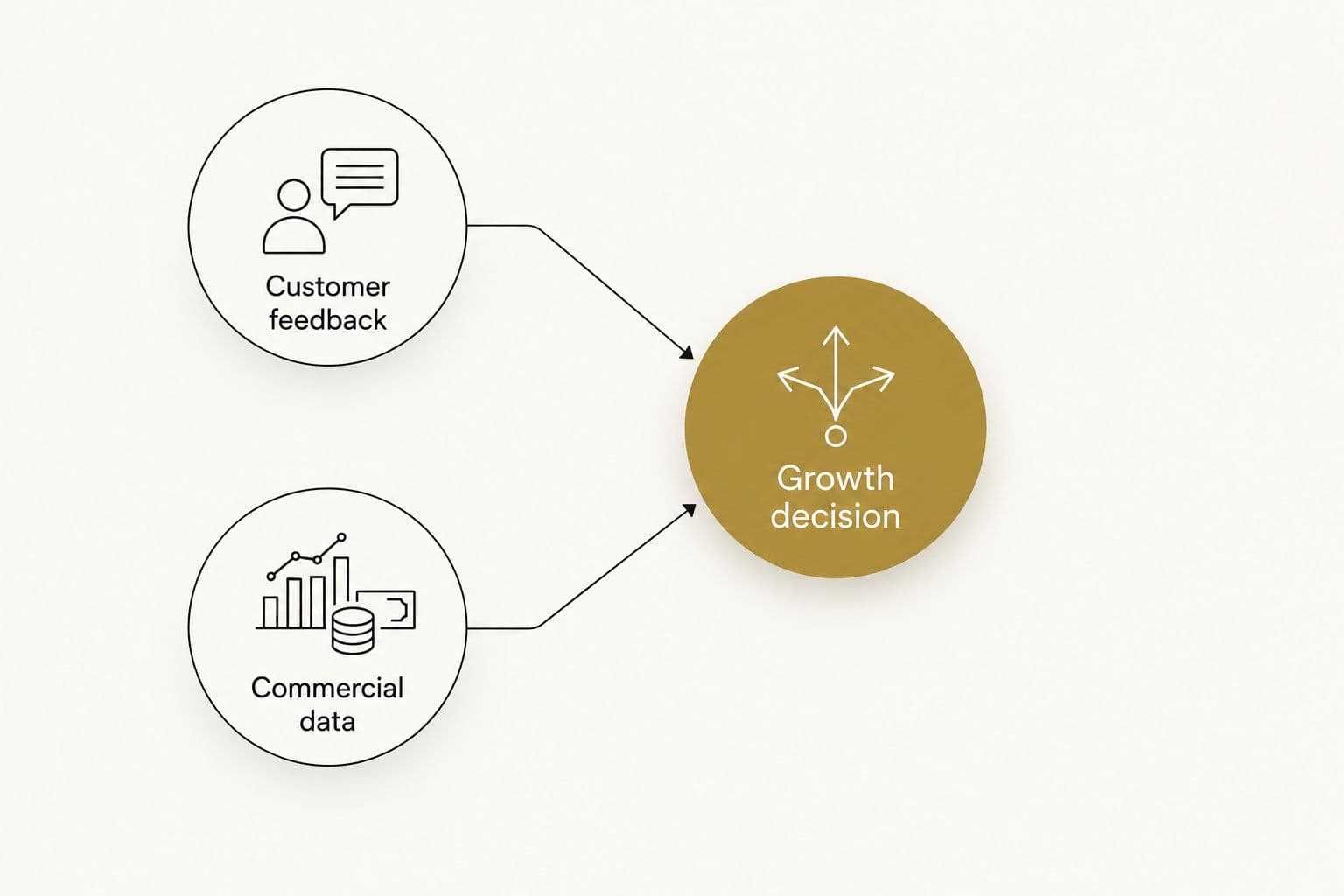
Use reported customer experiences alongside business results when deciding what to change.
Pricing: compare the responsibility you are buying
The pricing comparison is professional services versus software access. A growth engagement buys agreed work and responsibility. A survey subscription buys access to software under its current plan terms.
For the service engagement, confirm deliverables, responsibilities, exclusions and how changes to scope are handled. For SurveyMonkey, confirm the current subscription terms and which capabilities your chosen plan includes.
Do not compare the software bill with a service proposal as if they cover the same work. Add the internal effort required to design the research, interpret responses and implement changes. Equally, do not buy a broad service engagement for a task your team can complete with a survey platform.
The useful 2026 comparison is total responsibility, not the apparent size of either invoice. Ask each provider what remains your team’s job after the purchase. That answer exposes a mismatch faster than a long feature checklist.
Final verdict: choose for the job your team cannot complete
Choose The fVnnel if you need connected growth execution
Best for: the established-business owner with real demand and a growth constraint spanning marketing, conversion or measurement. You need a partner to connect the evidence, choose the priority and carry out work across the stated service areas.
Do not choose a growth engagement merely because you want a questionnaire. The service model fits a broader business problem, not a preference for outsourcing every small task.
Choose SurveyMonkey if your team owns research and action
Best for: the marketing or research lead with a defined survey project and people ready to implement its findings. You need survey software, not a replacement for your growth team.
Do not choose a survey platform expecting it to rewrite your positioning, run paid acquisition or repair your website. Those responsibilities remain outside the survey project.
| Dimension | Winner |
|---|---|
| Connected growth strategy | Growth partner |
| Dedicated survey workflow | SurveyMonkey |
| Marketing implementation | Growth partner |
| Self-managed research | SurveyMonkey |
| Clear questions and useful interpretation | Tie: both require a sound brief |
| Combining feedback with business evidence | Tie: your decision process matters |
| Buying model | Match services to execution needs and software to research needs |
FAQ
Is The fVnnel better than SurveyMonkey?
The fVnnel is the better fit for connected growth strategy and execution; SurveyMonkey is the better fit for a defined survey project. They serve different jobs rather than competing as interchangeable survey platforms.
Can SurveyMonkey replace a growth agency?
SurveyMonkey does not replace a growth agency’s strategy and implementation work. It supports survey research, while your team or service partners remain responsible for changes to advertising, positioning, websites and measurement.
Which option is best for customer feedback?
SurveyMonkey is the more direct fit when you need software to create surveys and analyze responses. A growth engagement fits when the larger need is deciding how feedback should change marketing and then implementing those changes.
How should I compare the costs?
Compare software access with the full scope of service work, not just the invoices. Include the internal effort needed to design research, interpret findings and implement changes, and confirm each provider’s current terms.
Do I need a survey before changing my marketing?
You do not automatically need a survey before changing your marketing. Start with the decision and review the evidence you already have; commission research when it answers a question that affects your next action.
Can a business use a survey platform and a growth partner together?
Yes, a business can use survey software alongside a growth partner. Define who owns the questionnaire, interpretation, implementation and measurement so the research has a clear route to action.
What should I check before choosing in 2026?
Identify whether your missing capability is research software or growth execution. Then confirm current platform capabilities or service scope, assign internal responsibilities and define the decision or business outcome you expect the purchase to support.
One last thing
Before your next survey, write down the action each plausible answer would trigger. If you cannot name a different action, the immediate problem is your decision process, not your survey software.
Apply the same test to a service proposal. Name the business constraint, the work required and who will judge the result. Buy the missing responsibility, not another tool or another meeting.