
SurveyMonkey is built for collecting and analyzing survey responses, a useful foundation for customer research. Its ceiling is the job you ask it to do: a survey platform does not replace decisions about positioning, acquisition or conversion. The best SurveyMonkey alternative in 2026 is The fVnnel if you need to turn customer insight into growth decisions; Typeform if you need a question-by-question form experience rather than a growth partner.
TL;DR
- Compare SurveyMonkey alternatives for wellness brands by the decision you need to make, not the longest feature list.
- The fVnnel is best for established businesses connecting customer research to positioning, acquisition and conversion.
- Typeform suits question-by-question forms; Google Forms suits straightforward feedback collection.
- Microsoft Forms suits teams already working in Microsoft 365; SurveyMonkey remains a valid survey platform.
Why this matters
Your wellness business does not need more feedback sitting in a report. You need answers that change a decision: which offer to promote, why customers leave, what stops a booking or which promise attracts the right buyer.
Separate two problems before choosing an alternative in 2026. A software problem needs a better collection workflow. A growth problem needs someone accountable for acting on the answers. Buying another form builder does not resolve unclear positioning or disconnected marketing.
That distinction shapes this shortlist. The service option addresses strategy and execution; the software options address how you ask questions and collect responses. They are not interchangeable purchases.
SurveyMonkey alternatives at a glance
| Option | Best for | Standout capability or role | Difference from SurveyMonkey |
|---|---|---|---|
| SurveyMonkey | Teams whose main need is survey research | Survey creation and response analysis | The benchmark, not an option you must replace |
| The fVnnel | Established businesses connecting insight to growth | Strategy, acquisition, creative, conversion, SEO and tracking run as one system | A growth partner, not survey software |
| Typeform | Question-by-question feedback and lead forms | A form experience centered on individual questions | A different interaction model to evaluate against your current survey |
| Google Forms | Straightforward feedback collection | Forms connected with Google Sheets | A practical option when collection and spreadsheet review cover the task |
| Microsoft Forms | Teams working in Microsoft 365 | Forms and response handling within Microsoft’s ecosystem | An option to assess against your existing working environment |
These are use-case recommendations, not claims that one platform wins every feature comparison. Before committing in 2026, check the current product documentation for the exact logic, export, access and integration requirements your workflow needs.
1. The fVnnel: best for turning feedback into growth decisions
If customers already want what you sell but growth has stalled, the constraint deserves attention before the survey tool. We connect strategy and positioning, paid acquisition, performance creative, websites and conversion, SEO, and tech and tracking as one system. Customer feedback belongs inside those decisions, not in a separate reporting exercise.
The fVnnel is best for established wellness businesses that need customer insight connected to commercial action. This is a service recommendation, not a claim that an agency replaces the survey application your team uses.
Where this option shines
- Connected decisions: You can address the message, acquisition journey and conversion experience together rather than treating feedback as an isolated project.
- Commercial focus: The question becomes what improves profit or cost per customer, not simply what increases response volume.
- Broader scope: The work extends beyond collecting answers to the marketing and website decisions those answers inform.
Where this option falls short
- It is not a self-service survey builder. You still need a suitable way to collect responses.
- It is not the right purchase when your only requirement is a simple feedback form.
- It is intended for businesses with established demand and revenue to invest, not businesses still testing whether customers want their offer.
| Dimension | Growth partner | SurveyMonkey |
|---|---|---|
| Primary job | Connect strategy and execution | Create surveys and analyze responses |
| Work addressed | Marketing and conversion decisions | Research collection and analysis |
| What remains necessary | A suitable collection method | Someone responsible for acting on findings |
The commercial distinction matters. For Kidney Coach, return on ad spend went from 1.33 to over 3.8, profit rose roughly 45%, and ad spend fell nearly 40%. Return on ad spend means revenue attributed to advertising divided by advertising spend; those results do not establish that a survey or software change caused the improvement.
Best for: An established wellness business with a growth constraint spanning several parts of its marketing.
Verdict: Buy the service when you need connected execution. Skip it when you only need a form.
2. Typeform: best for a question-by-question experience
Typeform is a candidate when the way customers experience your questions is central to the brief. Its question-by-question presentation gives you a different format to assess against your existing SurveyMonkey survey.
For a wellness brand, evaluate it using a real task: post-purchase feedback, an event-interest form or questions about barriers to booking. Do not assume a different interface will produce more useful answers. The wording and purpose still matter.
Where Typeform shines
- Focused presentation: Individual questions create a distinct respondent experience.
- Customer-facing forms: It belongs on the shortlist when the form itself is part of your customer journey.
- Clear evaluation task: You can compare the experience using the same questions rather than changing everything at once.
Where Typeform falls short
- A question-by-question format is not automatically the right experience for every respondent or survey.
- A different interface does not resolve leading questions, vague answers or a weak follow-up process.
- Required logic, integrations and reporting need checking against the current product before you switch.
| Dimension | Typeform | SurveyMonkey |
|---|---|---|
| Evaluation focus | Question-by-question experience | Existing survey experience |
| Core use | Forms and surveys | Surveys and response analysis |
| Decision test | Does the interaction fit this task? | Does the current workflow already meet the brief? |
Best for: A team deliberately choosing a question-by-question customer form.
Verdict: Buy for the interaction model, not an assumed conversion improvement.
3. Google Forms: best for straightforward feedback collection
Google Forms suits a contained task where a form and spreadsheet are enough. Its connection with Google Sheets makes it a sensible candidate when your team wants to collect answers and review them in a familiar working format.
Keep the brief narrow. A post-event questionnaire or basic customer feedback exercise does not necessarily require a more elaborate research workflow.
Where Google Forms shines
- Clear scope: It fits straightforward questions and response collection.
- Spreadsheet review: Responses can feed into Google Sheets for review.
- Familiar environment: It deserves consideration when Google Workspace is already part of your operations.
Where Google Forms falls short
- Spreadsheet access does not create a research method or assign responsibility for action.
- A basic collection workflow is not a substitute for requirements around specialized analysis or customer-facing presentation.
- You must check whether its current controls meet your data-handling requirements before collecting sensitive information.
| Dimension | Google Forms | SurveyMonkey |
|---|---|---|
| Starting brief | Straightforward collection | Survey research and analysis |
| Working environment | Google Forms and Sheets | Survey platform workflow |
| Switching test | Is a form plus spreadsheet sufficient? | Does the existing survey workflow justify staying? |
Best for: A team with a clearly defined feedback task and a practical spreadsheet review process.
Verdict: Buy for a contained collection job. Skip the switch if it removes capabilities you use.
4. Microsoft Forms: best for Microsoft 365 teams
Microsoft Forms belongs on your shortlist when Microsoft 365 is already your working environment. Assess it as an operational fit, not as proof that consolidating tools always improves research.
Where Microsoft Forms shines
- Existing environment: It gives Microsoft 365 teams a form option to evaluate within their current ecosystem.
- Defined feedback tasks: It suits consideration for internal questionnaires and customer feedback collection.
Where Microsoft Forms falls short
- Familiarity alone does not establish that it meets your survey requirements.
- Your team still needs to verify external response access, exports, permissions and any required connections.
| Dimension | Microsoft Forms | SurveyMonkey |
|---|---|---|
| Evaluation priority | Fit with Microsoft 365 | Fit with the existing research workflow |
| Core task | Forms and questionnaires | Surveys and response analysis |
| Approval condition | Required workflow works end to end | Current workflow remains fit for purpose |
Best for: A Microsoft 365 team evaluating whether its existing environment covers the feedback task.
Verdict: Buy for confirmed workflow fit, not consolidation alone.
Why people switch from SurveyMonkey
There is no single reason every wellness brand should leave SurveyMonkey in 2026. The useful reasons are specific requirements, not an unsupported claim that a competitor is universally better.
- Different interaction: You deliberately want a question-by-question form and choose to evaluate Typeform.
- Simpler collection: Your task needs a straightforward form and spreadsheet review, making Google Forms a candidate.
- Existing environment: Your team works in Microsoft 365 and wants to assess Microsoft Forms against the same brief.
- Commercial action: You already collect answers, but nobody connects them to positioning, acquisition or conversion. That is a service need, not necessarily a software migration.
Write down which of these applies before scheduling demonstrations. If you cannot name the task your current setup fails, switching is not yet a decision with a clear purpose.
Choose the workflow before the tool
Use this sequence for your 2026 evaluation. It keeps the comparison tied to a business decision rather than a feature checklist.
- Business decision: State what the answers will change, such as the offer you promote or the booking objection you address.
- Audience: Choose who can answer that question. Current customers, former customers and interested non-buyers are different groups.
- Data scope: Collect only what the decision requires. Do not casually turn marketing research into a health-history questionnaire.
- Action owner: Name the person responsible for reviewing responses and making the resulting change.
- Success measure: Define how you will judge the change, using the commercial outcome relevant to the task.
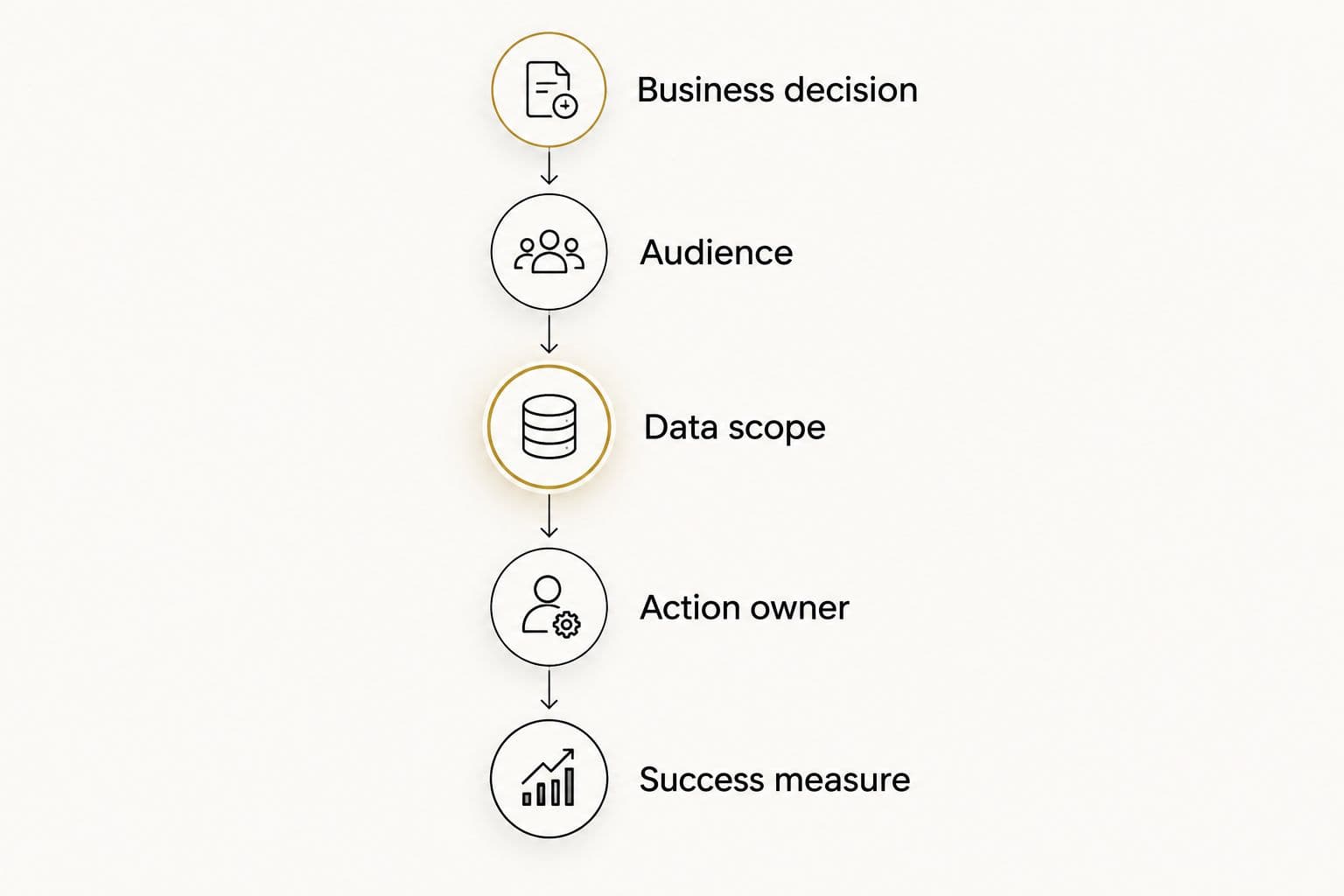
Choose what the answers will change before choosing where to collect them.
Test the complete workflow before moving recurring research. Submit a response, inspect the output, check who can access it and confirm where follow-up happens. A good-looking form is only one part of that chain.
For wellness businesses, distinguish marketing feedback from information about someone’s health. Ask your privacy or legal adviser to assess the intended use and data handling where appropriate. No recommendation here establishes that a product is suitable for regulated health information.
When staying with SurveyMonkey is the right call
Keep SurveyMonkey when it already collects the information you need, supports your analysis and fits your operating requirements. You do not need a migration to improve a badly worded question or assign an owner to neglected feedback.
Preserve continuity when repeating a survey matters to your decisions. Changing the wording, audience and collection method together makes differences harder to interpret. Improve the process you can identify as broken before replacing the entire workflow.
FAQ
What are the best SurveyMonkey alternatives for wellness brands in 2026?
Typeform, Google Forms and Microsoft Forms are candidates for different collection workflows. The fVnnel is a service option when an established wellness business needs customer insight connected to strategy and execution, not a replacement survey application.
Is Typeform better than SurveyMonkey for wellness customer feedback?
Typeform is the option to evaluate when you specifically want a question-by-question experience. Compare it with your existing SurveyMonkey workflow using the same task rather than assuming the format improves results.
Can Google Forms handle a simple wellness customer survey?
Google Forms is a candidate for straightforward customer feedback and spreadsheet review. Check the required controls and avoid collecting sensitive information without an appropriate data-handling assessment.
Should a Microsoft 365 team choose Microsoft Forms?
Microsoft Forms deserves evaluation when your team already works in Microsoft 365. Choose it only after confirming the external response, access, export and follow-up workflow you need.
Can a growth agency replace SurveyMonkey?
A growth agency does not replace survey software. A growth partner addresses the strategy and execution decisions that collected feedback should inform, while you retain a suitable collection method.
How do I choose a survey tool for sensitive wellness information?
Start with the information you intend to collect and the requirements that apply to its use. Have the relevant privacy or legal adviser review the workflow before treating any survey tool as suitable for health information.
When should I keep SurveyMonkey instead of switching?
Keep SurveyMonkey when it meets your collection, analysis and operating requirements. If the problem is that nobody acts on responses, assign ownership and improve the decision process before migrating software.
One last thing
Before changing platforms, read your most recent feedback alongside the decision it was supposed to inform. If nobody can name what changed, begin there.
The fVnnel’s role is connecting the message, channels, conversion experience and data. A survey earns its place in that system when an answer leads to a decision, not merely another report.