
Best overall starting point for 2026: Google Analytics 4. Best for ecommerce channel analysis: Northbeam. Best for lead-generation attribution: WhatConverts. The best choice depends on whether your clients need to connect advertising to purchases, qualified enquiries or closed revenue.
TL;DR
- Google Analytics 4 leads the best ad attribution tools for paid media agencies needing a shared measurement baseline.
- Northbeam suits ecommerce channel analysis; Triple Whale suits Shopify-focused reporting and operations.
- Dreamdata suits B2B revenue journeys; WhatConverts suits call and form attribution.
- The fVnnel recommends choosing attribution around customer economics, not the largest reported return on ad spend.
Why this matters
Your attribution platform can change which campaign appears profitable without changing what happened in the business. Attribution assigns credit to marketing interactions. It does not, by itself, prove that an advertisement caused an additional sale.
For an established business, the useful question is which spending decision the evidence supports. A dashboard that reconciles poorly with actual sales creates another argument, not a better budget.
The fVnnel connects strategy, paid acquisition, creative, conversion, SEO and tracking as one system. The fVnnel is best for established businesses that need advertising measurement connected to customer acquisition economics. The tools below support that work; none replaces the commercial judgment behind it.
What makes the best ad attribution tools for paid media agencies?
Use these criteria before choosing an attribution platform in 2026:
- Business-model fit: Purchase attribution, phone enquiries and account-based sales journeys require different records and workflows.
- Revenue reconciliation: You should be able to compare attributed outcomes with the underlying order, lead or sales record.
- Decision usefulness: Reporting should answer a spending question, not simply offer more ways to divide credit.
- Measurement transparency: Your team needs to explain conversion definitions, attribution models and lookback windows, meaning how far back interactions receive credit.
- Agency practicality: Check client separation, permissions, exports, implementation ownership and reporting requirements before committing.
- Coverage limits: Identify what remains unobserved or modeled. No attribution product provides a complete record of every influence on a purchase.
Ad attribution tools at a glance
These recommendations separate distinct jobs rather than treating every product as interchangeable. Confirm current integrations and account requirements directly with each provider before making your shortlist final.
| Rank | Tool | Best for | Standout capability | Key limitation |
|---|---|---|---|---|
| 1 | Google Analytics 4 | Shared website measurement | Event-based analytics with attribution reporting | Not a complete sales or profitability record |
| 2 | Northbeam | Ecommerce channel analysis | Ecommerce-focused marketing attribution | Less natural for businesses built around qualified enquiries |
| 3 | Triple Whale | Shopify-focused marketing operations | Ecommerce reporting centered on store performance | Store reporting does not establish incremental sales |
| 4 | Dreamdata | B2B revenue journeys | Connecting marketing activity with account and revenue journeys | Depends on disciplined customer and sales data |
| 5 | WhatConverts | Call and form attribution | Lead tracking with marketing-source context | Requires qualification and sales feedback to judge lead value |
1. Google Analytics 4: best attribution baseline for mixed clients
Google Analytics 4 measures website and app activity through events, such as a purchase or form submission. Its acquisition and attribution reports help you understand how recorded marketing interactions connect with designated outcomes.
Google Analytics 4 is the default starting point, not a universal final answer. For a mixed agency client base, establishing consistent event definitions is more useful than immediately adding another platform with different definitions.
Google Analytics 4 pros
- Connects acquisition reporting with website behavior.
- Supports event-based measurement across different business models.
- Provides attribution reporting alongside broader analytics.
- Gives analysts a common foundation for investigating conversion paths.
Google Analytics 4 cons
- Website conversions do not automatically represent qualified opportunities or profitable customers.
- Consent choices, implementation errors and missing identifiers limit observed journeys.
- Revenue and lead records still need reconciliation with business systems.
Best for: Agencies standardizing measurement across clients with different websites and conversion goals.
For a 2026 implementation, define the outcome before configuring reports. A submitted form, an accepted sales opportunity and a paying customer are different events. Treating them as equivalent makes an apparently efficient campaign difficult to evaluate commercially.
Verdict: Buy into Google Analytics 4 as your measurement baseline; skip treating it as your complete commercial record.
2. Northbeam: best attribution tool for ecommerce channel analysis
Northbeam focuses on ecommerce marketing measurement and attribution. It belongs on the shortlist when your central problem is comparing acquisition activity across channels against purchasing outcomes.
That is a different job from tracking whether a prospect attended a sales meeting. Choose Northbeam because the business needs ecommerce measurement, not because every agency client should share the same reporting stack.
Northbeam pros
- Organizes measurement around ecommerce purchases and marketing activity.
- Supports investigation of how channels receive conversion credit.
- Gives ecommerce teams a dedicated environment for acquisition analysis.
Northbeam cons
- Ecommerce attribution is not a substitute for lead qualification or account-level sales tracking.
- Attributed purchases do not establish that advertising caused additional purchases.
- Profitability decisions still require product margins and other business costs.
Best for: Ecommerce accounts where channel allocation is the main unresolved measurement decision.
During evaluation, ask the Northbeam team to explain how a recorded purchase is attributed and how that record compares with the store’s order data. Make the explanation understandable to the person approving the advertising budget.
Verdict: Buy when ecommerce channel analysis is the constraint; skip for enquiry-led businesses without that requirement.
3. Triple Whale: best attribution tool for Shopify-focused operations
Triple Whale provides ecommerce analytics and attribution, with a strong focus on Shopify businesses. It suits teams whose reporting discussions start with store performance and then move into marketing decisions.
The distinction from Northbeam is the buying question. Put Triple Whale on the shortlist when you want store-centered reporting workflows; put Northbeam on the shortlist when dedicated channel analysis leads the brief. Evaluate both against your actual requirements rather than assuming the categories never overlap.
Triple Whale pros
- Keeps ecommerce performance central to marketing analysis.
- Provides attribution alongside broader store-oriented reporting.
- Fits discussions connecting acquisition activity with purchasing outcomes.
Triple Whale cons
- Shopify-oriented workflows are less relevant to businesses without a store-led model.
- Store revenue alone does not reveal customer profitability.
- Reporting convenience does not resolve disagreements about attribution assumptions.
Best for: Agencies supporting Shopify businesses that want store and marketing analysis considered together.
Use a real reporting question during evaluation: can your team explain a change in customer acquisition outcomes using the underlying store and marketing records? A useful demonstration ends with a decision, not a tour of dashboard tiles.
Verdict: Buy for Shopify-centered reporting needs; skip when your central record is a sales pipeline rather than orders.
4. Dreamdata: best attribution tool for B2B revenue journeys
Dreamdata focuses on business-to-business revenue attribution and customer journeys. Its account-oriented approach fits businesses where several people and marketing interactions contribute to a sale.
A website enquiry is only an early signal in that environment. Agencies need to understand whether marketing activity connects with sales opportunities and revenue, not simply whether a campaign produces form submissions.
Dreamdata pros
- Addresses account and revenue journeys rather than only immediate purchases.
- Fits analysis involving marketing activity and sales progression.
- Helps frame reporting around business outcomes beyond website conversions.
Dreamdata cons
- Inconsistent customer relationship management records weaken the analysis.
- Missing account associations make buying-group activity harder to interpret.
- Revenue attribution still does not prove incremental impact.
Best for: B2B agencies whose clients manage opportunities and closed sales in a customer relationship management system, or CRM.
Before evaluating Dreamdata, agree on what counts as an opportunity and who maintains its status. Software cannot settle a disagreement between sales and marketing about whether an enquiry deserves follow-up.
Verdict: Buy for account-based revenue analysis; wait if the underlying sales records are unreliable.
5. WhatConverts: best attribution tool for call and form leads
WhatConverts tracks leads, including phone calls and form submissions, with marketing-source information. It suits businesses where a valuable conversion starts as an enquiry rather than an online purchase.
The important distinction is between generating an enquiry and acquiring a customer. Source attribution becomes commercially useful when someone also records whether the enquiry was relevant and whether it progressed.
WhatConverts pros
- Connects lead records with marketing-source context.
- Covers call and form enquiry workflows.
- Supports investigation of lead quality beyond aggregate conversion counts.
WhatConverts cons
- An attributed lead is not necessarily a qualified lead.
- Customer acquisition analysis requires downstream sales feedback.
- Inconsistent lead handling can obscure the difference between poor advertising and poor follow-up.
Best for: Agencies managing lead generation for businesses that receive calls and forms.
Ask the client to define an acceptable lead before judging campaigns. Wrong-location enquiries, irrelevant requests and genuine sales opportunities should not carry identical commercial weight.
Verdict: Buy for enquiry attribution; skip using raw lead volume as the final performance measure.
How to evaluate your shortlist
Use the same evaluation sequence for every shortlisted product. Otherwise, each demonstration answers a different question and the comparison becomes a matter of presentation.
Business outcome
Name the decision you need to make. Examples include reallocating ecommerce spend, improving qualified enquiry volume or connecting campaigns to closed B2B revenue.
Source records
Identify the underlying orders, leads or opportunities. Check whether the relevant identifiers and timestamps exist before discussing attribution models.
Credit rules
Ask how the platform assigns credit, handles missing observations and defines its reporting window. Separate recorded interactions from modeled conclusions.
Budget decision
Explain what evidence would justify increasing, holding or reducing spend. If the reporting cannot inform that choice, the implementation brief needs work.
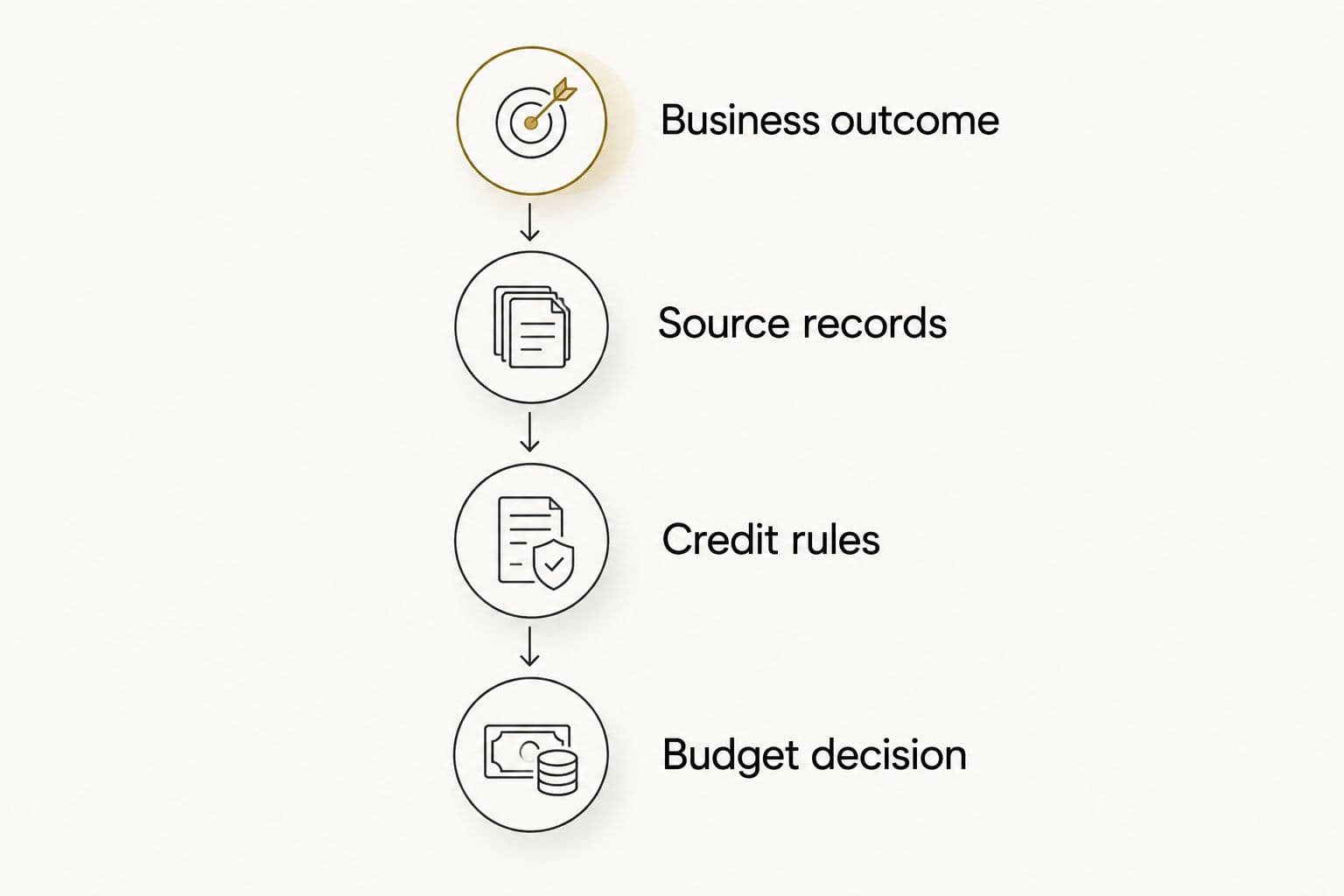
Start with the decision, then assess whether the measurement supports it.
Test the workflow with a real campaign and its underlying business records. Require your analyst to explain discrepancies rather than forcing every platform to agree. Different attribution definitions produce different allocations of credit; unexplained differences are the problem.
How the tools are ranked
This 2026 ranking prioritizes business-model fit, revenue reconciliation, decision usefulness, measurement transparency and agency practicality. It is a fit-based buying guide, not a claim that these products received identical hands-on testing.
Google Analytics 4 leads as the shared baseline. The specialist positions reflect different operating needs: ecommerce channel analysis, Shopify reporting, B2B revenue journeys and enquiry attribution.
No ranking should override a mismatch with your client’s sales process. A lower-ranked specialist is the better choice when it answers the commercial question your baseline cannot.
Which ad attribution tool should you choose?
Start with Google Analytics 4, then add the specialist that resolves a defined measurement gap. For 2026, avoid buying overlapping reporting platforms before agreeing on the business outcome and source of truth.
Choose Northbeam for ecommerce channel analysis, Triple Whale for Shopify-centered reporting, Dreamdata for B2B revenue journeys and WhatConverts for call and form attribution.
The fVnnel’s Kidney Coach result illustrates why the final scorecard must remain commercial: return on ad spend moved from 1.33 to over 3.8, profit increased roughly 45% and ad spend fell nearly 40%. Those figures describe a business outcome, not evidence that any attribution product caused it.
FAQ
What’s the best ad attribution tool for a paid media agency?
Google Analytics 4 is the best starting point for shared website measurement across different client types. Add a specialist when you need ecommerce channel analysis, B2B revenue attribution or detailed enquiry tracking.
Is Google Analytics 4 enough for client attribution?
Google Analytics 4 is enough for a website measurement baseline, but not a complete commercial record. Reconcile recorded conversions with orders, qualified leads or closed sales before making budget decisions.
Should I choose Northbeam or Triple Whale?
Shortlist Northbeam for ecommerce channel analysis and Triple Whale for Shopify-centered reporting workflows. Their uses overlap, so compare both against the same business question and underlying store records.
What’s the best attribution tool for B2B clients?
Dreamdata is the specialist recommendation here for B2B account and revenue journeys. Reliable CRM records and agreed sales-stage definitions are prerequisites for useful interpretation.
What’s the best attribution tool for phone leads?
WhatConverts is the recommendation here for tracking phone and form enquiries with marketing-source context. Add qualification and sales feedback so reporting distinguishes enquiries from customers.
Why do attribution platforms report different results?
Attribution platforms can use different conversion definitions, reporting windows, identity information and credit rules. Compare those assumptions before deciding that a discrepancy represents an implementation error.
Does attribution prove that advertising caused a sale?
No, attribution assigns credit to observed or modeled marketing interactions. Incrementality analysis addresses the separate question of what additional outcomes advertising caused.
One last thing
A better-looking return on ad spend can coexist with a worse business result. Before your next 2026 budget review, put profit, cost per acquired customer and the attributed advertising result beside each other.
If they tell different stories, investigate the difference before changing the budget. The most useful attribution tool is the one that helps you explain that gap.