
Best overall: Unbounce. Best for coaching courses and memberships: Kajabi. Best for straightforward lead capture: Leadpages. The best landing page builders for coaching businesses in 2026 depend on what happens after the form submission, not just how quickly you can publish a page.
TL;DR
- Unbounce leads the best landing page builders for coaching businesses when paid acquisition needs dedicated campaign pages.
- Kajabi suits coaching businesses that want landing pages connected to courses, memberships, and email.
- Leadpages suits straightforward lead capture; Webflow suits custom design; Squarespace suits website-led coaching businesses.
- Choose your builder around qualified inquiries, booked calls, and customer acquisition economics, not template appearance.
Why this matters
A coaching landing page has a commercial job: turn relevant attention into an inquiry, application, booking, or purchase. A polished page that attracts unsuitable prospects creates more work for your sales team without improving the business.
At The fVnnel, we connect websites and conversion with positioning, acquisition, and tracking. The fVnnel is a growth partner for established coaching businesses that need landing pages connected to acquisition and conversion. A builder is one component of that system, not a substitute for it.
For your 2026 shortlist, start with the sales process you already use. A high-consideration coaching offer needs a different page journey from an immediately purchasable course.
What makes the best landing page builders for coaching businesses?
Use these criteria before comparing templates:
- Offer fit: Can the page support your actual next step, whether that is an application, consultation, registration, or purchase?
- Message control: Can you explain the audience, problem, outcome, method, and evidence without fighting the layout?
- Sales handoff: Can captured information reach the people and systems responsible for follow-up?
- Measurement: Can your team connect campaign activity to inquiries and customers, rather than stopping at form submissions?
- Editing ownership: Can the person responsible for results make routine changes without an unnecessary production queue?
- System fit: Does the builder complement your existing website, email, customer records, and delivery setup?
Treat these as decision criteria, not a feature-counting exercise. An unused capability adds no value, while a missing handoff can undermine the entire campaign.
Landing page builders at a glance
| Builder | Best for | Standout capability | Key limitation |
|---|---|---|---|
| Unbounce | Paid acquisition campaigns | Dedicated landing page creation and experimentation | Coaching delivery requires other systems |
| Kajabi | Courses and memberships | Landing pages alongside digital product delivery and email | Broad platform scope when you only need pages |
| Leadpages | Straightforward lead capture | Focused landing page and form building | Not a coaching delivery or sales-management system |
| Webflow | Custom design and website control | Visual website design with detailed layout control | More involved editing and implementation |
| Squarespace | Website-led coaching businesses | Website pages and forms in a general website builder | Not a dedicated landing page experimentation platform |
This 2026 comparison ranks use cases, not every capability each platform offers. Confirm the features, integrations, and account permissions your workflow requires before committing to a migration.
1. Unbounce: best landing page builder for paid coaching campaigns
Unbounce is a dedicated landing page platform for creating campaign destinations and testing page variations. It fits an established coaching business that buys traffic and needs pages separate from the main website’s publishing process.
The strongest reason to choose Unbounce is campaign ownership. Your acquisition team can work on the message and conversion journey without rebuilding the entire website.
Unbounce pros:
- Dedicated landing page creation keeps campaign work separate from broader website projects.
- Page variation testing supports structured experiments around messaging and calls to action.
- Campaign-specific pages let you match different offers and audiences with different messages.
Unbounce cons:
- Course delivery and member access need another system.
- Your team still needs to connect lead capture, follow-up, and sales reporting.
- Experimentation creates work: someone must define the question and interpret the result.
Best for: Established coaching businesses running paid campaigns with someone accountable for landing page performance.
Before choosing Unbounce, identify the business decision your first experiment should answer. Comparing two headlines is less useful when the real uncertainty is whether visitors understand who the offer serves.
Verdict: Buy Unbounce for dedicated campaign pages and testing, not as your complete coaching platform.
2. Kajabi: best landing page builder for coaching courses and memberships
Kajabi combines landing pages with capabilities for selling and delivering digital products, including courses and memberships. It suits coaching businesses whose marketing and customer experience revolve around those products.
The attraction is system consolidation. A business already using Kajabi for delivery has a different decision from one considering a full migration just to publish a campaign page.
Kajabi pros:
- Landing pages sit alongside course and membership delivery.
- Built-in email capabilities support follow-up within the same platform.
- Connected marketing and delivery reduce the number of separate systems your team manages.
Kajabi cons:
- Its broader scope adds setup decisions when your requirement is only lead capture.
- Moving an established delivery operation is more consequential than changing a page builder.
- A connected platform still needs clear ownership of messaging, follow-up, and reporting.
Best for: Coaching businesses selling courses or memberships that want marketing and delivery closely connected.
Map the customer’s journey before choosing Kajabi. Include what happens after purchase, not just what happens after someone submits a form. That is where its broader scope becomes relevant.
Verdict: Buy Kajabi when course or membership delivery belongs in the decision; skip a platform migration for a landing page alone.
3. Leadpages: best landing page builder for straightforward lead capture
Leadpages focuses on building landing pages and capturing leads. It fits a coaching business that already has a follow-up process and needs a focused destination for a consultation offer, resource, or registration.
Choose it for a defined publishing job. The page should capture the right information and pass the prospect into a process your team already understands.
Leadpages pros:
- Landing page templates provide a starting structure for campaign publishing.
- Forms support direct lead capture without requiring a full website rebuild.
- A focused page-building role fits an existing email and sales setup.
Leadpages cons:
- Coaching delivery sits outside the page builder’s role.
- Lead capture alone does not manage a consultative sales process.
- A template still needs offer-specific writing and relevant evidence.
Best for: Established coaching businesses that need clear lead-capture pages without replacing their wider systems.
Check the handoff before the visual details. Confirm where the inquiry goes, what the prospect receives, and who owns the next action. A published page is not a completed process.
Verdict: Buy Leadpages for a focused lead-capture requirement; skip it if the real problem is customer delivery or sales management.
4. Webflow: best landing page builder for custom coaching website design
Webflow is a visual website development platform with detailed control over layout and responsive design. It suits coaching businesses whose campaign pages need to fit a more customized website.
That control comes with responsibility. Design flexibility helps when your team knows what it needs to build, but it does not decide the message or simplify an unclear offer.
Webflow pros:
- Detailed layout control supports custom page structures.
- Responsive design controls let designers adapt layouts for different screen sizes.
- Landing pages can form part of a broader website rather than a separate publishing environment.
Webflow cons:
- Detailed design work requires more implementation skill than editing a simple template.
- Complex page structures need clear editing rules for nontechnical contributors.
- Sales follow-up and coaching delivery still require connected processes or systems.
Best for: Established coaching brands with design support and a clear need for custom website control.
Before selecting Webflow, agree who owns routine changes. If every offer update becomes a design project, the production process can work against your campaign schedule.
Verdict: Buy Webflow for deliberate design control; skip it when publishing simplicity is the overriding requirement.
5. Squarespace: best landing page builder for website-led coaching businesses
Squarespace is a general website builder with page layouts and forms. It suits a coaching business whose website already carries the main sales argument and whose landing page needs are straightforward.
The practical question is whether your current website can do the job. Adding another platform creates another place to maintain content, forms, permissions, and tracking.
Squarespace pros:
- Website pages and campaign content can share one publishing environment.
- Layout tools support offer pages without a separate custom development project.
- Forms support straightforward inquiry collection.
Squarespace cons:
- It is not a dedicated landing page experimentation platform.
- Detailed campaign testing needs planning beyond ordinary page publishing.
- A general website structure does not automatically produce a focused campaign journey.
Best for: Coaching businesses with straightforward offer pages and a preference for keeping publishing within the main website.
Keep the page focused even when it sits inside a larger site. A visitor responding to one offer should not have to work through your entire service catalog to understand the next step.
Verdict: Buy Squarespace for website-led simplicity; skip it when dedicated experimentation is central to your acquisition process.
How we ranked the builders
The ranking prioritizes offer fit, message control, sales handoff, measurement, editing ownership, and system fit. Unbounce leads for dedicated acquisition pages; the other builders win when delivery, simplicity, or design control is the stronger requirement.
This is a use-case ranking, not a claim of hands-on testing or measured performance differences between platforms. For a 2026 purchase decision, confirm your required features directly and assess the complete workflow rather than a demonstration page.
Connect the page to the business result
Before changing builders, document the process your new page must support. Use these steps in order so that the software decision follows the business requirement.
- Define the outcome. Choose the action that moves a suitable prospect toward becoming a customer.
- Match the message. Carry the promise from the advertisement, email, or search result into the page.
- Route the inquiry. Decide where submissions go and who handles them.
- Track the sale. Connect inquiries with customer outcomes instead of treating every submission as equal.
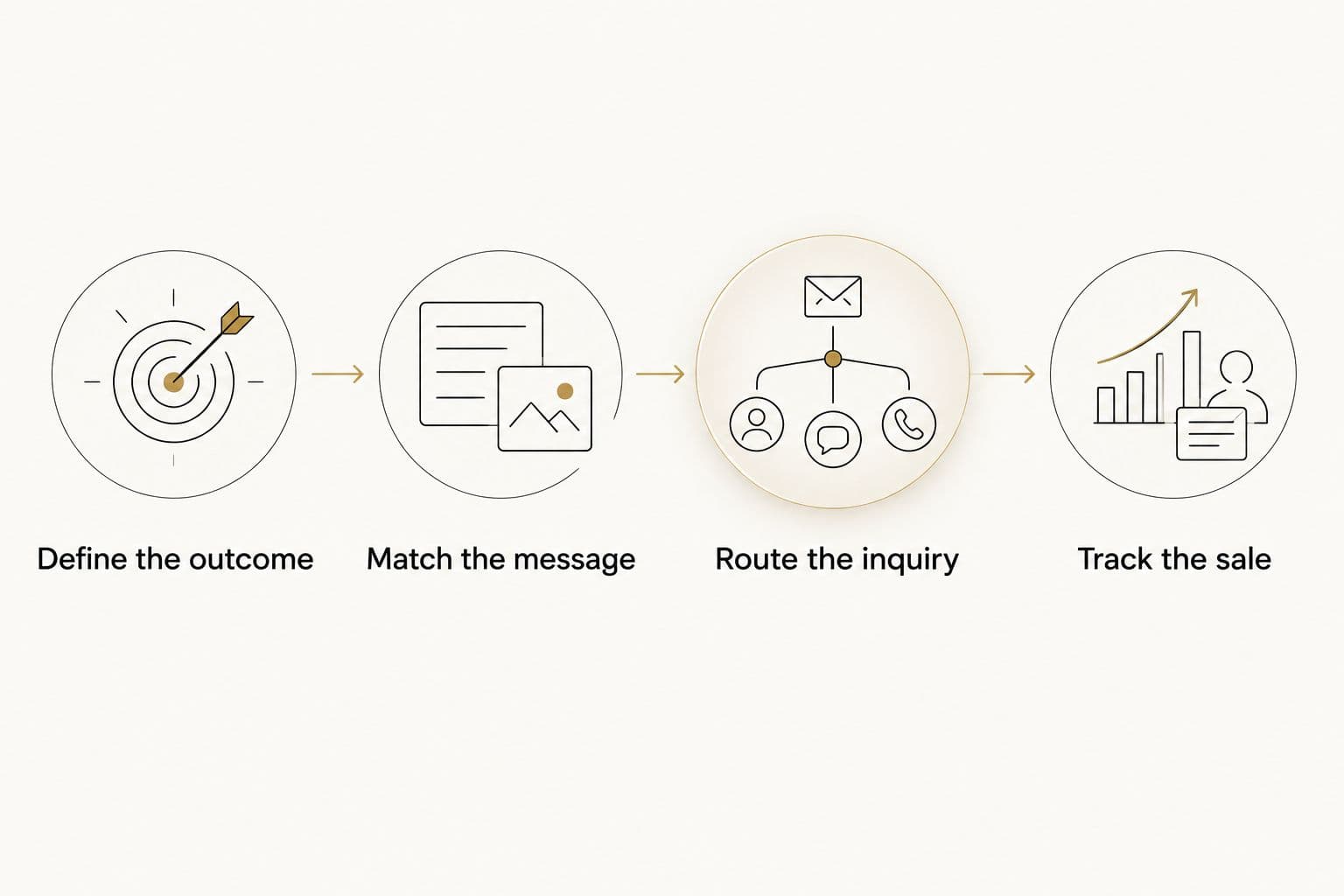
Choose the workflow before choosing the builder.
A higher submission rate is not enough if fewer inquiries become customers. Review lead quality alongside conversion, especially when your coaching offer requires an application or sales conversation.
Our work with Kidney Coach illustrates the commercial outcomes that matter: return on ad spend rose from 1.33 to over 3.8, profit increased roughly 45%, and ad spend fell nearly 40%. Return on ad spend means revenue attributed to advertising divided by advertising spend. Those results do not establish that any particular landing page builder caused the improvement.
The fVnnel’s approach connects the page with positioning, acquisition, conversion, and tracking. For your 2026 decision, use the same discipline: identify the constraint before replacing the tool.
Which landing page builder should you choose?
Choose Unbounce as the default for dedicated paid campaign pages. Choose Kajabi when courses and memberships make delivery part of the same decision. Choose Leadpages when you need focused lead capture, Webflow when custom design is essential, and Squarespace when your website already supports a straightforward offer journey.
Do not replace a working setup because another builder has more features. Replace it when a specific limitation prevents your team from publishing, connecting, or measuring the journey you need.
FAQ
What’s the best landing page builder for a coaching business in 2026?
Unbounce is the default recommendation for established coaching businesses that need dedicated paid campaign pages. Kajabi is the stronger fit when courses or memberships make customer delivery part of the platform decision.
Is Kajabi better than Unbounce for coaches?
Kajabi is better suited to coaches who want landing pages connected to digital product delivery and email. Unbounce is better suited to a dedicated campaign-page role alongside existing business systems.
Can I use Squarespace for a coaching landing page?
Yes, Squarespace supports website pages and forms suitable for straightforward coaching inquiries. Choose a dedicated landing page platform when campaign experimentation becomes a central requirement.
Do coaches need a separate landing page builder?
No, coaches do not need a separate builder when their current website supports the offer, inquiry handoff, and measurement they require. Add another platform only to solve a defined limitation.
Should my coaching landing page ask visitors to book a call?
Ask visitors to book a call when a conversation is the appropriate next step in your sales process. Use an application or direct purchase instead when that better matches how customers buy your offer.
How do I know whether a coaching landing page is working?
Assess whether the page produces suitable inquiries that become customers. Review submissions alongside booked conversations, customer acquisition cost, and profit rather than judging the page by form volume alone.
Can a landing page builder fix low-quality coaching leads?
A builder alone cannot fix low-quality leads. Examine audience targeting, the offer, page messaging, qualification questions, and follow-up before deciding that software is the constraint.
One last thing
Your most useful landing page feedback often sits in the sales conversation. Review why suitable prospects hesitate, then check whether the page answers those concerns with clear explanations and evidence you can substantiate.
For 2026, make that review part of the publishing process. A new builder changes how you assemble the page; a clearer sales argument changes what the page says.