
Choose The fVnnel if your established business needs strategy, acquisition and conversion work managed together; choose SmartSurvey if your team needs survey software to collect feedback and already owns the work that follows. This 2026 comparison separates a growth partner from a research tool so you can buy the capability your business actually needs.
TL;DR
- The fVnnel vs SmartSurvey compares growth services with survey software, not competing versions of the same product.
- Choose the growth partner when strategy, paid acquisition and conversion need coordinated execution.
- Choose SmartSurvey when collecting feedback is the job and your team can act on the findings.
- Compare total delivery effort, not just access to software or the scope of an agency engagement.
Why this matters
A marketing lead can buy the right tool for the wrong problem. If you know customers hesitate but nobody owns fixing the offer, collecting more responses leaves the underlying constraint untouched.
The reverse mistake also costs you time. If your team has a clear research question and an owner ready to act, a broader service engagement is not the direct answer to a survey requirement.
The fVnnel is a growth partner for established businesses that need coordinated marketing execution, not another survey platform. SmartSurvey belongs on your shortlist when the immediate requirement is creating surveys and collecting responses. Neither category replaces the other.
For your 2026 decision, start with the outcome you need and the work your team can already deliver. Then choose the missing capability, rather than comparing unrelated feature lists.
At a glance
| Dimension | The fVnnel | SmartSurvey |
|---|---|---|
| Best for | Established businesses needing coordinated growth work | Teams with a defined survey requirement |
| Standout capability | Strategy, acquisition, creative, conversion, SEO and tracking run as one system | Online survey creation and response collection |
| Execution scope | Growth services across connected marketing functions | Software for a defined research workflow |
| Survey workflow | Not positioned as a survey software product | The direct fit for creating and distributing surveys |
| Ownership | You still own business priorities and internal decisions | Your team owns research decisions and follow-through |
| Measurement | Commercial outcomes such as acquisition cost and return on ad spend | Survey responses that inform business decisions |
| Implementation | Requires agreement on the growth constraint and work scope | Requires a clear question, audience and response process |
| Pricing model | Compare the proposed service scope and responsibilities | Compare software access with internal delivery effort |
The table is a category comparison, not a feature-by-feature software test. A survey subscription and a growth engagement solve different jobs, so the decision should turn on responsibility and execution rather than the longest specification sheet.
The growth partner wins when connected execution is the job
The best reason to hire a growth partner is a gap between identifying a problem and fixing it across several parts of your business. You need more than a place to record customer opinions.
We connect strategy and positioning, paid acquisition, performance creative, websites and conversion, search engine optimization [SEO], and tech and tracking. The aim is to identify the constraint in the system rather than assume the advertising channel is always the problem.
Consider an established consumer brand with proven demand. Customers understand the product, but the advertisement promises something the landing page barely explains. A survey can help investigate the mismatch; it does not rewrite the positioning, produce the creative or change the page by itself.
Best for: an owner who needs connected marketing work delivered, not just another source of information.
The tradeoff is scope. If your only requirement is a customer questionnaire, buying a broader growth service does not match that narrow job. Keep the purchase proportionate to the problem.
SmartSurvey wins when survey delivery is the job
SmartSurvey is online survey software. Its direct role in this comparison is helping your team create surveys and collect responses, rather than taking responsibility for your marketing system.
That makes it the clearer fit when an education business wants feedback from learners, or an event team wants to understand the attendee experience. Your team defines the research question, reaches the audience and decides what the answers mean for the business.
Best for: a marketing or research lead who already owns the feedback process and needs survey software.
The limitation is the boundary between information and action. A completed questionnaire does not establish which message to test, which page to change or which acquisition activity to stop. Those remain decisions for whoever owns the commercial outcome.
Before selecting a survey platform in 2026, separate your essential requirements from optional features. Define who needs to answer, what decision the research will support and how you will use the responses. If the category is right but the provider is undecided, compare SmartSurvey alternatives against that brief.
Connected marketing work favors the service model
A software tool gives your team a capability. A service engagement assigns work to people. That distinction matters when the bottleneck is execution capacity rather than access to information.
Use this practical sequence to decide what you are buying:
- Research question: What do you need to learn before making a decision?
- Customer evidence: What information would change your current view?
- Business decision: Which action will the evidence inform?
- Execution owner: Who will make the approved change?
- Commercial outcome: How will you judge whether the change helped?
The sequence prevents research from becoming an isolated activity. If you cannot name the execution owner, resolve that gap before commissioning another round of feedback.
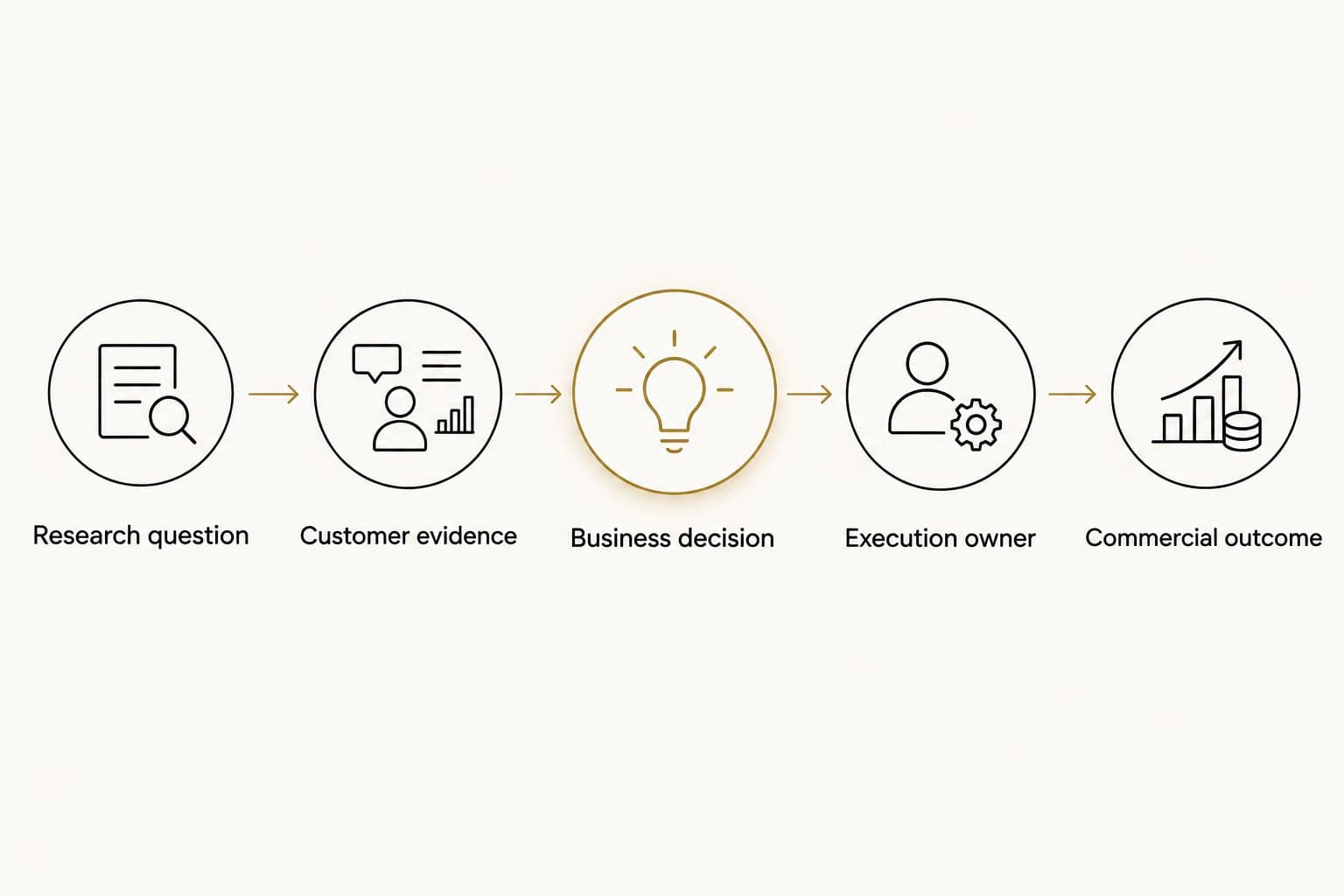
Research needs an execution owner before it can change a business outcome.
A technology company might already have a product team ready to act on research. Survey software fits that operating model. A business with disconnected campaigns, pages and tracking needs to address those responsibilities, whether through internal hires or a growth partner.
The service model wins the connected-execution dimension. It does not win simply because it involves more work; it wins when that work is the missing capability.
Both require you to own the business decision
Neither hiring a partner nor buying software removes your responsibility for business priorities. You still decide what you sell, which customers you want and what economics make growth acceptable.
For a survey project, nominate someone who can approve the research question and respond to the findings. That person needs the authority to turn evidence into a decision, not just distribute a report.
For a growth engagement, nominate someone who can resolve priorities and approve changes. A partner cannot make competing internal objectives disappear without your input.
This dimension is a tie: both routes need an accountable decision-maker inside your business. The work differs, but the need for ownership does not.
Before committing your 2026 budget, write down the decisions that stay with your team. Include access approvals, message approval and the definition of an acceptable commercial result. Clear boundaries make both software purchases and service engagements easier to manage.
Commercial accountability favors the growth partner
Survey responses help you understand what respondents report. Commercial measures tell you whether the business outcome changed. Treat those as related but distinct forms of evidence.
Return on ad spend [ROAS] is revenue attributed to advertising divided by advertising spend. Cost per customer measures acquisition spending against customers acquired. Neither should be replaced by the number of completed questionnaires.
The supplied client results illustrate the commercial outcomes associated with our work:
- Sniffspot: cost per host acquired down 78%, with host growth roughly ninefold.
- Kidney Coach: return on ad spend from 1.33 to over 3.8, with profit up roughly 45% while ad spend fell nearly 40%.
- Think and Grow Education: the Melbourne event sold out two weeks early at 104% of capacity, with 850 attendees over two days. The return on ad spend target was beaten by nearly 15%.
These are individual client results, not a forecast for your business. They also do not establish a performance comparison with SmartSurvey, which serves a different purpose.
The useful distinction is accountability. If your brief is to improve acquisition economics, assess the people and work responsible for changing those economics. If your brief is to gather customer evidence, assess the research workflow and the team responsible for interpreting it.
Choose commercial measures for a growth brief and research measures for a survey brief. Do not penalize a survey platform for failing to act as an agency, or credit an agency merely for producing more information.
SmartSurvey wins for a survey-only implementation brief
When the brief begins and ends with delivering an online survey, SmartSurvey is the direct fit. You do not need to define an entire growth engagement to establish a questionnaire workflow.
That is a scope advantage, not a promise about setup time. Implementation still requires a defined audience, clear questions, appropriate data handling and an owner for the findings.
For an event business or coaching company, the practical priority is often participation without unnecessary friction. When evaluating easy-to-implement customer feedback software, judge the workflow from invitation through response review and action ownership, not just the form-building screen. A simple launch is only useful if the resulting evidence reaches someone who can use it.
Your 2026 implementation brief should answer these questions before you choose a platform:
- What decision will the responses support?
- Which customers or prospects should receive the survey?
- What information is genuinely necessary?
- Who reviews the answers and approves the next action?
For a broader growth brief, the starting point changes. Identify where demand, message, acquisition, conversion or measurement stops connecting, then define the work needed to fix that break.
Pricing: neither model wins without a defined scope
Compare a service engagement with software access, not two interchangeable subscriptions. The useful financial question is what you must still supply after the purchase.
For the service route, request a proposal that specifies responsibilities, deliverables, exclusions and how success will be assessed. Do not assume a particular billing arrangement or that every marketing task belongs in the engagement.
For the software route, verify current commercial terms directly with the provider. Add the internal work needed to design the research, manage responses, interpret findings and implement changes.
| Cost consideration | Service route | Software route |
|---|---|---|
| What you are assessing | Defined work and assigned responsibilities | Access to the required survey capabilities |
| Internal contribution | Business direction, approvals and agreed inputs | Research ownership, administration and follow-through |
| Predictability | Depends on clear scope and change control | Depends on suitable terms and understood requirements |
| Flexibility | Requires agreement when the work changes | Still requires people to operate the workflow |
Pricing is a tie until you define the job and the remaining internal effort. A narrower purchase is not better value if it leaves the actual problem unsolved. Equally, a broader engagement is unnecessary when your team only needs a survey tool.
Final verdict: choose the missing capability
Choose The fVnnel if you need a growth execution partner
Best for: the owner or marketing lead of an established business with real demand and disconnected marketing execution. You need strategy, acquisition, creative, conversion and tracking considered together, with business economics guiding the work.
Do not choose this route simply to obtain a questionnaire. Choose it when the problem extends beyond collecting customer feedback and your business needs help making the changes.
Choose SmartSurvey if you need survey software
Best for: the marketing or research lead with a defined feedback question and an internal team ready to act. You need a platform for the survey workflow, not an external team to manage growth execution.
Do not treat the software purchase as a solution to unclear positioning or unowned marketing work. Resolve those responsibilities separately.
For 2026, the deciding question is straightforward: do you need to collect evidence, or do you need help changing the business system that evidence describes?
| Dimension | Winner |
|---|---|
| Connected growth brief | Growth partner |
| Standout capability | Match the capability to the job |
| Cross-functional execution | Growth partner |
| Survey workflow | SmartSurvey |
| Internal decision ownership | Tie |
| Commercial execution accountability | Growth partner |
| Survey-only implementation | SmartSurvey |
| Pricing and total effort | Tie until scope is defined |
FAQ
Is The fVnnel better than SmartSurvey?
The fVnnel is the better fit for connected growth services; SmartSurvey is the better fit for a survey software requirement. Choose according to whether you need execution support or a tool your team will operate.
Is this a comparison between two survey platforms?
No. This compares a growth partner with online survey software, so the central difference is the work each category is designed to support.
Which option is best for an established business with stalled growth?
A growth partner fits when the constraint spans strategy, acquisition, conversion or tracking. If the immediate gap is a defined customer research task and execution is already covered, survey software fits that narrower need.
Can customer feedback replace conversion work?
No. Customer feedback informs decisions, while conversion work changes the experience that turns interest into an action such as an inquiry or purchase. Someone must own and implement those changes.
Can a business use both options?
Yes. Survey software can support customer research while a growth partner works on strategy and execution. Define responsibility for the research and resulting changes rather than assuming either arrangement includes both.
How should I compare the cost of an agency and survey software?
Compare the full work required to reach your outcome. Assess the service scope on one side and software access plus internal research and implementation effort on the other.
What should I prepare before choosing either option?
Prepare a clear business question, an accountable decision-maker and a description of the work your team can already deliver. Those inputs reveal whether the missing capability is evidence collection or execution.
One last thing
Write this sentence before you approve either purchase: “When the evidence is available, this person will make this decision and own the change.” If you cannot complete it, your immediate constraint is ownership, not software selection.
Get in Touch to discuss the growth constraint your established business needs to fix.