
SmartSurvey provides online survey creation and response collection, but collecting answers is not the same as improving customer acquisition or conversion. If your constraint is acting on customer insight, The fVnnel is a growth partner rather than a replacement survey platform. The best SmartSurvey alternative in 2026 is The fVnnel if you need research connected to growth execution; Typeform if you need a conversational questionnaire.
TL;DR
- Compare SmartSurvey alternatives by the decision you need to make, not the length of the feature list.
- The fVnnel is a growth partner for established businesses, not survey software.
- Typeform suits conversational questionnaires; Google Forms suits straightforward data collection.
- Microsoft Forms fits Microsoft-based teams; SurveyMonkey belongs on a broader survey-platform shortlist.
- Keep SmartSurvey when it already supports your research and the real problem is acting on results.
Why this matters
A survey has commercial value when its answers change a decision. You need to know whether customers misunderstand your offer, hesitate before purchasing, or leave because the experience falls short. A different form editor does not resolve those problems by itself.
For your 2026 shortlist, separate two purchases: software that collects information and support that turns information into action. Compare survey platforms against survey platforms. Consider a growth partner only when the work extends into positioning, campaigns, websites, conversion, or tracking.
Before switching, finish this sentence: “We need customer answers so we can decide whether to change…” If you cannot name the decision, start there rather than migrating your questionnaire.
SmartSurvey alternatives at a glance
These options serve different jobs. The table includes SmartSurvey as the benchmark and separates a service engagement from software you operate yourself.
| Option | Best for | Standout capability | Difference from SmartSurvey |
|---|---|---|---|
| SmartSurvey | Continuing an existing survey workflow | Dedicated survey creation and response collection | The benchmark, not a switch |
| The fVnnel | Connecting customer insight to growth execution | Strategy, acquisition, creative, conversion, SEO, and tracking run as one system | A growth partner, not survey software |
| Typeform | Conversational questionnaires | A question-by-question response experience | A different respondent experience to evaluate |
| Google Forms | Straightforward questionnaires and internal collection | Forms connected with Google Sheets | A general-purpose form workflow within Google’s tools |
| Microsoft Forms | Questionnaires within Microsoft-based teams | Forms and quizzes within the Microsoft ecosystem | A workflow aligned with Microsoft tools |
| SurveyMonkey | Evaluating another dedicated survey platform | Survey design and response analysis | A direct platform comparison rather than a service alternative |
Do not treat this order as a universal software ranking. The first option addresses a business execution problem; the remaining options address questionnaire and research workflows.
1. The fVnnel: best for connecting insight to growth execution
The fVnnel is a growth partner for established businesses with demand and the resources to invest in growth. We connect strategy and positioning, paid acquisition, performance creative, websites and conversion, SEO, and tech and tracking as one system.
This is not a like-for-like SmartSurvey replacement. Choose a growth partner when you need someone to address the commercial problem behind the survey, not simply provide a place to ask questions.
Where this approach shines
- Connected execution: Customer insight can inform the message, campaign, website, and measurement plan rather than ending in a report.
- Business economics: The discussion starts with profit and cost per customer, not response volume alone.
- Cross-channel scope: You can address a constraint that sits between acquisition, conversion, and tracking.
The published client results illustrate the commercial focus, not survey-platform performance. For Sniffspot, cost per host acquired fell 78%, with host growth roughly ninefold. For Kidney Coach, return on ad spend, revenue attributed to advertising divided by advertising spend, moved from 1.33 to over 3.8; profit rose roughly 45% while ad spend fell nearly 40%.
Where this approach falls short
- It does not replace a self-service survey builder.
- It is the wrong purchase if your only requirement is collecting questionnaire responses.
- It is not positioned for businesses still validating whether customers want their offer.
| Dimension | Growth partnership | SmartSurvey |
|---|---|---|
| What you buy | Strategy and execution services | Survey software |
| Core job | Address constraints across the growth system | Create surveys and collect responses |
| Who operates the work | A service engagement with an agreed scope | Your team’s survey workflow |
| Replacement relationship | Can sit alongside a survey platform | Remains the collection platform |
Best for: Established businesses that need insight translated into changes across their growth system.
Verdict: Buy the partnership for execution; skip it as a survey-software replacement.
2. Typeform: best for conversational questionnaires
Typeform is a form and survey builder known for its question-by-question respondent experience. Put it on your shortlist when how people encounter the questions is central to your brief.
A different presentation does not prove that you will get better answers. Test your actual questionnaire on the devices your audience uses before choosing it for your 2026 workflow.
Where Typeform shines
- Its conversational presentation gives you a clear alternative to evaluate against your existing questionnaire.
- It supports forms as well as surveys, making it relevant when the task includes an inquiry or application.
- It puts the respondent’s path through the questions at the center of the comparison.
Where Typeform falls short
- A question-by-question experience is not automatically the best fit for every questionnaire.
- Presentation does not fix leading questions or an unclear research objective.
- Choosing it for appearance alone leaves analysis, exports, and operational requirements unresolved.
| Dimension | Typeform | SmartSurvey |
|---|---|---|
| Primary category | Forms and surveys | Surveys |
| Evaluation focus | Conversational respondent experience | Your existing survey workflow |
| Decision test | Does this presentation suit your questions? | Does the current setup already meet the brief? |
Best for: Teams prioritizing the respondent experience for a customer questionnaire, inquiry, or application.
Verdict: Buy for a demonstrated workflow fit, not an assumed conversion increase.
3. Google Forms: best for straightforward data collection
Google Forms creates questionnaires and can connect responses to Google Sheets. It belongs on your shortlist when you need a direct collection workflow and your team already works in Google’s tools.
Start with the job, not the interface. A short internal questionnaire and a customer research program do not necessarily need the same setup.
Where Google Forms shines
- The connection with Google Sheets gives teams a familiar place to organize responses.
- It handles general-purpose forms, surveys, and quizzes.
- It offers a clear candidate for simple collection tasks without requiring a dedicated survey workflow.
Where Google Forms falls short
- Spreadsheet access does not provide an analysis plan or a decision owner.
- Familiarity with Google’s tools is not evidence that every research requirement is covered.
- You still need to check permissions, question behavior, and exports against your brief.
| Dimension | Google Forms | SmartSurvey |
|---|---|---|
| Primary category | General-purpose forms and questionnaires | Dedicated survey platform |
| Workflow emphasis | Collection with Google Sheets | Survey creation and response collection |
| Best evaluation task | Build a representative straightforward form | Compare it with your current survey process |
Best for: Teams collecting straightforward information and organizing responses in Google Sheets.
Verdict: Buy for a simple collection job; hold if the research requirements remain undefined.
4. Microsoft Forms: best for Microsoft-based teams
Microsoft Forms supports forms, surveys, and quizzes within Microsoft’s ecosystem. Evaluate it when your team’s existing work already centers on Microsoft tools and internal questionnaire handling matters more than changing presentation.
Where Microsoft Forms shines
- It fits a shortlist built around Microsoft-based work.
- It supports both survey and quiz use cases.
- It gives internal teams another route for structured information collection.
Where Microsoft Forms falls short
- An ecosystem fit does not establish a research fit.
- Familiar software still requires clear ownership of responses and follow-up.
- Customer-facing requirements deserve their own test rather than an automatic extension of an internal workflow.
Best for: Microsoft-based teams assessing internal surveys, questionnaires, or quizzes.
Verdict: Buy when the actual questionnaire and handling process fit; skip an ecosystem-only decision.
5. SurveyMonkey: best for a dedicated survey-platform comparison
SurveyMonkey is a dedicated survey platform with survey design and response-analysis capabilities. It is a direct shortlist candidate when you want another survey platform rather than a general-purpose form tool or an execution partner.
Where SurveyMonkey shines
- It keeps the comparison focused on survey creation and analysis.
- It lets you assess another dedicated platform against a defined research brief.
- It belongs in a platform evaluation where questionnaire design and interpreting responses both matter.
Where SurveyMonkey falls short
- A platform switch still leaves research quality and business action with your team.
- A recognizable name does not establish that your required workflow is supported.
- Migration creates work without a clear payoff if you cannot identify what SmartSurvey currently prevents.
Best for: Teams with a specific unmet survey requirement and a brief for evaluating another dedicated platform.
Verdict: Buy only after demonstrating the requirement that justifies switching.
Why switch from SmartSurvey?
A useful reason to switch names a requirement, not a competitor’s reputation. For 2026, use these decision triggers without assuming that SmartSurvey fails any of them:
- Respondent experience: You want to compare a conversational questionnaire with your current presentation.
- Team workflow: You need collection to fit how your team already handles information in Google or Microsoft tools.
- Research requirements: You have a defined survey or analysis need to test against another dedicated platform.
- Execution gap: You already collect useful answers but need changes to positioning, campaigns, conversion, or tracking.
These are evaluation criteria, not claims about outages, policy changes, or missing SmartSurvey features. Switch only when the proposed alternative solves an identified problem.
Choose by the decision, then test the workflow
Use the same evaluation sequence for every candidate in your 2026 shortlist. Changing the questionnaire between demonstrations makes the comparison less useful.
- Decision: Name the business choice the answers must inform.
- Questions: Use a representative questionnaire, including any required routing between questions.
- Response handling: Check how your team receives, organizes, and accesses the answers.
- Action owner: Assign responsibility for interpreting the findings and making the change.
- Success measure: Define how you will judge the resulting business decision.
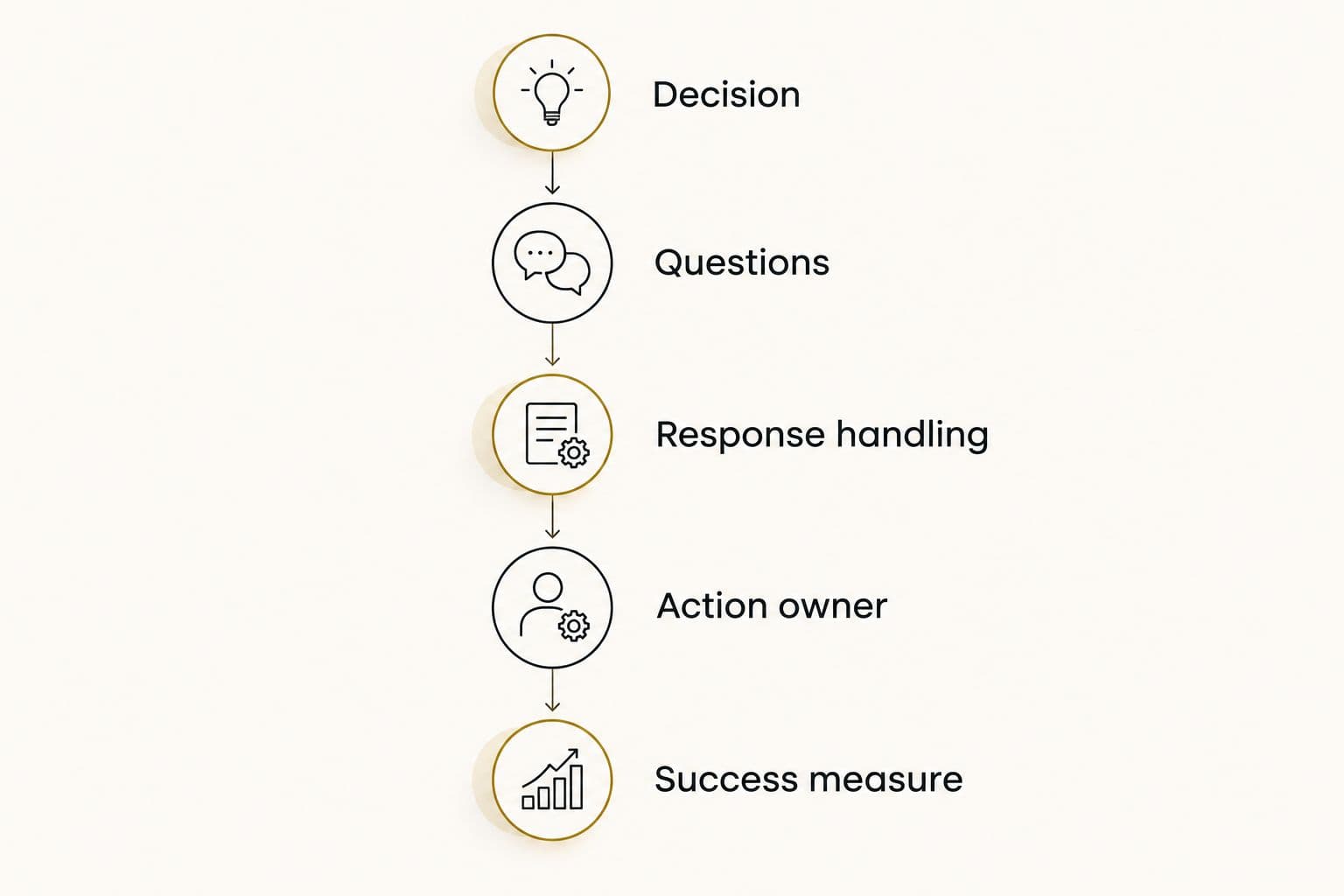
Choose the collection workflow around the decision and the person responsible for acting.
Keep the distinction between research quality and software capability visible. A platform can collect exactly what you ask and still leave you with answers that do not resolve the decision. Check the wording, audience, and intended action before blaming the collection tool.
When staying with SmartSurvey is the right call
Stay with SmartSurvey when it handles your questionnaire, gives your team usable responses, and supports the workflow you need. An alternative’s different interface is not, by itself, a business case for migration.
If the problem is that nobody acts on the findings, fix ownership first. If customer objections never reach the people writing ads or changing the website, changing survey software addresses the wrong part of the system.
Your 2026 decision should be based on the requirement you can demonstrate, not the length of the shortlist.
FAQ
What’s the best SmartSurvey alternative in 2026?
The best SmartSurvey alternative depends on the job: Typeform suits conversational questionnaires, while Google Forms suits straightforward collection connected to Google Sheets. Choose a growth partner instead when the unmet need is acting on customer insight, not collecting it.
Is The fVnnel a survey platform?
The fVnnel is a growth partner, not survey software. Its services cover strategy and positioning, paid acquisition, performance creative, websites and conversion, SEO, and tech and tracking.
Is Typeform better than SmartSurvey?
Typeform is the option to evaluate when a conversational, question-by-question experience is your priority. Compare the same questionnaire in both platforms rather than assuming that presentation alone improves results.
Can Google Forms replace SmartSurvey?
Google Forms is a candidate for straightforward questionnaire collection, particularly when your team organizes responses in Google Sheets. Test your actual questions, permissions, and response-handling requirements before replacing an existing survey workflow.
Should a Microsoft-based team choose Microsoft Forms?
Microsoft Forms belongs on the shortlist for a Microsoft-based team, but ecosystem fit should not decide the purchase alone. Confirm that the questionnaire and response-handling process meet the intended research need.
When should I keep SmartSurvey instead of switching?
Keep SmartSurvey when it meets your survey requirements and gives your team usable responses. If the real constraint is interpreting findings or making business changes, address that constraint rather than migrating software.
One last thing
Before approving a replacement, take a recent customer response and trace what happened next. Did it change a message, a campaign, a page, or a business decision?
If the answer is nothing, your first task is to assign an action owner, not select another survey builder. That test separates a collection problem from an execution problem without another software demonstration.