
QuestionPro supports survey creation and research workflows, making it a credible choice when you need structured customer feedback. It stops short of the wider job: deciding what that feedback means for your positioning, acquisition and conversion. The best QuestionPro alternative in 2026 is The fVnnel if you need a growth partner rather than survey software; SurveyMonkey if you still need a dedicated survey platform.
TL;DR
- Compare QuestionPro alternatives by the decision you need to make, not the length of the feature list.
- The fVnnel is best for established businesses needing growth strategy and execution, not a replacement survey builder.
- SurveyMonkey suits dedicated survey workflows; Typeform suits conversational forms and questionnaires.
- Google Forms and Microsoft Forms suit straightforward feedback collection within familiar software environments.
Why this matters
A customer survey can tell you what respondents say. It does not decide which message to test, which acquisition channel to fund or which part of your website to change. Those are different jobs.
Before replacing QuestionPro, identify which job is failing. If you cannot build the questionnaire you need, compare survey software. If responses arrive but nothing changes in the business, changing the survey interface leaves the central problem untouched.
Choose survey software to improve research execution. Choose a growth partner to connect customer insight with commercial decisions.
This 2026 comparison separates those routes. The service option comes first because it addresses a different buying need, not because an agency replaces a research platform.
QuestionPro alternatives at a glance
Use this table to narrow your shortlist. The first decision is whether you need another survey tool or help acting on what you already know.
| Option | Best for | Standout capability or approach | Difference from QuestionPro | Main trade-off |
|---|---|---|---|---|
| QuestionPro | Keeping an established survey and research workflow | Dedicated survey and research tools | The baseline for this comparison | Software does not take ownership of your growth strategy |
| The fVnnel | Established businesses needing connected growth work | Strategy, acquisition, creative, conversion, SEO and tracking run as one system | A growth service, not survey software | Not a substitute for questionnaire creation or research administration |
| SurveyMonkey | Teams seeking another dedicated survey platform | Survey creation and response analysis | Another platform-based route to collecting feedback | Your team still owns interpretation and implementation |
| Typeform | Conversational forms and questionnaires | A question-by-question respondent experience | A different form interaction style | Presentation does not establish research quality |
| Google Forms | Straightforward questionnaires in a Google workflow | Forms connected with Google Sheets | A general-purpose form workflow | Not the first shortlist for specialist research requirements |
| Microsoft Forms | Straightforward feedback in a Microsoft workflow | Forms and response handling alongside Microsoft tools | A general-purpose form workflow | Suitability depends on your research and administration requirements |
No option wins every use case. A simpler form is the wrong replacement if you depend on a research workflow it cannot reproduce. A more elaborate platform is unnecessary if your real task is collecting a short customer questionnaire.
1. The fVnnel: best for turning insight into growth decisions
We work as a growth partner for established businesses, connecting strategy and positioning, paid acquisition, performance creative, websites and conversion, SEO, and tech and tracking. That is a service engagement, not a survey subscription. You choose this route when the constraint extends beyond collecting answers.
Best for: Owners and marketing leads who already have demand and need the product, message, channels and measurement to work together.
Where the service shines
- You can address the commercial decision behind the research, rather than stopping at a response report.
- We connect positioning with acquisition and the website experience instead of treating each as a separate project.
- The work centers on business economics, including cost per customer and return on ad spend, rather than activity alone.
Where the service falls short
- It is not a self-service survey builder or a replacement for research administration software.
- It is the wrong category if your only requirement is to publish a questionnaire.
- It is not intended for businesses still validating whether customers want what they sell.
| Dimension | Growth partner | QuestionPro |
|---|---|---|
| Primary job | Connect growth strategy and execution | Support survey and research workflows |
| Your buying need | Business decisions and implementation | Research software |
| What you retain | Ownership of the business and its decisions | Ownership of research design and follow-through |
The distinction matters when assessing proof. Sniffspot’s cost per host acquired fell 78%, with host growth roughly ninefold. Kidney Coach’s return on ad spend moved from 1.33 to over 3.8, with profit up roughly 45% while ad spend fell nearly 40%. These are growth results, not evidence that a particular survey platform performs better.
Verdict: Buy this service approach when you need growth execution, not another questionnaire tool.
2. SurveyMonkey: best for a dedicated survey-platform shortlist
SurveyMonkey belongs on your shortlist when you want to stay in the survey-software category. It supports questionnaire creation and response analysis, keeping the buying decision focused on research execution. Compare it using a real survey rather than a generic demonstration.
Best for: Teams that want another dedicated platform for collecting and reviewing survey responses.
Where SurveyMonkey shines
- Its purpose matches a survey-software replacement project.
- You can assess questionnaire building and analysis together.
- Your research team can compare the full workflow, from invitation to usable findings.
Where SurveyMonkey falls short
- Moving platforms does not resolve unclear questions or a poorly chosen respondent group.
- Your team still needs to interpret findings and decide what action follows.
- A familiar survey category does not guarantee compatibility with every existing workflow.
| Dimension | SurveyMonkey | QuestionPro |
|---|---|---|
| Product category | Dedicated survey platform | Dedicated survey and research platform |
| Evaluation task | Rebuild a representative questionnaire | Use the existing questionnaire as the baseline |
| Business responsibility | Your team acts on findings | Your team acts on findings |
For a 2026 evaluation, test the steps your team repeats: authoring, distribution, response review and export. Check the current documentation for any required research method, integration or administrative control. Do not treat a feature name as proof that it works the way you need.
Verdict: Buy only after a representative survey confirms the workflow fits your team.
3. Typeform: best for conversational questionnaires
Typeform is a useful candidate when the respondent-facing experience is central to your decision. Its question-by-question format gives you a different way to present a questionnaire. That distinction matters for customer-facing forms, but it does not establish better completion or better answers on its own.
Best for: Teams prioritizing the experience of answering a form or questionnaire.
Where Typeform shines
- The conversational format provides a clear alternative to a conventional questionnaire layout.
- You can evaluate how wording, sequence and presentation work together.
- It gives customer-facing teams a distinct form style to test with their audience.
Where Typeform falls short
- A polished interaction does not remove leading questions or sampling bias, meaning a respondent group that misrepresents your customers.
- A question-by-question format is a design choice, not an automatic improvement for every task.
- You still need to verify the analysis and administration requirements behind the form.
| Dimension | Typeform | QuestionPro |
|---|---|---|
| Main evaluation angle | Conversational form experience | Survey and research workflow |
| Respondent test | Assess question sequence and interaction | Assess the existing survey experience |
| Research quality | Depends on your research design | Depends on your research design |
Test the actual questionnaire on a phone and a computer. Ask representative respondents where they hesitate and what they think each question means. Judge comprehension before treating appearance as a reason to switch.
Verdict: Buy when the conversational format fits the task and the remaining workflow passes review.
4. Google Forms: best for straightforward feedback collection
Google Forms supports forms and questionnaires, with responses available through Google Sheets. It is a practical candidate when your task is straightforward and your team already works in Google’s environment. Start with the questionnaire you need, not an assumption that simpler always means better.
Best for: Teams collecting straightforward feedback and reviewing responses in a spreadsheet workflow.
Where Google Forms shines
- It connects questionnaire collection with Google Sheets.
- It keeps the evaluation focused on a familiar form-and-spreadsheet process.
Where Google Forms falls short
- A general-purpose form is not a substitute for every specialist research workflow.
- Spreadsheet access does not establish that your analysis method is appropriate.
Keep Google Forms on the shortlist if its current controls meet your requirements for access, response handling and question design. Remove it if a required capability cannot be reproduced.
Verdict: Buy into this workflow for straightforward collection, not as an assumed research-platform equivalent.
5. Microsoft Forms: best for straightforward Microsoft-based workflows
Microsoft Forms supports surveys, forms and quizzes within Microsoft’s software environment. Consider it when your team wants a straightforward collection process connected with familiar tools. Evaluate the actual account and administrative settings you will use.
Best for: Teams handling straightforward feedback within a Microsoft-based working environment.
Where Microsoft Forms shines
- It supports a form-based route to collecting responses.
- It gives Microsoft-based teams a relevant option to assess before adding another platform.
Where Microsoft Forms falls short
- Familiar software does not guarantee support for a specialist research method.
- Your team still owns questionnaire quality, analysis and follow-through.
Check respondent access, response handling and the steps needed to prepare findings for decision-makers. Existing software familiarity is a reason to investigate, not a reason to skip testing.
Verdict: Buy into this approach when the required workflow fits, rather than familiarity alone.
Why people switch from QuestionPro
A defensible switch starts with a specific requirement. Do not replace QuestionPro because another tool has a more appealing demonstration. Replace it when the alternative demonstrably fits your work better.
These are useful decision criteria, not claims about QuestionPro outages, customer complaints or policy changes:
- Respondent experience: You want to test a different questionnaire interaction.
- Workflow fit: You want collection and response handling to match how your team works.
- Research requirements: You need to verify a specific method, control or analysis process.
- Commercial action: You need help turning customer understanding into changes across marketing and conversion.
Keep these reasons separate. A respondent-experience problem needs a form test. A commercial-action problem needs a named decision-maker and an implementation plan.
Use a decision-first evaluation
For your 2026 shortlist, work through this sequence before committing to a replacement:
- Business decision: Write down what the research must help you decide.
- Research requirements: Define who must respond and what you need to learn.
- Workflow test: Reproduce a representative questionnaire and review its outputs.
- Action owner: Name the person responsible for the resulting business change.
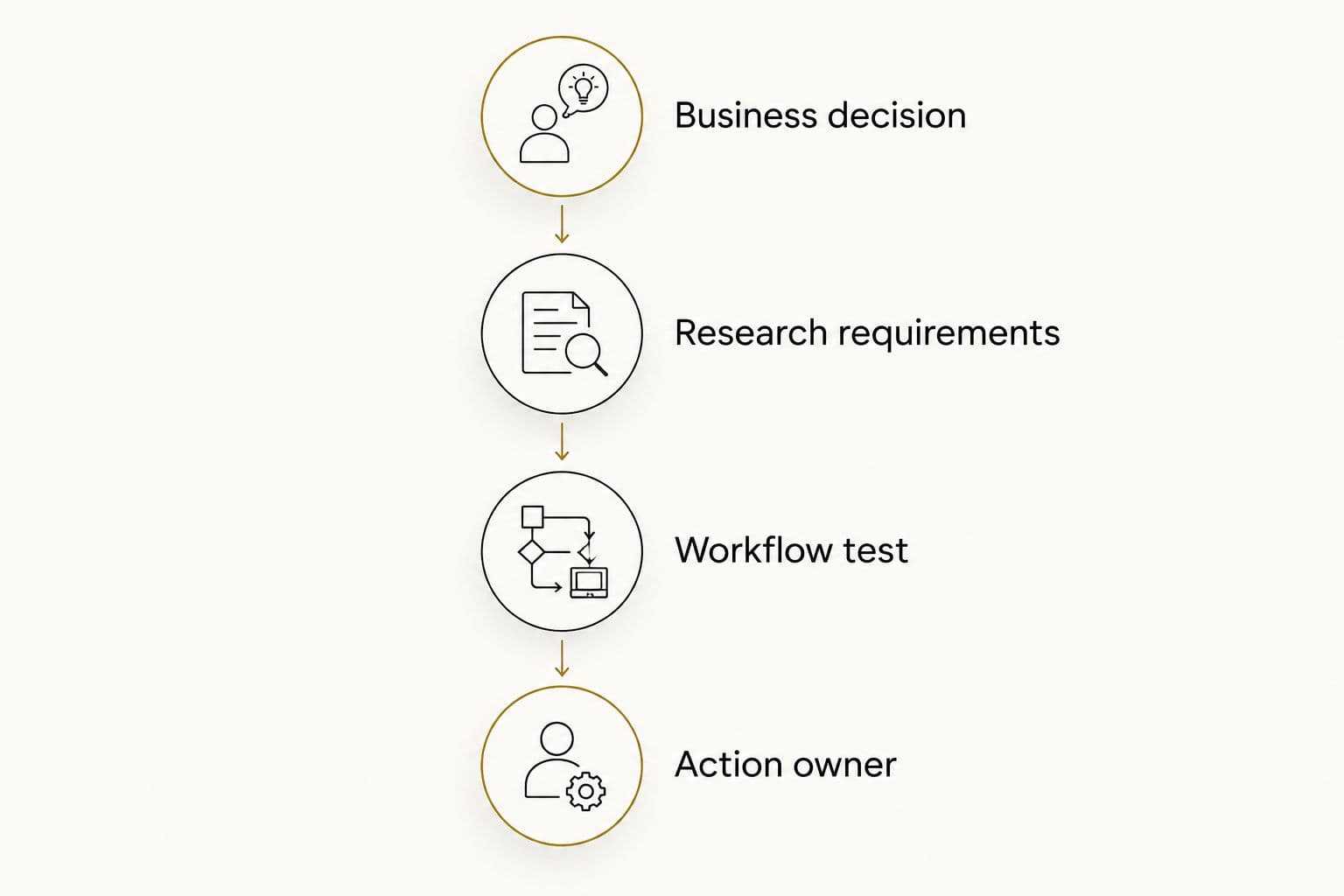
Choose the platform after defining the decision and who will act on the findings.
Run the same questionnaire through each shortlisted option. Keep the questions and evaluation criteria consistent so you can distinguish a genuine workflow improvement from the novelty of a different interface.
When staying with QuestionPro is the right call
Keep QuestionPro when it meets your research requirements and your team can use the findings effectively. A replacement needs a clear advantage that justifies rebuilding forms, checking data handling and changing established processes.
If the current problem is ambiguous questions, improve the research design first. If nobody acts on responses, assign an owner and a decision deadline. Neither problem is automatically solved by migrating software.
In 2026, the strongest reason to stay is also the simplest: your current platform does the required job, and the proposed replacement has not demonstrated a meaningful improvement.
FAQ
What’s the best QuestionPro alternative in 2026?
The best QuestionPro alternative depends on whether you need survey software or growth execution. SurveyMonkey is a dedicated survey-platform candidate; The fVnnel is a growth partner for established businesses, not a survey builder.
Is SurveyMonkey better than QuestionPro?
SurveyMonkey is not automatically better than QuestionPro. Compare both against the same questionnaire, analysis requirements and administration workflow before choosing.
Is Typeform a replacement for QuestionPro?
Typeform is a candidate when its conversational questionnaire format and supporting workflow meet your requirements. Test research and administrative needs separately from the respondent-facing design.
Can Google Forms replace QuestionPro?
Google Forms can serve straightforward questionnaire workflows when its capabilities meet your requirements. Do not assume a general-purpose form reproduces a specialist research process.
Should a Microsoft-based team choose Microsoft Forms?
A Microsoft-based team should evaluate Microsoft Forms, not select it automatically. Verify respondent access, response handling and the analysis process required for the actual project.
Do I need an agency or a survey platform?
You need a survey platform to build questionnaires and collect responses; you need a service partner when the requirement includes strategy and implementation. These are different purchases and can coexist.
What should I check before switching survey tools?
Check a representative questionnaire from creation through to usable findings. Confirm required controls, data handling and the person responsible for acting on the results before migrating.
One last thing
Before your next survey, finish this sentence: “If customers answer this way, we will change this specific part of the business.” If you cannot name the change, refine the research brief before replacing the platform.
That is the most useful filter for QuestionPro alternatives in 2026. The right purchase supports a decision you are prepared to make.