
SurveyKing provides survey creation and analysis, but collecting answers is different from deciding what to change in your business. The best SurveyKing alternative in 2026 is The fVnnel if you need a growth partner to turn customer understanding into action; Google Forms if you need straightforward questionnaires rather than a broader growth engagement.
TL;DR
- Compare SurveyKing alternatives by the decision you need to make, not the length of a feature list.
- The fVnnel is a growth partner, not a replacement survey application.
- Google Forms suits straightforward questionnaires; Typeform suits conversational forms.
- Microsoft Forms fits Microsoft-centered workflows; SurveyMonkey is a dedicated survey-platform option.
Why this matters
Your business does not benefit from customer feedback until someone uses it. A questionnaire can identify objections, but it cannot rewrite your offer, improve a landing page or decide how to allocate advertising spend.
That distinction matters when comparing SurveyKing alternatives in 2026. There are two separate buying decisions here: choosing software to collect information and choosing support to act on it. Do not replace a survey application to solve an execution problem.
For an established business, start with the commercial question. Are you trying to understand why qualified prospects do not buy, why customers leave or which offer deserves more investment? The answer determines what you ask, whom you ask and what happens afterward.
SurveyKing alternatives at a glance
These options are not interchangeable. The table separates survey applications from a growth service so you can compare the right kind of solution.
| Option | Best for | Standout capability | How it differs from SurveyKing | Main trade-off |
|---|---|---|---|---|
| SurveyKing | Continuing an existing survey workflow | Survey creation and analysis | The benchmark, not an alternative | Collecting feedback still requires someone to act on it |
| The fVnnel | Established businesses needing growth execution | Strategy, acquisition, creative, websites, SEO and tracking run as one system | A growth partner rather than survey software | Not a questionnaire-building application |
| Google Forms | Straightforward questionnaires | Forms connected to Google Sheets | A general-purpose form workflow | Not the same proposition as a dedicated research platform |
| Typeform | Conversational forms and questionnaires | A question-by-question respondent experience | A different approach to presenting questions | The format needs testing against your questionnaire |
| Microsoft Forms | Microsoft-centered teams | Forms connected to Microsoft’s productivity environment | A workflow choice for teams using Microsoft tools | Less relevant when Microsoft is not part of your workflow |
| SurveyMonkey | Teams evaluating another dedicated survey platform | Survey-focused creation and analysis | A direct software comparison rather than a service alternative | Migration needs a specific, demonstrable benefit |
No single application wins every questionnaire. Test the question types, response exports and reporting you actually need before moving an existing workflow.
1. The fVnnel: best for turning insight into growth decisions
Best for: established businesses with real demand that need coordinated growth execution.
We connect strategy and positioning, paid acquisition, performance creative, websites and conversion, search engine optimization [SEO], and technology and tracking. The work addresses how those parts function together, rather than treating each channel as a separate problem.
That makes this a different buying decision from choosing SurveyKing. If you already understand customer objections but your message, website and advertising still contradict each other, another questionnaire builder does not address that problem.
Where the growth-partner approach shines
- You need customer understanding translated into positioning and creative decisions.
- You need acquisition and website decisions evaluated together.
- You want business economics, rather than isolated channel metrics, to guide priorities.
Where it falls short
- It is not a self-service application for building and distributing surveys.
- It is the wrong category if your only requirement is collecting questionnaire responses.
- It is not positioned for businesses still validating whether customers want their offer.
Growth partner versus SurveyKing
| Dimension | Growth-partner approach | SurveyKing |
|---|---|---|
| What you are buying | Strategy and execution services | Survey software |
| Central task | Connect growth decisions across the business | Create surveys and analyze responses |
| Appropriate problem | Disconnected messaging, acquisition, conversion and tracking | A requirement to collect structured feedback |
| Relationship between them | Can address the business decisions surrounding research | Can remain part of a feedback workflow |
The supplied client results illustrate commercial outcomes, not evidence of survey-platform performance. Sniffspot’s cost per host acquired fell 78%, with host growth roughly ninefold. Kidney Coach’s return on ad spend [ROAS], revenue attributed to advertising divided by advertising spend, increased from 1.33 to over 3.8; profit rose roughly 45% while ad spend fell nearly 40%.
Those results do not establish that switching survey tools caused an improvement. They demonstrate why the buying brief should name the business outcome, not just the software category.
Verdict: Skip as a software replacement. Choose this service category when the problem is growth execution.
2. Google Forms: best for straightforward questionnaires
Best for: teams that need a practical form-and-spreadsheet workflow.
Google Forms lets you create questionnaires and work with responses in Google Sheets. That makes it a relevant option when your immediate requirement is asking clear questions and organizing the answers.
For a 2026 shortlist, define the questionnaire before comparing applications. A simple customer follow-up does not automatically require the same setup as a specialized research project.
Where Google Forms shines
- A familiar connection between a questionnaire and spreadsheet analysis.
- A practical fit for straightforward internal or customer feedback forms.
- A clear starting point when your research question is narrow.
Where Google Forms falls short
- A general-purpose form workflow is not a substitute for a research methodology.
- Specialized questionnaire requirements need checking before you commit.
- Spreadsheet access alone does not establish who will interpret the answers or make changes.
| Dimension | Google Forms | SurveyKing |
|---|---|---|
| Core use | General-purpose forms and questionnaires | Survey creation and analysis |
| Workflow emphasis | Collect responses and work with them in Google Sheets | Work within a dedicated survey environment |
| Decision to test | Does the form-and-spreadsheet workflow cover your brief? | Does the existing survey workflow already cover it? |
Verdict: Buy into this approach for straightforward questionnaires, not because a simpler interface guarantees better research.
3. Typeform: best for conversational questionnaires
Best for: teams that want a question-by-question form experience.
Typeform presents a different respondent experience from a conventional questionnaire layout. Consider it when how someone moves through the questions is an important part of your brief.
Do not assume a conversational presentation produces better business outcomes. Test whether respondents understand the questions and whether the resulting answers support your decision.
Where Typeform shines
- A conversational approach to presenting forms and questionnaires.
- A useful option when the respondent experience is central to your selection criteria.
- A distinct format to evaluate alongside your existing survey.
Where Typeform falls short
- A different presentation does not fix leading questions or an unclear research objective.
- Question-by-question presentation needs checking against the length and complexity of your form.
- Your export and follow-up requirements still need a separate review.
| Dimension | Typeform | SurveyKing |
|---|---|---|
| Comparison focus | Conversational presentation | Dedicated survey workflow |
| Best evaluation | Test the respondent’s journey through the questions | Test the survey and analysis requirements |
| Shared responsibility | You still need a clear research brief | You still need a clear research brief |
Verdict: Buy for a deliberate format choice. Skip if appearance is the only reason to migrate.
4. Microsoft Forms: best for Microsoft-centered teams
Best for: businesses that want questionnaires within a Microsoft-centered workflow.
Microsoft Forms is a relevant alternative when your team already works with Microsoft’s productivity tools. Evaluate it around the people who create forms, review responses and use the findings, not just the person selecting software.
Where Microsoft Forms shines
- A form option within Microsoft’s productivity environment.
- A relevant shortlist entry when Microsoft tools already support your internal work.
- A practical comparison for routine questionnaires and internal feedback.
Where Microsoft Forms falls short
- Ecosystem fit does not prove that every required question type or report is supported.
- It offers less reason to switch if your team does not use the surrounding Microsoft workflow.
- A convenient internal tool still needs a suitable customer-facing questionnaire.
Verdict: Buy for workflow fit after checking the questionnaire. Skip an ecosystem-led switch that adds no operational benefit.
5. SurveyMonkey: best for a dedicated survey-platform comparison
Best for: teams that specifically want another survey application rather than a general form tool.
SurveyMonkey belongs on a direct survey-software shortlist. Compare it with SurveyKing using a representative questionnaire and the analysis your team must deliver.
Where SurveyMonkey shines
- A survey-focused alternative to evaluate against an existing survey process.
- A relevant choice when questionnaire creation and response analysis remain the central requirements.
Where SurveyMonkey falls short
- Another survey platform still leaves interpretation and execution with your team.
- Switching adds work without a clear benefit if the current application already meets the brief.
- Product capabilities must be checked against your specific research requirements.
Verdict: Buy only when a demonstrated survey-workflow improvement justifies migration. Otherwise, hold.
Why people switch from SurveyKing
A sound reason to switch is a mismatch between your requirement and your current workflow. A new shortlist alone is not evidence that your existing application is inadequate.
Use these decision triggers for your 2026 evaluation:
- Question design: Your required questionnaire cannot be represented clearly in the current setup.
- Response analysis: The team cannot produce the analysis needed for its decision through an acceptable workflow.
- Team workflow: Ownership, handoffs or exports create unnecessary manual work.
- Growth execution: The research exists, but nobody connects it to messaging, acquisition or conversion decisions.
The first three triggers justify evaluating software. The last calls for an execution decision, potentially without changing SurveyKing at all.
For example, customer feedback about an unclear offer should lead to a positioning or page decision. Moving the same questionnaire into another application does not resolve the underlying issue.
How to choose without creating another migration project
Use a decision sequence before rebuilding anything. For a 2026 evaluation, judge the alternatives against the work your team must complete, not a generic checklist.
- Business decision: State what you will change based on the answers.
- Question design: Write the questionnaire that supports that decision.
- Response analysis: Identify the output the decision-maker needs.
- Team workflow: Assign ownership for collection, interpretation and action.
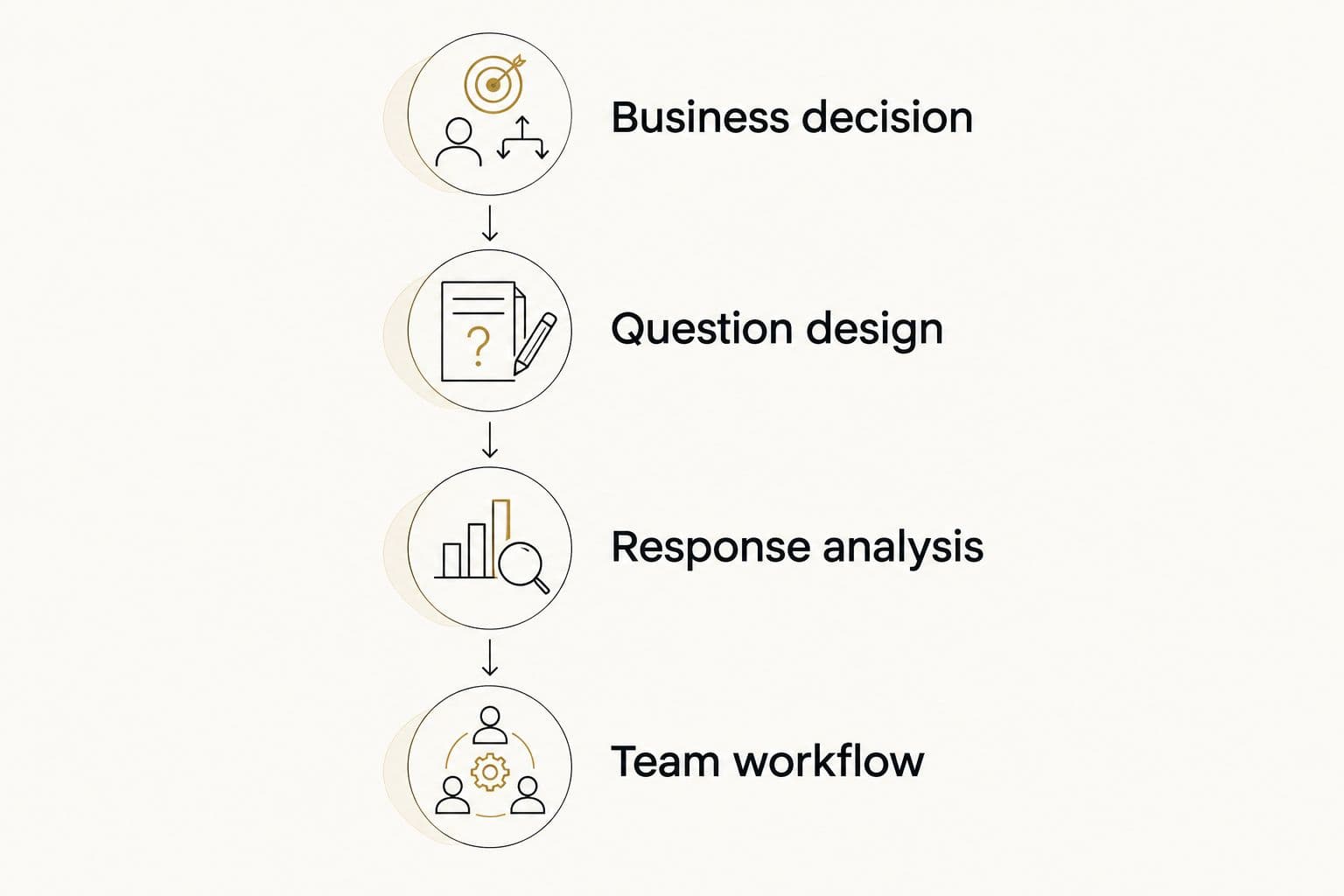
Choose the application after defining the decision and the work around it.
Test a representative questionnaire from beginning to end. Include the response review and export, not just form creation. If the alternative improves the editor but makes the final analysis harder, it has not solved the whole requirement.
When staying with SurveyKing is the right call
Stay with SurveyKing when it supports your questionnaire, produces usable responses and fits the team’s workflow. Familiarity is not a weakness when the process works.
Keep the application and improve the brief if the real problem is unclear questions. Keep it and assign an owner if findings disappear into reports. Consider a different service category if your team needs help translating findings into commercial action.
A defensible 2026 decision includes “no change” as an option. Migration should solve a named problem, not become a substitute for making the business decision.
FAQ
What’s the best SurveyKing alternative in 2026?
Google Forms is a relevant choice for straightforward questionnaires, Typeform for conversational forms, and Microsoft Forms for Microsoft-centered teams. SurveyMonkey belongs on a dedicated survey-platform shortlist. Choose against your actual questionnaire and analysis requirements.
Is The fVnnel a direct replacement for SurveyKing?
No. The fVnnel is a growth partner offering strategy, acquisition, creative, websites, SEO and tracking, not a survey application. It addresses execution needs rather than replacing questionnaire software.
Is Google Forms better than SurveyKing?
Google Forms is a better fit when a straightforward form connected to Google Sheets covers your requirement. That does not make it better for every research project. Test your required questions and analysis before switching.
Should I choose Typeform for customer feedback?
Choose Typeform when you specifically want a conversational questionnaire format. Test whether that presentation suits your questions and respondents rather than assuming the format improves results.
Can I keep SurveyKing and still improve marketing performance?
Yes, keeping SurveyKing does not prevent you from changing your message, website or acquisition strategy. Separate the application decision from the business decisions informed by customer feedback.
What should I check before moving an existing survey?
Check question types, response handling, exports and the analysis your team needs. Test a representative questionnaire through the full workflow before rebuilding your existing process.
How do I compare survey software without getting distracted by features?
Start with the decision the research must support. Then compare the questionnaire, analysis and team workflow required to reach that decision. Features matter only when they support that work.
One last thing
Write the action before you write the survey. Complete this sentence: “If customers tell us this, we will change that.” If you cannot finish it, clarify the decision before changing applications.
If your established business needs help connecting customer understanding with growth execution, Get in Touch.