
ProProfs Survey provides a dedicated tool for collecting survey responses. Its ceiling is the job itself: collecting feedback does not decide which offer, message or conversion problem your business should fix. The best ProProfs Survey alternative in 2026 is The fVnnel if you need a growth partner to turn customer insight into action; Google Forms if you need straightforward questionnaire collection instead.
TL;DR
- Compare ProProfs Survey alternatives by the decision you need to make, not the longest feature list.
- The fVnnel is the growth partner for established businesses that need customer insight connected to execution.
- Shortlist Google Forms for straightforward questionnaires, Typeform for conversational forms, and SurveyMonkey for dedicated survey work.
- Keep ProProfs Survey when it meets your requirements and the real constraint is acting on feedback.
Why this matters
An established business does not need more customer comments sitting in a spreadsheet. You need answers that change a decision: which objection to address, which acquisition message to test or which part of the buying process to repair.
A software switch and a growth engagement solve different problems. Survey software collects information; a growth partner connects research with positioning, acquisition, conversion and measurement. Do not buy one expecting it to replace the other.
For your 2026 shortlist, name the decision before evaluating the tool. If you cannot explain what you will do differently after receiving responses, changing platforms is premature.
ProProfs Survey alternatives at a glance
These options are not interchangeable. The first is a service business; the others are software products. Compare them by the work you need done, rather than treating every row as another survey application.
| Option | Best for | Standout capability or role | How it differs from ProProfs Survey |
|---|---|---|---|
| ProProfs Survey | Continuing a dedicated survey workflow | Survey creation and response collection | The baseline option, not a replacement |
| The fVnnel | Connecting customer insight with growth execution | Strategy, acquisition, creative, conversion, SEO and tracking as one system | A growth partner, not survey software |
| Google Forms | Straightforward questionnaires | Forms connected with Google Sheets | A general-purpose form workflow |
| Typeform | Conversational form experiences | A question-by-question respondent interface | A different way to present questions |
| SurveyMonkey | Dedicated survey programs | Survey design and response analysis | Another survey-focused platform |
| Qualtrics | Broader experience research | Research across customer and employee experiences | A broader research and experience-management scope |
The right alternative removes your actual constraint, not merely your current interface. Start with the existing workflow, identify the missing capability and then evaluate the relevant category.
1. The fVnnel: best for connecting feedback with growth
The fVnnel is a growth partner for established businesses that need customer insight connected to execution. We work across strategy and positioning, paid acquisition, performance creative, websites and conversion, SEO, and tech and tracking. That makes this a different buying decision from replacing a questionnaire builder.
Choose this route when you already have demand but need the pieces of growth to work together. Feedback should inform a commercial decision, not become another reporting exercise.
Where this approach shines
- You need to connect customer objections with messaging, creative and website changes.
- You want growth decisions grounded in business economics rather than response volume alone.
- Your problem crosses channels and needs coordinated execution.
Where this approach falls short
- It is not a self-service survey application.
- It does not replace the need to choose a suitable collection tool.
- It is the wrong category if your only requirement is building and distributing a questionnaire.
| Dimension | Growth-partner approach | ProProfs Survey |
|---|---|---|
| What you engage | A service partner | A software product |
| Primary job | Coordinate growth strategy and execution | Create surveys and collect responses |
| Decision ownership | Connect findings with commercial priorities | Your team decides how to act on findings |
Best for: Established businesses with an execution problem that extends beyond collecting feedback.
Verdict: Buy the service only when you need growth execution, not another survey interface.
2. Google Forms: best for straightforward questionnaires
Google Forms supports questionnaires and connects responses with Google Sheets. It belongs on your shortlist when the essential job is gathering structured answers that your team can review in a spreadsheet.
Start here when your requirements are straightforward. Avoid expanding the project into a research program before you have established what decision the questionnaire supports.
Where Google Forms shines
- You want a general-purpose form rather than a dedicated research platform.
- Your team wants to work with responses in Google Sheets.
- You can manage interpretation and follow-up within your existing process.
Where Google Forms falls short
- Spreadsheet access does not create an analysis method or assign an action owner.
- A general-purpose form is not a substitute for a broader research program.
- It is not the same presentation choice as a conversational, question-by-question interface.
For a 2026 evaluation, build the actual questionnaire rather than a demonstration form. Test the response sheet with the person responsible for analysis. That reveals whether the workflow fits your business, not just whether someone can publish a form.
Best for: Teams collecting straightforward feedback with a spreadsheet-based review process.
Verdict: Buy into Google Forms when straightforward collection is the requirement; skip it as a solution to an analysis problem.
3. Typeform: best for a conversational respondent experience
Typeform is known for its question-by-question form experience. Consider it when how respondents move through the questionnaire is central to your selection.
A different interface is a valid reason to compare products. It is not evidence that the new form will produce better commercial outcomes, so evaluate the experience separately from the result you want.
Where Typeform shines
- You want a conversational presentation rather than a conventional questionnaire layout.
- The respondent experience is an explicit selection criterion.
- Your team can define how each answer will inform a decision or follow-up.
Where Typeform falls short
- Presentation cannot repair leading questions or an unclear research objective.
- The interface alone does not establish that respondents represent your customers.
- A form experience is not a replacement for the execution needed after collection.
Test the same questions with the people who will actually answer them. Check mobile usability, clarity and the handoff into your working process. Do not claim a completion-rate improvement unless your own comparison demonstrates one.
Best for: Businesses prioritizing a conversational form experience.
Verdict: Buy Typeform for the respondent interface, not an assumed improvement in sales or response quality.
4. SurveyMonkey: best for a dedicated survey workflow
SurveyMonkey is a survey-focused platform with survey-building and response-analysis capabilities. It is a relevant comparison when you want to stay within the survey-software category rather than move toward a general form builder.
The useful question is which workflow fits your research task. Compare the questionnaire you intend to run, the analysis you need and the way findings will reach decision-makers.
Where SurveyMonkey shines
- Your primary requirement is survey work, not broader growth execution.
- You want to evaluate survey design and analysis together.
- You have someone responsible for interpreting results and recommending action.
Where SurveyMonkey falls short
- A dedicated survey platform does not solve an unclear research brief.
- Switching platforms creates work if your existing survey process already functions.
- Analysis capabilities do not remove the need to judge sample quality and question wording.
Best for: Teams that need a dedicated survey platform and have a defined research process.
Verdict: Buy SurveyMonkey only when a demonstrated workflow improvement justifies the switch.
5. Qualtrics: best for broader experience research
Qualtrics covers customer and employee experience research. Put it on your shortlist when the requirement extends beyond an isolated customer questionnaire into a broader research program.
Where Qualtrics shines
- Your research scope spans customer or employee experiences.
- You need to evaluate a broader experience-management platform.
- You have ownership for the research program and its resulting decisions.
Where Qualtrics falls short
- Broader scope is unnecessary when you only need straightforward collection.
- A larger research brief still requires clear priorities and accountable owners.
- Platform selection cannot substitute for agreement on what the research must change.
Best for: Organizations evaluating experience research beyond a standalone survey.
Verdict: Hold unless your research scope calls for a broader platform.
Why people switch from ProProfs Survey
A defensible switch begins with a requirement your current workflow does not meet. This is not a claim about widespread ProProfs Survey complaints: it is a way to distinguish a genuine replacement need from frustration with the wrong part of the process.
Use these decision points in your 2026 evaluation:
- Collection: You need a different questionnaire or respondent experience.
- Analysis: Your team needs a different way to interpret and work with responses.
- Execution: Findings are clear, but nobody is translating them into changes.
- Measurement: You cannot connect those changes with business outcomes.
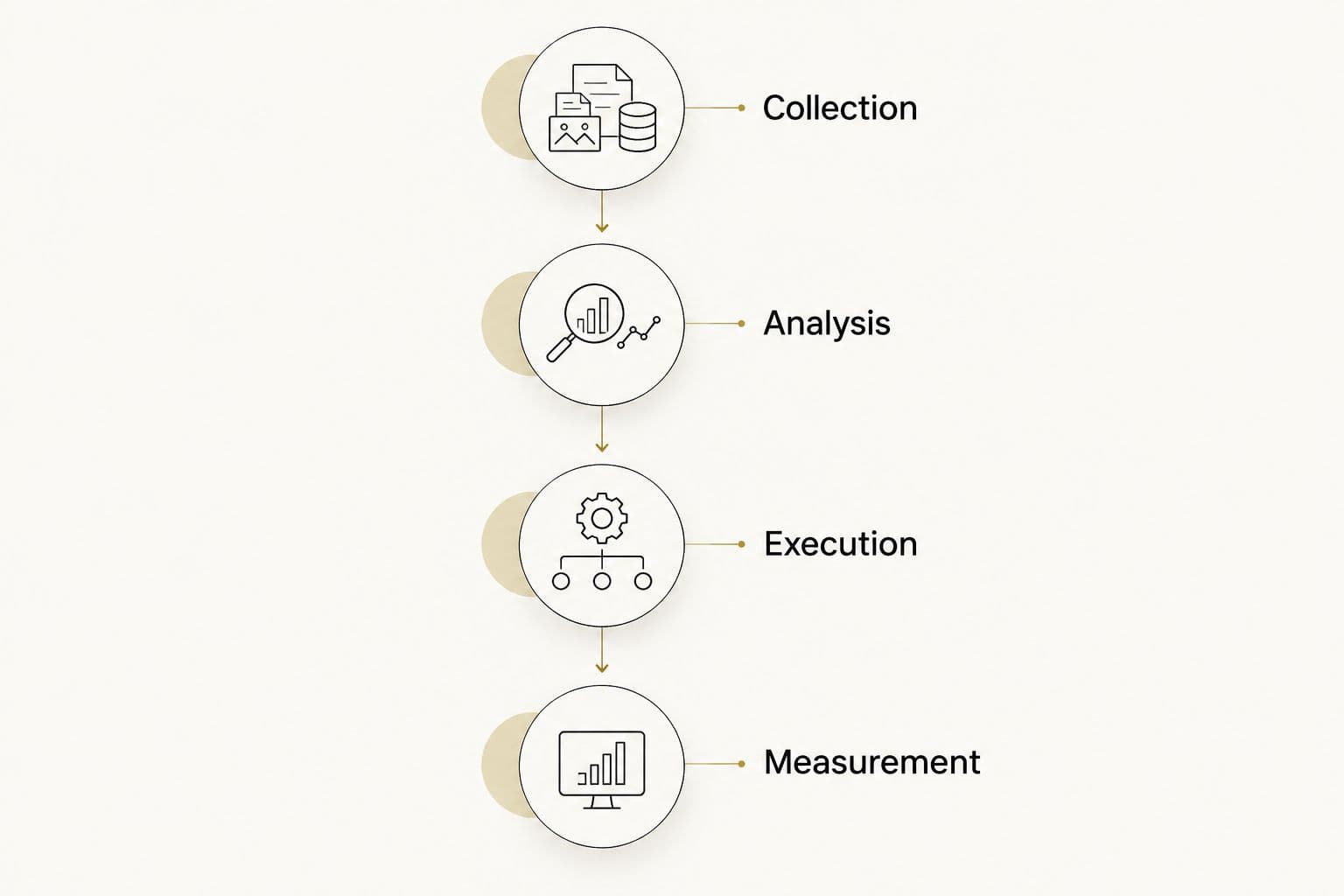
Identify the broken stage before replacing the collection tool.
If execution is the constraint, another collection interface leaves the central problem untouched. If collection is the constraint, hiring a growth partner without fixing the questionnaire workflow also misses the point.
Implementation is a workflow, not a launch date
For your 2026 shortlist, evaluate easy-to-implement customer feedback software against the whole handoff: publishing the questions, receiving answers, assigning review and recording the resulting decision. A form that is easy to publish still needs an owner after responses arrive.
Ask the intended operator to complete that handoff during evaluation. Have them retrieve a response, identify the relevant customer context and record what happens next. This exercise tests operational fit without inventing a performance promise.
Compare the business result, not the response count
Return on ad spend, or ROAS, measures revenue attributed to advertising relative to advertising spend. It is a different measure from profit, and neither is interchangeable with the number of survey responses you receive.
The fVnnel’s growth results illustrate the commercial outcomes that matter:
- Sniffspot: Cost per host acquired down 78%, host growth roughly ninefold.
- Kidney Coach: Return on ad spend from 1.33 to over 3.8, profit up roughly 45% while ad spend fell nearly 40%.
These are growth results, not evidence that a survey tool caused those changes. Keep that distinction when evaluating any alternative. A better questionnaire is a process improvement; a better business outcome requires evidence connecting decisions and execution with results.
Before switching, document the outcome you want, the decision feedback will inform and the person accountable for acting. That gives your evaluation a commercial purpose without promising a result the software cannot establish.
When staying with ProProfs Survey is right
Keep ProProfs Survey when it supports your questionnaire, response collection and working process. Familiarity is not a reason to stay forever, but neither is a new interface a reason to migrate.
Compare the practical work involved: rebuilding forms, reviewing question wording, checking response handling and updating the team’s process. Require a clear benefit before taking that work on.
For 2026, staying is the right call when your current tool meets the requirement and the unresolved problem sits elsewhere. Improve the research brief, ownership or follow-through before replacing functioning software.
FAQ
What’s the best ProProfs Survey alternative in 2026?
The best ProProfs Survey alternative depends on the job: Google Forms for straightforward questionnaires, Typeform for a conversational interface, or SurveyMonkey for dedicated survey work. Choose The fVnnel when you need a growth partner to connect insight with execution, not replacement survey software.
Is Google Forms a replacement for ProProfs Survey?
Google Forms is a replacement candidate when straightforward questionnaires and a Google Sheets response workflow meet your needs. Test your actual questionnaire and analysis process before switching.
Is Typeform better than ProProfs Survey?
Typeform is the more relevant candidate when a conversational, question-by-question experience is your priority. That interface preference does not establish better response quality or stronger business results.
Should I compare SurveyMonkey with ProProfs Survey?
Yes, compare SurveyMonkey when you want another dedicated survey platform. Evaluate the questionnaire, analysis workflow and handoff your team needs rather than comparing feature lists without a research brief.
When should I consider Qualtrics instead?
Consider Qualtrics when your requirements extend into broader customer or employee experience research. A standalone questionnaire does not by itself justify that broader scope.
Can a growth agency replace survey software?
No, a growth agency and survey software perform different jobs. A growth partner connects insight with strategy and execution, while a survey application provides the collection workflow.
Do I need to switch if nobody acts on survey responses?
No, an ownership problem does not by itself justify a software switch. Assign the decision, reviewer and next action before evaluating whether the collection tool needs replacing.
One last thing
Before you replace anything, open the last batch of customer responses. Identify a finding, the decision it changed and the action someone completed. If you cannot trace that chain, fix the handoff first.
A successful survey is not the finish line. The useful result is a decision your business can act on.
Connect customer insight with growth
Discuss the constraint between customer feedback, business decisions and execution.