
Health and nutrition coaches’ paid media is paid advertising designed to acquire clients at a cost your coaching business can support. This guide explains how to connect your offer, advertising, consultations and sales without sacrificing margin or making unsupported health claims.
TL;DR
- Paid media for health and nutrition coaches should optimize for paying clients, not cheap leads.
- The fVnnel suits established businesses that need paid acquisition, positioning, conversion and tracking managed together.
- Use Google Search for expressed demand and Meta for explaining your coaching approach.
- Set acquisition limits from collected revenue and delivery costs before increasing advertising spend.
Why paid media matters for health and nutrition coaches
Your advertising has to sell a relationship, not just a transaction. Prospective clients need to understand your coaching approach, the commitment involved and whether your service fits their goals. A cheap inquiry does not establish any of those things.
For your 2026 plan, start with the business constraint. You might need more qualified consultations, better attendance or stronger enrollment after the call. Each problem requires a different intervention; buying more traffic is not the answer to all three.
The fVnnel is best for established businesses that need paid media connected to positioning, conversion and tracking. The The fVnnel growth-partner model brings those services together rather than treating advertising as an isolated task.
Kidney Coach provides a relevant business example: return on ad spend increased from 1.33 to over 3.8, profit rose roughly 45%, and ad spend fell nearly 40%. Return on ad spend, or ROAS, measures revenue attributed to advertising divided by advertising spend. These results show that higher profit and lower spending can occur together; they are not a forecast for your coaching business.
Build your 2026 paid media plan
Define the offer you can profitably deliver
Start manually with your sales records and a spreadsheet. Separate your coaching offers rather than combining individual coaching, groups and memberships into one average. Their delivery requirements and revenue patterns differ.
Calculate what remains from collected revenue after refunds, payment fees and delivery costs. Then decide how much of that amount you can commit to acquisition while retaining your required profit. Do not justify today’s advertising spend with renewals you have not established through actual customer records.
For a consultation-led service, the offer must explain who it serves, what support includes and what participation requires. A prospect should understand the commitment before booking, not discover it during the sales conversation.
- Choose the established offer with documented customer demand.
- Separate collected revenue from contracted or projected revenue.
- Include coaching time and support costs in your margin calculation.
- Set an acquisition ceiling that preserves your required profit.
Map the journey from advertisement to enrollment
Trace a recent client’s path using your existing records. Record the advertisement or source, landing page, inquiry, appointment, attendance and enrollment. This exposes missing handoffs before you pay to send more people through them.
A landing page should answer the questions that determine fit: who the coaching serves, how sessions work, what the client must do and what happens next. Keep medical history out of advertising forms. Collect sensitive information only through an appropriate intake process, with clear reasons and suitable safeguards.
This is where connected execution matters. The fVnnel’s paid media, websites and conversion, and tech and tracking services address different parts of the same acquisition journey. The limitation is scope: an integrated engagement is unnecessary when your only problem is a clearly defined task your team can already fix.
- Match the landing-page promise to the advertisement.
- Explain the consultation’s purpose before asking for a booking.
- Test the form, confirmation and calendar on a phone.
- Assign responsibility for responding to every inquiry.
Choose the channel around buyer intent
Review how your current clients found you before selecting a channel. Search terms, inquiry messages and sales conversations can reveal whether buyers already know what service they want or need education before considering coaching.
Google Search advertising captures expressed intent through search queries. Its limitation is dependence on relevant searches and the ability to distinguish service buyers from people seeking general nutrition information. Meta advertising, across Facebook and Instagram, gives you room to explain your approach through creative, but an interested viewer is not automatically ready to enroll.
For 2026, choose a primary acquisition channel before spreading your attention across platforms. Add another channel when you can explain its role and measure what it contributes, not because competitors appear there.
- Use service-specific search themes when buyers express hiring intent.
- Exclude searches that do not match your coaching offer.
- Use Meta creative to explain your method and client experience.
- Keep prospecting and existing-audience campaigns distinguishable in reporting.
Write creative that earns trust without diagnosing
Begin with the questions your qualified prospects actually ask. Turn those questions into plain-language explanations of your coaching process, scope and expectations. A direct explanation is more useful than a dramatic promise you cannot substantiate.
Health-related advertising requires particular care. Avoid copy that tells viewers they have a condition or presents guaranteed body changes. Google and Meta have policies governing health-related content and targeting; check their current rules before launch and whenever your offer or creative changes.
Use testimonials only with permission and retain the evidence behind factual claims. A client’s experience does not establish that every future client will achieve the same outcome. Describe what your coaching provides without presenting coaching as diagnosis or medical treatment.
- Show how coaching works rather than promising a transformation deadline.
- Explain who the service fits without assigning a health condition to viewers.
- Keep claims consistent across advertisements and landing pages.
- Review testimonial permissions and supporting evidence before publication.
Qualify inquiries without creating unnecessary friction
Start with a short form and a clear consultation explanation. Ask questions that help determine service fit: the prospect’s goals, preferred support format and readiness to participate. Every question should have a purpose in routing or preparing the conversation.
Qualification is not a contest to collect the most detail. A long questionnaire can burden someone who only needs to understand whether your service is appropriate. Conversely, a form that collects only an email address leaves your team without useful context.
For your 2026 process, connect qualification to follow-up. A suitable inquiry needs an assigned owner, a clear next step and consistent records. If consultations are not attended, examine scheduling, reminders and expectations before blaming the advertising audience.
- Ask only questions your team uses to assess fit.
- State what the consultation covers and who conducts it.
- Record why inquiries do not progress.
- Keep health intake separate from marketing qualification.
Measure clients and contribution, not just leads
A spreadsheet can connect advertising spend to inquiries, attended consultations, enrollments and collected revenue. Use consistent definitions so your advertising platform and sales records do not tell incompatible stories.
Cost per lead measures spending divided by inquiries. Customer acquisition cost measures the cost of acquiring a paying customer; state whether your calculation includes only media or also creative, agency and sales costs. Contribution is the revenue left after the variable costs you have defined, not the same thing as revenue or ROAS.
Use ad attribution tools when you need help connecting recorded customer actions to marketing sources. Attribution assigns credit; it does not establish with certainty what would have happened without advertising.
- Reconcile advertising conversions with actual enrollment records.
- Report qualified inquiries separately from total inquiries.
- Compare acquisition cost with collected revenue and delivery costs.
- Document missing source data instead of assigning it to a favored channel.
Scale the constraint, not the budget
Review the acquisition journey in order: offer, message, traffic, conversion and economics. Identify the stage preventing profitable enrollment, then make a change that addresses that stage. More spending magnifies an unresolved problem.
If inquiries are suitable but consultations do not convert, review the offer and sales conversation. If enrollments are profitable but your coaching calendar is full, delivery capacity becomes the constraint. Neither problem is solved by increasing impressions.
A useful 2026 scaling decision explains what improves, how you will measure it and what would make you stop. Avoid changing the audience, creative, page and follow-up simultaneously when you need to understand which change affected results.
- Offer: confirm the service is clear and commercially workable.
- Message: check that advertising attracts the right expectations.
- Traffic: inspect search terms, placements and inquiry quality.
- Conversion: review booking, attendance and enrollment separately.
- Economics: approve expansion only within your acquisition and capacity limits.
The review sequence keeps your team focused on the business outcome rather than whichever platform metric changed most recently.
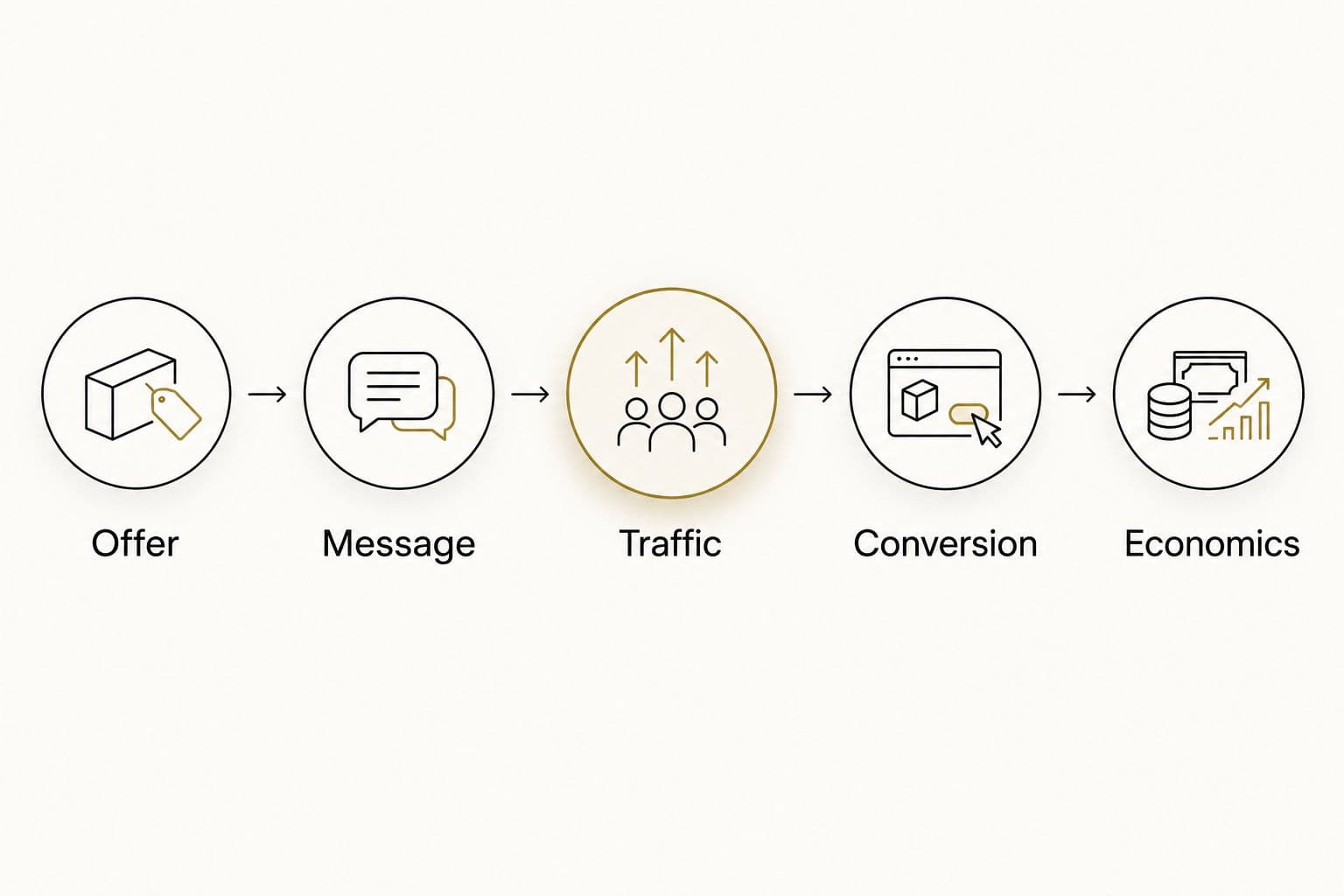
Review the full acquisition journey before deciding to increase spending.
Compare paid media options for your coaching business
Choose channels and management support separately. Google Search and Meta are advertising options; in-house management and a growth partner are ways to operate them. You can use the same channel under either operating model.
| Option | Best for | Main advantage | Key limitation |
|---|---|---|---|
| Google Search advertising | Coaches with clearly expressed service demand | Reaches people searching for a relevant service | Informational searches need separating from hiring intent |
| Meta advertising | Coaches who need to explain their approach | Supports visual demonstrations and educational creative | Engagement does not establish purchase readiness |
| In-house management | Teams with execution time and measurement skills | Keeps campaign decisions close to sales feedback | Requires ownership across creative, tracking and follow-up |
| The fVnnel | Established businesses with connected growth problems | Combines strategy, acquisition, creative, conversion and tracking | Broader scope than a business needing only isolated campaign maintenance |
Before selecting outside support, identify which decisions you need help making. Channel operation alone does not resolve an unclear offer, a confusing booking page or missing enrollment records. Equally, do not buy a wider engagement when a narrow repair addresses the constraint.
Common mistakes health and nutrition coaches make
Optimizing for the cheapest inquiry
A low inquiry cost is useful only when those inquiries become suitable, profitable clients. Compare campaigns through qualification, attendance and enrollment. Stop rewarding advertisements that generate volume your team cannot convert.
Treating health claims as a creative shortcut
Dramatic claims create expectations your service must support. Review the advertisement, testimonial and landing page as one message, and remove claims you cannot substantiate. Explain your coaching process instead of making a stronger promise.
Sending every prospect through the same journey
Individual coaching, group coaching and memberships involve different commitments. Match the next step to the offer rather than forcing every visitor to book a consultation. A consultation should serve a real qualification or decision-making purpose.
Scaling beyond coaching capacity
Advertising decisions affect delivery. Before increasing acquisition, confirm who will onboard clients, provide support and deliver sessions. Use actual team capacity rather than assuming future hiring will solve the problem.
Reading ROAS as profit
ROAS does not deduct every cost of serving or acquiring a client. Review refunds, delivery costs and the timing of collected revenue alongside platform reporting. Kidney Coach’s roughly 45% profit increase is a separate result from its ROAS improvement, not another way to express it.
FAQ
What is the best paid media channel for health and nutrition coaches?
The best channel depends on how your qualified clients make buying decisions. Google Search fits expressed service intent; Meta fits explaining a coaching approach before someone searches for it. Choose using customer evidence and acquisition economics.
How much should a nutrition coach spend on advertising?
Set advertising spend from your acquisition ceiling, cash flow and delivery capacity. Calculate what collected revenue leaves after delivery costs and required profit, then determine what you can commit to acquiring clients.
Are Meta ads better than Google ads for health coaching?
Neither channel is universally better for health coaching. Meta supports discovery and explanation, while Google Search reaches expressed search intent. Compare paying-client outcomes rather than click or inquiry costs alone.
Can I run coaching advertisements without a complicated marketing system?
Yes, you can start with a clear landing page, a working inquiry process and a spreadsheet connecting spend to enrollments. Add systems when a specific reporting or operational problem requires them.
What should a health coaching landing page include?
A health coaching landing page should explain who the service serves, how coaching works, what participation requires and what happens next. Keep its claims consistent with the advertisement and separate marketing qualification from sensitive health intake.
How do I know whether paid media is profitable?
Compare collected client revenue with advertising, acquisition and delivery costs using clearly defined calculations. Platform ROAS alone does not establish profit, and projected renewals should not substitute for documented customer behavior.
When should an established coach hire a growth partner?
Hire a growth partner when the constraint spans connected areas your team cannot manage effectively together. Examples include advertising that attracts the wrong expectations, landing pages that lose qualified visitors, and tracking that cannot connect campaigns to enrollments.
One last thing
Before approving your next 2026 budget increase, review the inquiries that did not become clients. Sort them by fit, booking, attendance and enrollment. The stage where suitable prospects stop progressing tells you where to investigate first.
Your next growth move might be a better handoff, not another advertisement. Make that decision from customer records, not from the lowest cost per lead on your dashboard.