
Online fitness coaches’ Meta advertising is paid promotion on Facebook and Instagram with the aim of acquiring profitable coaching clients. This 2026 guide shows you how to connect your offer, creative, sales process and measurement when your business already has demand but paid growth is not translating into enough profit.
TL;DR
- Meta ads for online fitness coaches should optimize for paying clients, not inexpensive inquiries.
- The fVnnel suits established coaching businesses that need paid acquisition, conversion and tracking managed together.
- Choose lead generation or direct enrollment around how clients actually buy your coaching.
- Measure customer acquisition cost and collected revenue before increasing ad spend.
A personal coaching relationship requires more trust than a casual purchase. Prospects need to understand your method, the support they receive and whether the commitment fits their lives before they enroll.
The fVnnel is best for established coaching businesses that need paid acquisition, conversion and tracking managed as one system. An integrated growth partner is not a substitute for proving that customers want your offer.
Why Meta ads matter for online fitness coaches
Meta ads give online fitness coaches a way to put an established offer in front of prospective clients beyond their existing audience. But attention is not the business outcome. A campaign must bring in clients whose revenue supports acquisition, coaching delivery and profit.
Your constraints are specific: consultation availability, coach capacity, client suitability and the time required to build trust. An ad account can report more leads while your calendar fills with people who cannot commit to your service.
Your 2026 objective is profitable enrollment, not the lowest cost per lead. A lead is an inquiry; a client is someone who has purchased. Keep those definitions separate in every report.
The fVnnel’s supplied Kidney Coach results show why economics matter: return on ad spend increased from 1.33 to over 3.8, profit rose roughly 45%, and ad spend fell nearly 40%. Return on ad spend, or ROAS, measures attributed revenue against advertising spend. These are Kidney Coach results, not an online fitness coaching benchmark or a promised outcome.
How to build a profitable acquisition system
Set acquisition limits
Start with your own payment records and delivery costs. A spreadsheet is enough to establish what you collect from a new client, what it costs to serve that client and how much contribution you need to retain after advertising.
Customer acquisition cost, or CAC, is acquisition spending divided by new paying clients. State whether your calculation includes only media spend or also creative, management and sales costs. Mixing definitions makes campaign comparisons unreliable.
Use collected revenue rather than the full value of a payment plan when assessing immediate cash flow. A signed agreement does not put every future installment in your bank account.
Set your acquisition limit before choosing a daily budget. Otherwise, campaign spending becomes detached from the economics of your coaching business.
- Separate collected revenue from contracted revenue.
- Include coaching delivery and payment-processing costs in your economics.
- Define an acceptable acquisition cost and a cash-recovery period.
- Record how many additional clients your team can serve properly.
Define qualified clients
Review recent sales conversations manually. Identify what made a prospect suitable: their goals, readiness to participate, preferred support and ability to commit to the program. Use that information to define a qualified inquiry without collecting unnecessary sensitive information.
Then choose the buying path. A consultation suits an offer that needs explanation and mutual assessment. Direct enrollment suits an offer customers already understand and can evaluate without a sales call.
A downloadable guide can start a relationship, but downloading does not establish purchase intent. Treat educational inquiries separately from people requesting coaching.
We connect positioning, paid acquisition and conversion work at The fVnnel. That approach suits an established business with a broken handoff between stages; it does not remove the owner’s responsibility to define a suitable client.
- Write down the characteristics of a suitable coaching client.
- Explain the required participation before someone books a call.
- Ask qualification questions relevant to service fit.
- Separate educational subscribers from enrollment-ready prospects.
Build the message
Start with the questions prospective clients ask before buying. Turn each recurring question into an ad concept: how coaching works, what accountability looks like, how sessions fit into a working week or what happens after enrollment.
You can record clear explanations yourself before commissioning production. Show your process rather than relying on dramatic promises. A useful ad gives someone a reason to investigate your service and sets an expectation the landing page can meet.
For your 2026 creative plan, distinguish a new message from a cosmetic variation. Changing a background does not test a different reason to buy. Keep a record of the promise, audience context and destination behind each concept.
Our guide to Meta ads creative tools covers production options. Tools support execution; they cannot decide which customer problem your offer should address.
- Explain a specific part of your coaching process.
- Use substantiated testimonials with permission and appropriate context.
- Avoid copy that asserts a viewer’s health condition or personal attributes.
- Match every ad’s promise to the destination page.
Connect the journey
Walk through the complete enrollment process on your phone before sending paid traffic. Submit the form, read the confirmation, book a consultation and check every message that follows. This manual test exposes problems an ad dashboard cannot explain.
The destination needs to answer practical questions: who the coaching serves, what support includes, what participation requires and what happens next. Keep the main action clear. Competing invitations to subscribe, download and book make the intended path harder to follow.
Response handling belongs in the campaign plan. Assign responsibility for new inquiries and make the next step explicit. An unanswered request is a sales-process problem, not evidence that the audience targeting failed.
Keep the promise consistent from the first ad through the sales conversation. Use this sequence to find the first point where expectations or information break down.
- Ad promise: state the reason to investigate your coaching.
- Landing page: explain the offer and intended client.
- Qualification: establish whether the service fits.
- Sales conversation: resolve questions without changing the promise.
- Enrollment: confirm the commitment and next steps.
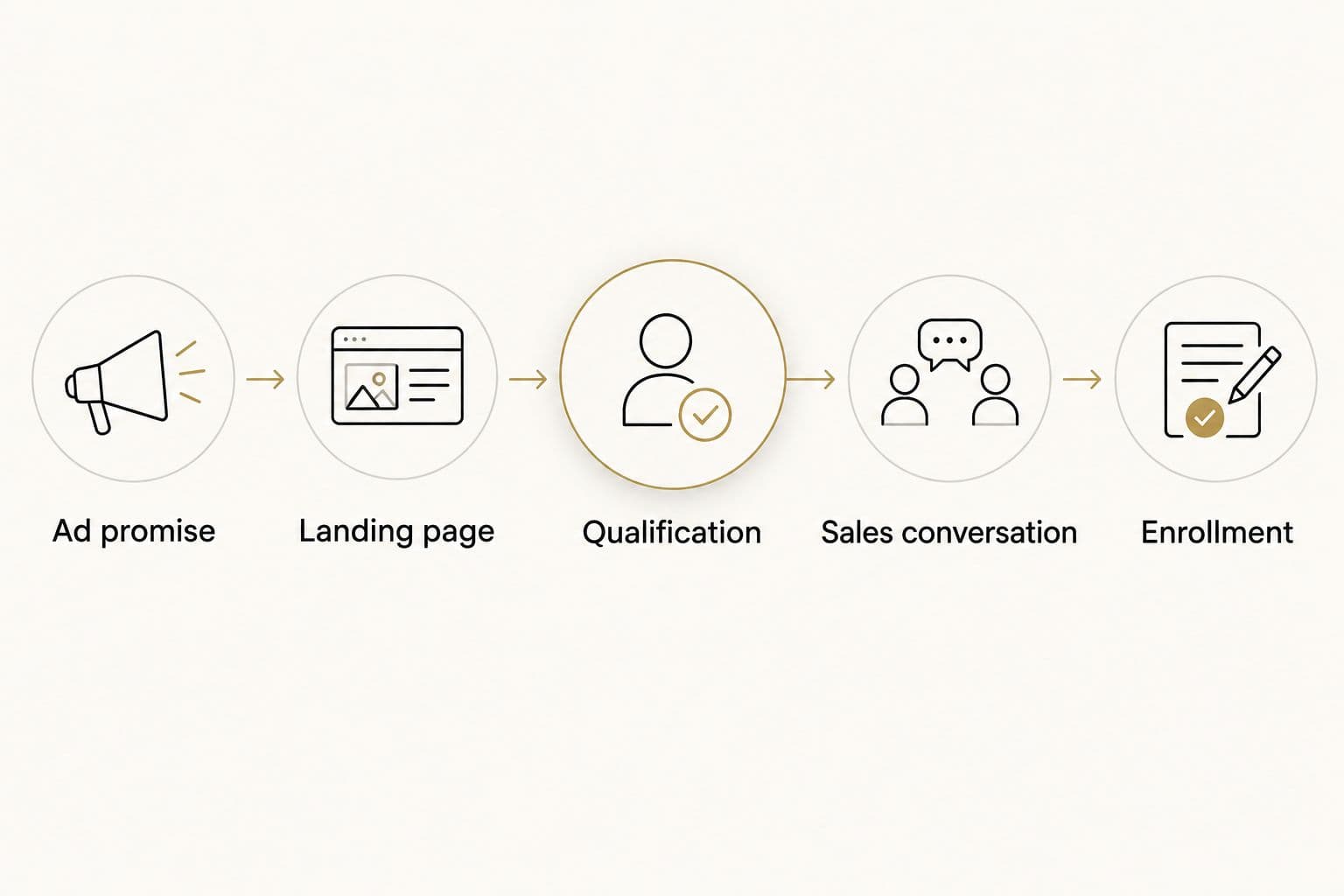
Find the first broken handoff before increasing traffic.
Measure paying clients
Start with a shared spreadsheet that joins campaign sources to inquiries, qualified prospects, consultations, enrollments and collected revenue. A customer relationship management system, or CRM, can organize this process once manual updates become difficult to maintain.
Meta’s reporting and your payment records answer different questions. Platform attribution assigns credit to advertising interactions under its reporting rules. Your payment records establish what customers actually paid. Use both, but do not expect them to be interchangeable.
For 2026 reporting, compare leads acquired during the same period after allowing them time to progress through your normal sales process. Comparing fresh inquiries with mature sales records distorts the result.
Keep health details out of advertising event data. Review what forms, page addresses and connected systems transmit, and follow applicable privacy requirements and Meta’s current terms.
- Record campaign source alongside the customer record.
- Distinguish a submitted form from a qualified inquiry.
- Track attended consultations separately from bookings.
- Reconcile new paying clients with collected revenue.
- Review tracking whenever forms or enrollment systems change.
Scale within capacity
Increase investment only when the acquisition economics and delivery capacity support it. More clients are not useful if onboarding slows, coaching quality drops or cash collection cannot support the additional spending.
Begin with a manual decision log. Record what changed, why you changed it and which business result will determine whether the change worked. This prevents simultaneous edits from making the outcome impossible to interpret.
The fVnnel’s growth work connects paid acquisition with positioning, performance creative, websites and tracking. The advantage is coordinated decisions across those functions; the limitation is that effective coordination still requires access to your business economics and timely input from your team.
Scale the working enrollment system, not an isolated ad. If lead volume rises but qualified enrollment does not, identify the failed stage before buying more traffic.
- Check available coaching and onboarding capacity.
- Review acquisition cost against collected revenue.
- Change a clearly defined variable and document it.
- Inspect lead quality before blaming the sales team.
- Revisit creative when its message no longer matches the offer.
Compare ways to manage Meta ads
Choose an operating model around the work you cannot currently manage well. The best option is the one that addresses that constraint, not the one with the longest service list.
| Option | Best for | Main advantage | Key limitation |
|---|---|---|---|
| Owner-managed campaigns | Coaches who understand their economics and can manage execution | Direct access to customer conversations and business decisions | Campaign work competes with coaching and sales time |
| Paid-media freelancer | Businesses with a working offer, sales journey and measurement | Dedicated attention to campaign execution | Responsibilities outside the ad account need separate ownership |
| Integrated growth partner | Established businesses with problems across acquisition and conversion | Coordinated decisions across messaging, media, pages and tracking | Requires broader business access and active collaboration |
Owner-managed campaigns are a valid starting point when you have the time and the sales process already works. A paid-media specialist fits a narrower execution gap. An integrated partner fits a cross-functional problem, but is unnecessary if your only constraint is a well-defined campaign task.
Common mistakes online fitness coaches make
Optimizing for inquiries instead of enrollment
An inexpensive form submission is not a profitable client. Compare qualified inquiries, attended consultations and paid enrollments by campaign before declaring a winner. Keep low-intent educational leads out of the same success category as coaching applications.
Advertising an outcome without explaining the work
A prospect needs to understand the coaching relationship, not just the desired result. Explain participation, support and responsibilities. Unrealistic expectations create a mismatch that persuasive ad copy cannot fix after enrollment.
Copying targeting instead of clarifying the offer
Another coach’s audience setup does not explain why their clients buy. Review your own sales conversations first. If prospects misunderstand your service, fix the message and destination before treating targeting as the answer.
Counting future installments as available cash
Contracted revenue and collected cash are different. Base immediate spending decisions on your actual collection pattern and obligations. Otherwise, apparent campaign success can leave too little cash to fund delivery.
Scaling past delivery capacity
A full calendar can conceal a service problem. Check onboarding, check-ins and coach availability before expanding acquisition. Your advertising promise must remain deliverable as enrollment grows.
FAQ
Do Meta ads work for online fitness coaches?
Meta ads can acquire coaching clients when the offer, buying journey and acquisition economics work together. Judge performance by qualified enrollment and collected revenue, not lead volume alone.
Should I use a lead form or send people to my website?
Choose the route that gives prospects enough information to take a qualified next step. A lead form simplifies the inquiry, while a website gives you more room to explain the coaching offer; both need follow-up and measurement.
What budget should an established fitness coach use?
Set your budget from acceptable acquisition cost, available cash and delivery capacity. There is no universal spending figure that establishes whether your coaching business can acquire clients profitably.
Should I optimize for leads or purchases?
Choose an optimization event that matches the buying journey and that you can measure accurately. A consultation-led service must connect inquiry reporting to downstream enrollment; a direct-enrollment offer should track completed purchases.
Can fitness ads mention weight loss or health concerns?
Fitness ads must comply with Meta’s current advertising standards, including restrictions involving personal attributes and health-related content. Describe the service without asserting that the viewer has a particular condition, and substantiate any outcome claims.
How do I know whether my ads or sales process are failing?
Compare each stage from inquiry to paid enrollment. A drop in qualified inquiries points to a different problem from strong qualification followed by missed consultations or weak enrollment.
Should I hire an agency before testing my coaching offer?
Establish real customer demand before hiring an integrated growth partner. The fVnnel serves established businesses that have an offer customers want and the resources to invest in growth, not businesses still validating demand.
One last thing
Before increasing your 2026 budget, trace a recent paying client backward from payment to the first recorded interaction. Then trace an inquiry that did not enroll. Compare where expectations, information or follow-up diverged.
That exercise gives your next campaign decision a business question to answer. Fix the first measurable constraint before paying to send more people through it.