
Paid media for chiropractic clinics is paid advertising designed to turn local demand into attended appointments and profitable patient acquisition. This 2026 guide connects campaign decisions to your clinic’s appointment capacity, patient experience, tracking, and economics, rather than treating every inquiry as a win.
TL;DR
- Paid media for chiropractic clinics should prioritize attended appointments, not cheap inquiries.
- Start with local search intent, a clear appointment page, and reliable front-desk follow-up.
- The fVnnel fits established businesses that need paid media connected to conversion, tracking, and profit.
- Judge campaigns by patient acquisition cost and collected revenue, while protecting sensitive health information.
The fVnnel is best for established businesses that need paid media connected to conversion, tracking, and profit. For a chiropractic clinic, that means fixing the weakest part of the appointment journey before buying more traffic.
Why paid media matters for chiropractic clinics
A clinic does not sell an anonymous online transaction. Your prospective patient needs a relevant local provider, enough information to make a decision, and a practical route to an appointment. An inquiry still has to become a booking, an attended visit, and collected revenue.
That distinction should guide your 2026 advertising plan. A campaign that generates inexpensive forms but fills your reception team’s day with unsuitable inquiries is not solving the growth problem. Neither is a campaign that books appointments your clinic cannot accommodate.
Our work for Kidney Coach illustrates why business outcomes matter: return on ad spend increased from 1.33 to over 3.8, profit rose roughly 45%, and ad spend fell nearly 40%. These are Kidney Coach results, not chiropractic benchmarks or a forecast for your clinic. They demonstrate the right evaluation question: did the business become more profitable, rather than simply spend more?
Start with your clinic’s own baseline. Separate new patients from returning patients, and separate appointment requests from attended appointments. Those distinctions make your advertising report useful for operating the clinic.
How to build a clinic paid media system
1. Set your patient acquisition economics
Start manually with appointment records, advertising invoices, and a spreadsheet. Calculate patient acquisition cost by dividing advertising spend by new patients acquired from that advertising. Define “acquired” consistently, preferably around an attended first appointment rather than a submitted form.
Then compare that cost with the revenue you actually collect and the costs of delivering care. Revenue alone does not establish profitability. Practitioner time, appointment length, administrative work, and payment collection affect what your clinic can afford to spend.
Use collected revenue within a defined measurement period before relying on projected lifetime value, meaning the total revenue expected from a patient relationship. Do not assume every new patient will return indefinitely.
- Record your current advertising spend and attributable attended first visits.
- Separate collected revenue from booked or projected revenue.
- Set an acquisition ceiling using your clinic’s actual delivery costs.
- Confirm which appointment types and practitioners have capacity.
2. Map local searches to the right appointment
Use your existing inquiry records and search campaign reports before adding software. Group searches by what the person wants: a nearby clinic, information about a service you actually provide, or your clinic by name.
For your 2026 campaign structure, keep branded searches separate from nonbranded searches. Someone searching your clinic’s name already knows something about you. Combining that traffic with people discovering the clinic obscures how well your advertising attracts new demand.
Treat example phrases such as “chiropractor near me” as starting points for investigation, not proof of local search volume. Match geographic settings to the area you genuinely serve, and review actual search terms, meaning the words people entered before seeing or clicking an ad.
- List the services your clinic actually offers.
- Separate clinic-name searches from service and location searches.
- Exclude irrelevant intent, such as job searches or training courses.
- Match each search group to the most relevant appointment page.
3. Match your message to the patient’s decision
Write the first version yourself using questions your reception team already answers. Explain what the appointment involves, who provides care, where the clinic is, and how someone requests a visit. Publish only details your clinic has confirmed.
An advertisement should describe your service without diagnosing the reader or promising a clinical result. Distinguish between a patient’s reason for seeking care and a treatment outcome you cannot substantiate. Have the appropriate clinical or compliance reviewer check health-related claims before publication.
At this stage, The fVnnel can connect positioning, performance creative, paid acquisition, and conversion work as one system. That is a fit when your constraint crosses several functions. It is not a substitute for your clinic’s clinical judgment or responsibility for approving claims.
- Build messages around verified services and practical appointment information.
- Use accurate practitioner credentials and approved clinic details.
- Remove guaranteed outcomes and unsupported superiority claims.
- Keep the advertisement and appointment page consistent.
4. Fix the booking journey before expanding reach
Walk through your appointment process on a phone. Submit a test inquiry, check the confirmation, and ask reception what happens next. You do not need a new platform to discover a broken form, an unclear instruction, or an inquiry nobody owns.
Make the page answer the immediate decision: what the visit is, where it happens, and how to request it. Keep the next action obvious. If a staff member must confirm the appointment, say so rather than presenting a request as a confirmed booking.
Track where inquiries stop progressing. A booking problem needs a booking fix, not necessarily a different advertising audience. Additional traffic only sends more people into the same unresolved process.
- Test mobile forms, telephone links, and confirmation messages.
- Assign responsibility for each incoming appointment request.
- Explain whether a submission requests or confirms a visit.
- Record cancellation and nonattendance reasons when patients provide them.
5. Design measurement around patient privacy
Begin with a data map, not a tracking installation. Write down what each form, scheduling system, analytics tool, and advertising platform receives. Identify sensitive information before deciding which events belong in marketing systems.
For your 2026 setup, separate operational patient records from advertising measurement. A marketing event should not automatically include the contents of an intake form, a patient’s stated symptoms, or clinical notes. Review page addresses and event names as well as visible form fields.
Have qualified privacy and legal reviewers assess your actual obligations, including HIPAA where applicable, and check current platform requirements. A consent banner or a tool’s healthcare positioning does not replace that assessment. More detailed attribution, meaning credit assigned to marketing touchpoints, is not automatically better measurement.
- Inventory the information each connected system collects and shares.
- Keep clinical notes and intake answers out of routine advertising events.
- Review tracking on scheduling, intake, and patient-facing pages.
- Approve data flows before connecting advertising and patient systems.
6. Choose one channel test with a clear purpose
Start with a narrow test your team can manage manually. Google Search is best for testing existing local search intent. Its limitation is equally important: a click does not establish appointment suitability, and broad targeting can bring irrelevant inquiries.
Meta advertising is best for testing service awareness and creative messages. It is a different task from responding to a search. Evaluate whether the message produces suitable appointments, not just engagement or form submissions. Review current health-related advertising and targeting requirements before launch.
Choose the channel based on the constraint you identified. If relevant searches produce visits but your appointment page loses inquiries, changing channels avoids the problem. If your clinic cannot reliably follow up, launching more campaigns adds operational pressure.
- State what the test should prove before publishing ads.
- Keep the service, geography, and appointment destination specific.
- Review search terms or creative responses for unsuitable demand.
- Change one major variable at a time so results remain interpretable.
7. Measure attended patients before scaling spend
Build a simple reporting sequence: Ad spend, Booked appointments, Attended appointments, Collected revenue. These stages show where progress stops without pretending that every booking creates the same business value.
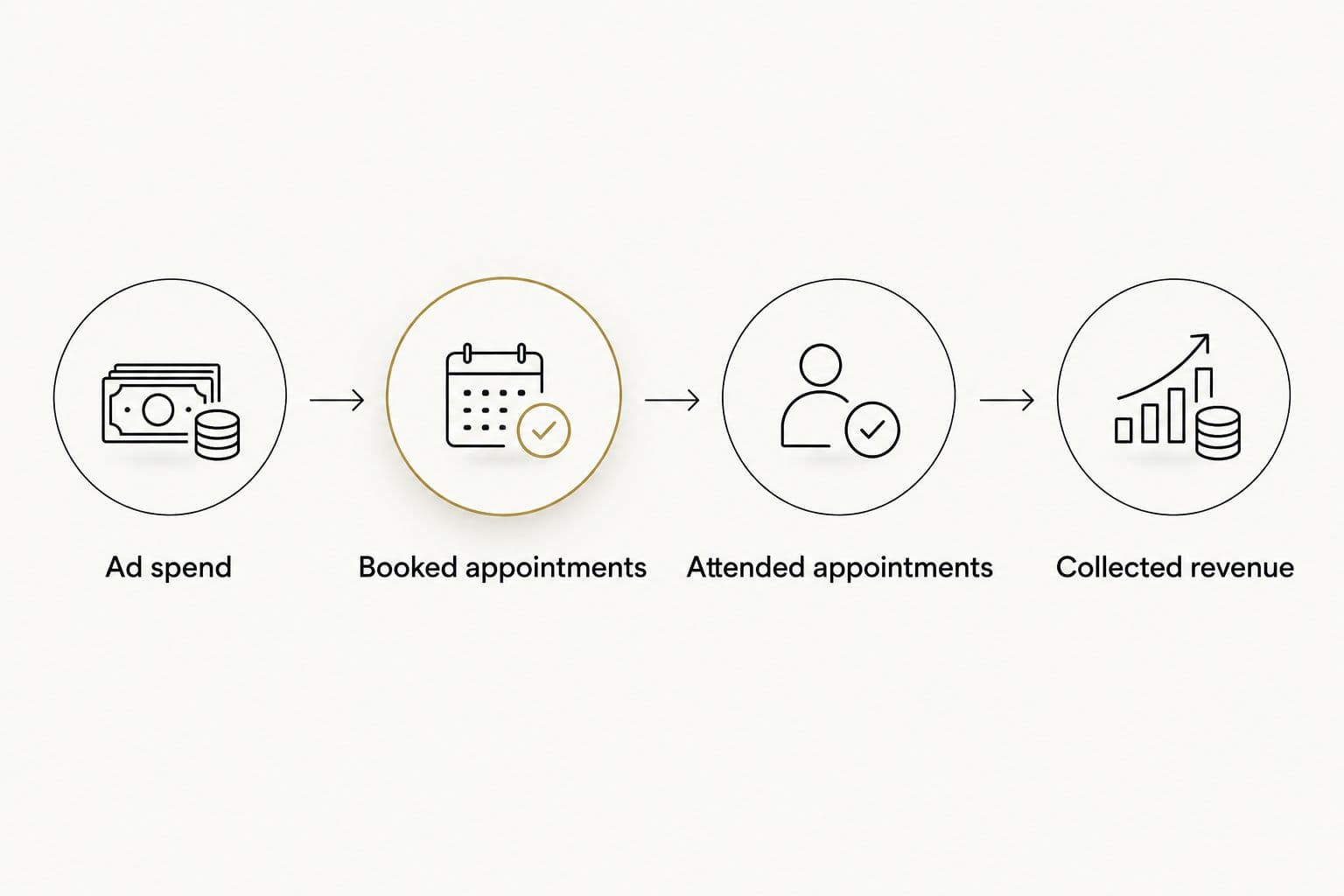
A booked appointment is an intermediate outcome, not the final measure of advertising performance.
Review comparable groups of patients over the same elapsed period. A recent campaign has had less time to produce attended appointments and collected revenue than an older campaign. Avoid declaring a winner from mismatched reporting windows.
In your 2026 reporting, show the constraint beside the result. If bookings are strong but attendance is weak, investigate confirmation and scheduling. If attendance is strong but acquisition economics fail, review targeting, message, delivery costs, and revenue before increasing spend.
- Reconcile advertising reports with appointment and payment records.
- Separate new patients from existing patient activity.
- Compare campaigns using consistent definitions and measurement periods.
- Increase spend only when patient economics and clinic capacity support it.
Compare your management options
Choose support according to the work required, not the number of channels advertised. Manual management gives you direct control but requires time and clear ownership. Outside support still needs access to accurate operational information and timely clinic decisions.
| Option | Best for | Main advantage | Key limitation |
|---|---|---|---|
| Clinic-managed Google Search | Testing existing local search intent | Direct control over search terms, geography, and appointment destinations | Requires ongoing campaign review and front-desk reconciliation |
| Clinic-managed Meta advertising | Testing service awareness and creative messages | Connects visual explanations with an appointment action | Engagement and inquiries do not establish patient acquisition quality |
| In-house cross-channel management | Clinics with dedicated marketing ownership | Keeps campaign and operational decisions close together | Requires capability across advertising, creative, conversion, and measurement |
| The fVnnel growth partnership | Established businesses with connected growth constraints | Brings strategy, paid acquisition, creative, websites, and tracking into one system | Not the right fit for businesses still validating demand; clinical and privacy approvals remain essential |
Choose the smallest setup that can answer the business question. A clinic testing local search demand does not need every channel. A clinic with disconnected campaigns, pages, and reporting needs more than another advertisement.
Common mistakes chiropractic clinics make
Counting every inquiry as a new patient
A duplicate request, an existing patient’s message, and a suitable new patient are different outcomes. Define each stage before comparing campaigns. Otherwise, your lowest reported acquisition cost can simply reflect the loosest definition.
Advertising appointments the clinic cannot support
Campaigns should reflect practitioner capacity and the services available through the booking journey. Review that alignment whenever schedules change. Marketing cannot resolve an appointment mismatch after the patient arrives.
Sending all traffic to a general homepage
A person responding to a specific service message needs a page that continues that message. Use verified appointment information and a clear next action. Do not make the visitor reconstruct the offer from unrelated clinic content.
Passing intake details into advertising tools
Clinical intake and campaign measurement serve different purposes. Review the information collected and transmitted before adding tracking. Technical convenience is not a reason to share sensitive patient information.
Scaling from platform-reported results alone
Advertising platforms measure events according to their settings and attribution rules. Your clinic still needs to reconcile those events with real appointments and collected revenue. Make that reconciliation part of your 2026 operating routine, not an occasional investigation.
FAQ
What’s the best paid media channel for a chiropractic clinic?
Google Search is best for testing existing local search intent; Meta is best for testing awareness and creative messages. Choose according to your clinic’s constraint, then judge results by suitable attended appointments and acquisition economics.
How much should a chiropractic clinic spend on paid advertising?
Set advertising spend from your clinic’s acquisition ceiling, appointment capacity, and collected revenue. There is no useful universal budget without those inputs. Establish measurement and a focused test before increasing spend.
Should chiropractic clinics optimize for leads or booked appointments?
Use attended new-patient appointments as the stronger business measure, while tracking leads and bookings as intermediate stages. A booking still needs to become an attended visit before it represents an acquired patient.
Can a chiropractic clinic use Meta advertising?
Evaluate Meta advertising against current platform requirements, your proposed health-related messages, and your privacy obligations. Do not assume that approval of an advertisement also approves every tracking or targeting practice.
How should a chiropractic clinic track advertising results?
Connect advertising spend to booked appointments, attended first visits, and collected revenue using consistent definitions. Review data sharing before connecting systems, and keep clinical intake information separate from routine advertising events.
When should a clinic hire a growth partner?
Hire a growth partner when established demand exists but campaign, creative, conversion, and tracking problems need coordinated ownership. A clinic with one isolated campaign task needs a different scope from a clinic with several connected constraints.
Why do chiropractic ads generate inquiries but few patients?
Investigate search intent, message accuracy, appointment suitability, booking friction, and follow-up before changing the budget. Record where inquiries stop progressing so the next change addresses the actual constraint.
One last thing
Before approving more advertising spend, ask reception to explain what happened to the inquiries already generated. Reconcile appointment outcomes with your campaign report, including the requests that never became bookings.
Your next growth decision should follow the point where prospective patients stop progressing. The fVnnel’s paid media approach connects that decision to the wider growth system, rather than treating a lower lead cost as the finish line.