
Medical spa paid media is paid advertising designed to turn local treatment demand into attended consultations and profitable customers. This guide to paid media for medical spas explains how to connect advertising, patient intake, booking and measurement without treating a cheap inquiry as a business result.
TL;DR
- Paid media for medical spas should optimize for attended consultations and profitable customers, not cheap inquiries.
- Google Search fits existing treatment demand; Meta fits visual education, subject to advertising restrictions.
- The fVnnel is best for established businesses seeking paid acquisition connected to conversion and tracking.
- Keep sensitive treatment information out of advertising tracking and audience uploads.
Medical spa advertising has a specific challenge: an inquiry is not a treatment decision. Your campaign must explain the service accurately, reach people within your service area and support a booking process that leaves clinical suitability to qualified practitioners.
The fVnnel is best for established businesses that need paid media connected to positioning, conversion and tracking. The The fVnnel growth-partner model covers those functions as one system, rather than treating media buying as an isolated task.
Why paid media matters for medical spas
An established medical spa needs more than additional form submissions. It needs inquiries for treatments it can deliver, appointment slots it can fulfill and customers whose contribution supports the acquisition spend.
That makes the booking process part of the advertising strategy. A campaign promoting consultations cannot succeed commercially if the front desk cannot reach the people who respond, or if the advertised service does not match what the consultation delivers.
For your 2026 plan, separate the problem into three questions: are you reaching suitable prospective customers, are they booking, and are those bookings producing profitable business? Each question needs a different fix. More advertising cannot repair all three.
Build your medical spa paid media plan
Define the business outcome before buying traffic
Start with your appointment records and a spreadsheet. Separate inquiries, booked consultations, attended consultations and new customers so you can see where the process loses people.
Define customer acquisition cost as the acquisition spend included in your calculation divided by new customers acquired. State whether that spend includes media alone or also includes creative and management. Otherwise, two reports can show different numbers while both appear correct.
Use contribution after treatment delivery costs to judge what the business can afford to spend. Revenue alone leaves out practitioner time, consumables and other costs associated with delivering the service. Keep projected repeat visits separate from contribution already earned.
Set your acquisition ceiling from your business economics, not another clinic’s advertising results. A treatment with strong demand can still be a poor campaign choice if the business cannot deliver it profitably.
- Define an inquiry, a booking and a new customer separately.
- Record attended appointments, not just scheduled appointments.
- Document which costs your acquisition calculation includes.
- Separate realized contribution from expected repeat business.
- Assign an owner to update the numbers consistently.
Choose a treatment and a specific booking action
Review your service menu manually before writing ads. Choose a treatment with demonstrated demand in your business, a clear explanation and enough operational capacity to accept additional consultations.
Avoid combining unrelated treatments into one message. Someone researching skin resurfacing needs different information from someone exploring an injectable treatment. The ad and destination page should answer the same question, without promising a clinical outcome.
For a 2026 campaign brief, specify the intended audience, service area, treatment, next action and evidence you can substantiate. Include the reasons an inquiry should not proceed, such as a service you do not provide or a location you cannot serve.
The fVnnel’s paid media approach connects positioning, creative and conversion. That is the managed path when those decisions need coordination across your team; it does not replace your clinical team’s responsibility for treatment information.
- Select a treatment with existing demand in your records.
- Confirm appointment capacity before promoting the service.
- Give each campaign a clear booking action.
- Match ad language to the destination page.
- Have qualified staff review treatment claims.
Match the channel to the customer’s intent
Start by reviewing how existing customers found you and what they asked before booking. Use those conversations to distinguish active treatment searches from earlier-stage research.
Google Search is best for reaching people expressing a relevant search intent. Its strength is the query itself: you can organize campaigns around the treatment and location being searched. Its limitation is that relevant searches do not automatically produce suitable or profitable customers.
Meta is best for visual education and introducing a service to prospective customers. The creative must explain the service without implying that you know a viewer’s medical condition or making unsupported claims about appearance or outcomes. Review current platform policies before publishing.
Do not make channel diversification the objective. Add a channel when you can explain its role and measure the next action it should produce. A separate channel with no clear purpose adds reporting work, not a growth strategy.
- Group search campaigns by treatment intent.
- Review search terms for irrelevant inquiries.
- Set geography around the area you actually serve.
- Give educational creative a clear consultation action.
- Review targeting and creative against current policies.
Align the landing page with the consultation
Open your destination page on a phone and complete the booking journey yourself. Check whether the page explains the advertised treatment, identifies the next step and makes the location clear before asking for information.
A landing page, meaning the page an ad sends someone to, should help a prospective customer decide whether to inquire. It should not attempt to make a clinical assessment through promotional copy. Explain the consultation process and leave individual suitability to the practitioner.
Use authentic evidence only with appropriate permission and context. A testimonial or treatment image must not become a guarantee of what another person will experience. Have your clinical and legal advisers assess the claims you intend to publish.
For your 2026 page review, test the confirmation experience too. A completed form needs a clear explanation of what happens next, not an unexplained success message.
- Match the page heading to the advertised treatment.
- Make the clinic’s location easy to find.
- Explain what happens during the consultation process.
- Ask only for information needed at that stage.
- Test form submission and booking confirmation on mobile.
Connect advertising records to appointment outcomes
Start with a restricted-access appointment report and consistent source labels. You need to know whether an inquiry became a booked consultation, an attended consultation and a customer, without exposing unnecessary health information.
A customer relationship management system, or CRM, can organize those stages. A spreadsheet can also establish the process before you invest in additional systems. The essential requirement is consistent definitions and someone responsible for maintaining them.
Treat advertising platforms and clinical records as different systems. Do not place symptoms, treatment histories or other sensitive details in tracking URLs, advertising events or audience uploads. Ask a qualified privacy adviser to review your tracking design, consent requirements and any applicable health-information obligations.
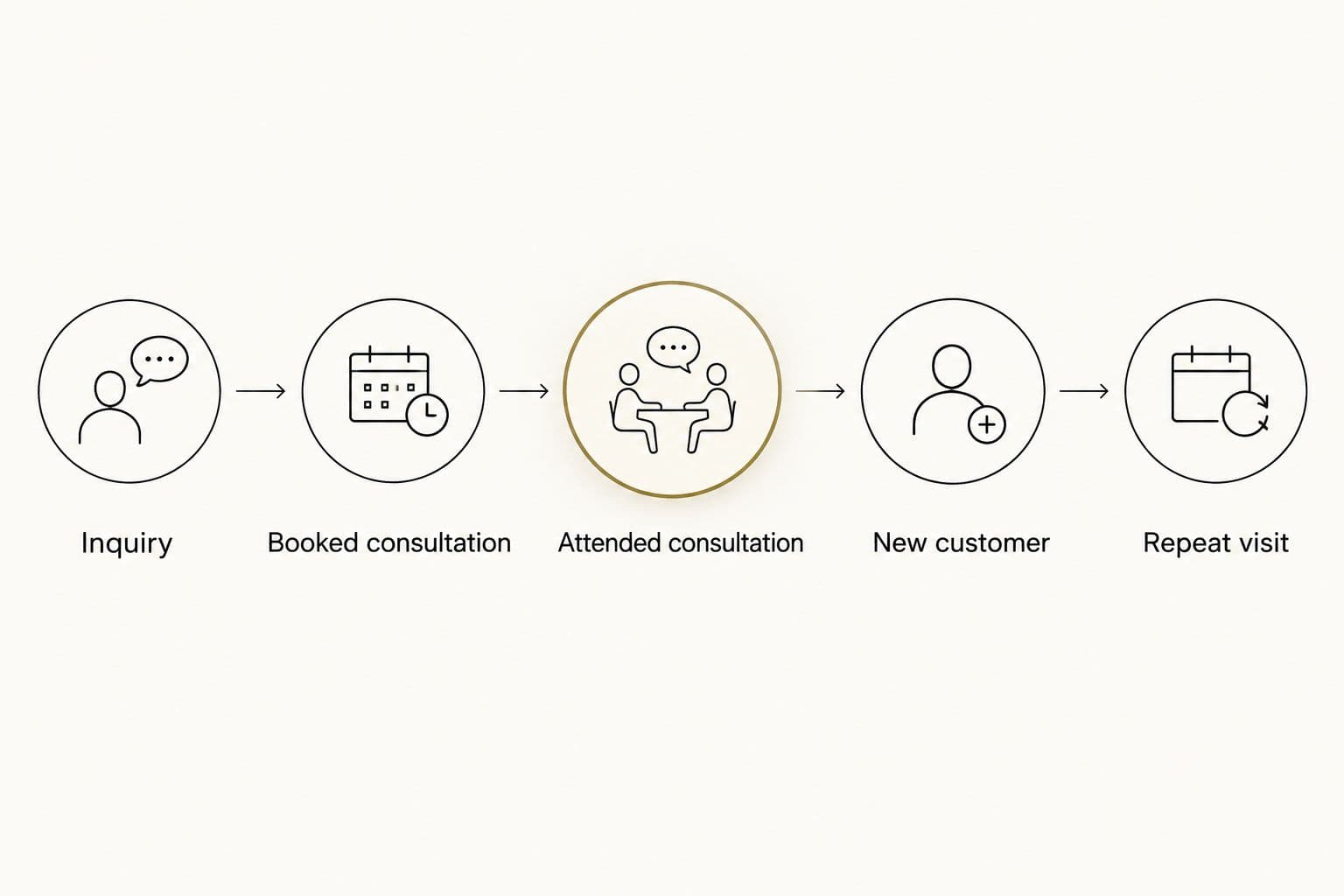
Measure what happens after the inquiry without sending clinical details to advertising platforms.
For 2026 measurement, keep appointment outcomes visible to the people making budget decisions. An advertising dashboard cannot explain the whole business result if its reporting stops at the form submission.
- Use consistent source labels without sensitive details.
- Record Inquiry and Booked consultation as separate stages.
- Distinguish Attended consultation from New customer.
- Track Repeat visit separately from initial acquisition.
- Review access permissions and data-sharing arrangements.
Fix follow-up before increasing spend
Manually inspect unresolved inquiries before changing campaign budgets. Look for failed contact attempts, unanswered questions, booking confusion and appointments that were canceled without a recorded reason.
Agree on who handles each inquiry and how the handoff works when that person is unavailable. A campaign creates an operational obligation: someone must help the prospective customer understand the next step. That conversation should stay within the staff member’s role and avoid clinical promises.
Use automation for approved acknowledgments and administrative reminders, not for unsupervised suitability decisions. Keep sensitive conversations in an appropriate system and confirm the permissions required for email or text follow-up.
A missed appointment also needs diagnosis. Separate people who canceled, people who could not be reached and people who booked again. Combining them into one lost-lead category hides different problems and makes campaign changes harder to justify.
- Assign responsibility for each new inquiry.
- Test telephone, form and booking handoffs.
- Give staff approved answers to administrative questions.
- Record cancellation and nonattendance reasons consistently.
- Review messaging permissions before automating follow-up.
Test the constraint before expanding the channel mix
Use your existing reports to identify the weakest transition. If inquiries arrive but consultations do not get booked, investigate the inquiry quality and follow-up process before buying more traffic.
Change a defined part of the journey and document the decision. That might mean clarifying the ad, simplifying a booking step or correcting the service area. Changing everything together makes it difficult to understand which change mattered.
Programmatic advertising, meaning automated buying of digital ad placements, belongs in this discussion only when it has a defined job. The question behind programmatic advertising for small brands is commercial: does the additional reach produce outcomes that justify the spend? Apply that same test to a medical spa instead of adding another channel to make the plan look complete.
Expand only when the additional spend has a clear purpose, measurable outcomes and operational support. More inquiries are not progress if the business cannot convert or serve them.
- Identify the weakest measurable stage.
- Write a hypothesis before changing the campaign.
- Keep a record of creative and booking changes.
- Compare attended consultations and customers, not clicks alone.
- Confirm capacity before expanding reach.
Compare paid media options for medical spas
These options serve different purposes. Choose the channel based on customer intent, then choose the management approach based on your team’s capacity. Neither decision substitutes for accurate treatment information or a functioning booking process.
| Option | Best for | Main advantage | Key limitation |
|---|---|---|---|
| Google Search | Existing treatment searches | Connects advertising to an expressed query | Relevant queries still require qualification and conversion |
| Meta advertising | Visual education and discovery | Explains a service through creative | Engagement does not establish booking intent |
| Programmatic advertising | A defined reach objective beyond existing campaigns | Adds placement options | Additional reach needs its own commercial justification |
| In-house management | Teams with campaign and measurement ownership | Keeps day-to-day decisions close to operations | Requires staff time across media, creative and reporting |
| The fVnnel paid media support | Established businesses needing connected growth functions | Connects acquisition with positioning, conversion and tracking | Requires internal access, operational ownership and clinical review |
Common mistakes medical spas make
Treating a low inquiry cost as success
A cheap form submission can still produce no attended consultation. Judge campaigns against the appointment and customer stages you defined, not a platform’s most convenient reporting metric.
Advertising treatments without checking capacity
An ad campaign and a practitioner’s schedule must agree. Confirm who can deliver the service and how inquiries will be handled before increasing demand for it.
Using creative that overstates the result
Avoid guarantees, unsupported clinical claims and messaging that assumes a viewer has a particular condition. Review the ad and its destination together because the landing page is part of the claim.
Copying another business’s performance target
Cross-sector results are evidence of a particular engagement, not medical spa benchmarks. Kidney Coach’s return on ad spend moved from 1.33 to over 3.8, with profit up roughly 45% while ad spend fell nearly 40%. Those figures support measuring business outcomes together; they do not establish your clinic’s target.
FAQ
What is paid media for medical spas?
Paid media for medical spas is paid advertising designed to generate relevant inquiries, consultations and customers. A useful plan connects the ad to booking, attendance and business economics rather than stopping at lead volume.
Is Google Search better than Meta for a medical spa?
Google Search is better suited to expressed treatment-search intent, while Meta is better suited to visual education and discovery. Choose based on the campaign’s role and compare appointment outcomes rather than engagement alone.
How should a medical spa set its advertising budget?
Set the budget from treatment contribution, customer acquisition economics and appointment capacity. Separate earned contribution from projected repeat visits so the plan does not depend on revenue the business has not received.
Should medical spa ads send people to the homepage?
Send people to the page that best answers the specific ad and supports its booking action. A treatment-focused page is appropriate when the homepage does not clearly explain that service and the next step.
Can a medical spa use patient information for advertising?
Do not assume patient information is suitable for advertising use. Keep sensitive information out of tracking and audience uploads, and obtain qualified advice on consent, platform policies and applicable privacy obligations.
When should a medical spa increase paid media spend?
Increase spend after you can connect campaigns to suitable inquiries, attended consultations and commercially acceptable customer acquisition. Confirm that staff and practitioner capacity can support the additional demand.
Does a medical spa need an agency to run paid media?
A medical spa can manage paid media internally when someone owns campaigns, creative, measurement and operational follow-up. Agency support fits an established business that needs those functions coordinated, but the clinic still owns clinical decisions and patient care.
One last thing
An unfilled appointment is not automatically an advertising problem. It can reflect the wrong inquiry, an unclear booking process or an operational handoff that failed.
Before approving another 2026 campaign, follow a real inquiry from ad to appointment outcome. Find the point where the next action became unclear. Fixing that point gives your existing spend a better chance to produce business value.
Get in Touch to discuss how your acquisition, conversion and tracking should work together.