
Yoga studio Meta advertising is paid promotion on Facebook and Instagram with the aim of turning local interest into attended classes and profitable memberships. Effective meta ads for yoga studios in 2026 connect the class experience, booking process and follow-up, rather than treating a cheap lead as a new customer.
TL;DR
- Meta ads for yoga studios should optimize for paying members, not the lowest lead cost.
- The fVnnel suits established studios needing paid acquisition, conversion and tracking managed together.
- Match Facebook and Instagram advertising to specific classes, realistic travel distances and a clear booking action.
- Measure bookings, attendance and membership contribution before increasing advertising spend.
Why Meta ads matter for yoga studios
A yoga studio sells a recurring, in-person experience. Your advertising needs to answer practical questions: where the studio is, whether the class fits the student’s experience, and whether the timetable works for them. A persuasive ad cannot compensate for a booking journey that hides those answers.
Meta ads give you a way to show the experience before someone searches for your studio by name. But interest is not attendance. Your acquisition system must connect the ad to an appropriate class, a completed booking and a reason to return.
The fVnnel is best for established businesses that need paid acquisition, conversion and tracking managed as one system. For yoga studio Meta ads, that means assessing the commercial constraint before changing campaign settings.
Keep your 2026 reporting grounded in business outcomes. In the supplied Kidney Coach case, return on ad spend rose from 1.33 to over 3.8, profit increased roughly 45%, and ad spend fell nearly 40%. This is not a yoga studio benchmark; it shows why spend, revenue and profit belong in the same conversation.
How to build Meta ads around profitable studio growth
1. Define the customer and acquisition limit
Start with your booking records and a spreadsheet. Identify which classes attract first-time visitors, which visitors return, and which memberships produce enough contribution to support acquisition. Contribution means revenue left after the relevant costs of delivering the service.
For your 2026 plan, choose a consistent 30-day measurement window for new-student cohorts, meaning groups acquired during the same period. Extend the window when your purchase cycle requires it. Do not compare a recent cohort with one that has had months to renew.
Set the acquisition limit before setting the advertising budget. Base it on observed customer economics, not a competitor’s advertised offer or an assumed lifetime value.
- Separate first-time visitors from existing members in your records.
- Calculate acquisition cost using new paying customers, not inquiries.
- Review class-level delivery costs and contribution.
- Record repeat purchases within the same measurement window.
- Set a maximum acquisition cost your cash flow supports.
2. Choose the booking action that fits the class
Walk through your existing booking process on your phone before buying another tool. A prospective student should understand the class, find a suitable time and complete the booking without guessing what happens next.
Direct booking and inquiry forms serve different purposes. Direct booking fits a clear class offer with an understandable timetable. An inquiry form fits situations where someone needs help choosing a suitable starting point, but it adds a follow-up responsibility.
The fVnnel’s work on Meta ads connects paid acquisition with websites, conversion and tracking. That is the managed route when your team needs these pieces coordinated; it does not remove the need for accurate class information and operational ownership.
- Choose one primary action for each campaign.
- Show the location and class level before the booking action.
- Make the relevant timetable easy to find.
- Confirm what students should expect after booking.
- Assign an owner to every inquiry-based journey.
3. Match the audience to the actual catchment
Use your existing customer records to understand where students come from. Ask recent joiners what made the journey practical and which class times they considered. Build your geographic approach around evidence from your studio, not an arbitrary radius borrowed from another business.
Location is only part of fit. A beginner considering an introductory class needs different information from an experienced student comparing teaching styles. Address those differences in the creative and destination page rather than relying entirely on audience settings.
Start with a clear local proposition before creating more audience segments. Excessive segmentation makes it harder to see whether the message or the audience caused a change in results.
- Map existing customers by neighborhood or postcode.
- Exclude locations your studio does not realistically serve.
- Separate in-person classes from any online offering.
- Match the promoted class to the relevant experience level.
- Review location settings inside the current campaign interface.
4. Show the class experience without personal assumptions
Begin with real footage your team can capture, with permission from everyone identifiable. Show the space, the instructor’s explanation and what a new student can expect. Clarity matters more than making every ad look like a brand film.
Describe the class rather than diagnosing the viewer. For example, explain that a session introduces foundational poses instead of asserting that the person seeing the ad has a health problem. Avoid unsupported claims about pain relief, treatment or guaranteed physical outcomes.
In 2026, treat each creative concept as a question to answer: does showing the instruction, the environment or the first-visit process attract suitable bookings? Change one meaningful idea at a time so the result informs your next decision.
- Show a representative class environment.
- Explain who the class is designed for.
- Put the location and booking action in clear language.
- Use captions so the message works without sound.
- Obtain permission before using student images or testimonials.
5. Remove friction between interest and attendance
Audit the full journey manually before adding automation. Follow an ad through the page, booking, confirmation and arrival instructions. Look for missing information, repeated questions and handoffs where nobody owns the next action.
A booking is not the endpoint. Students still need to know where to go, when to arrive and what to bring. Make those instructions consistent with what the ad promised, and record attendance so you can distinguish booking problems from arrival problems.
Use this sequence to find the stage that needs attention: interest, booking, attendance, membership. Fix the weak transition rather than increasing traffic to the same problem.
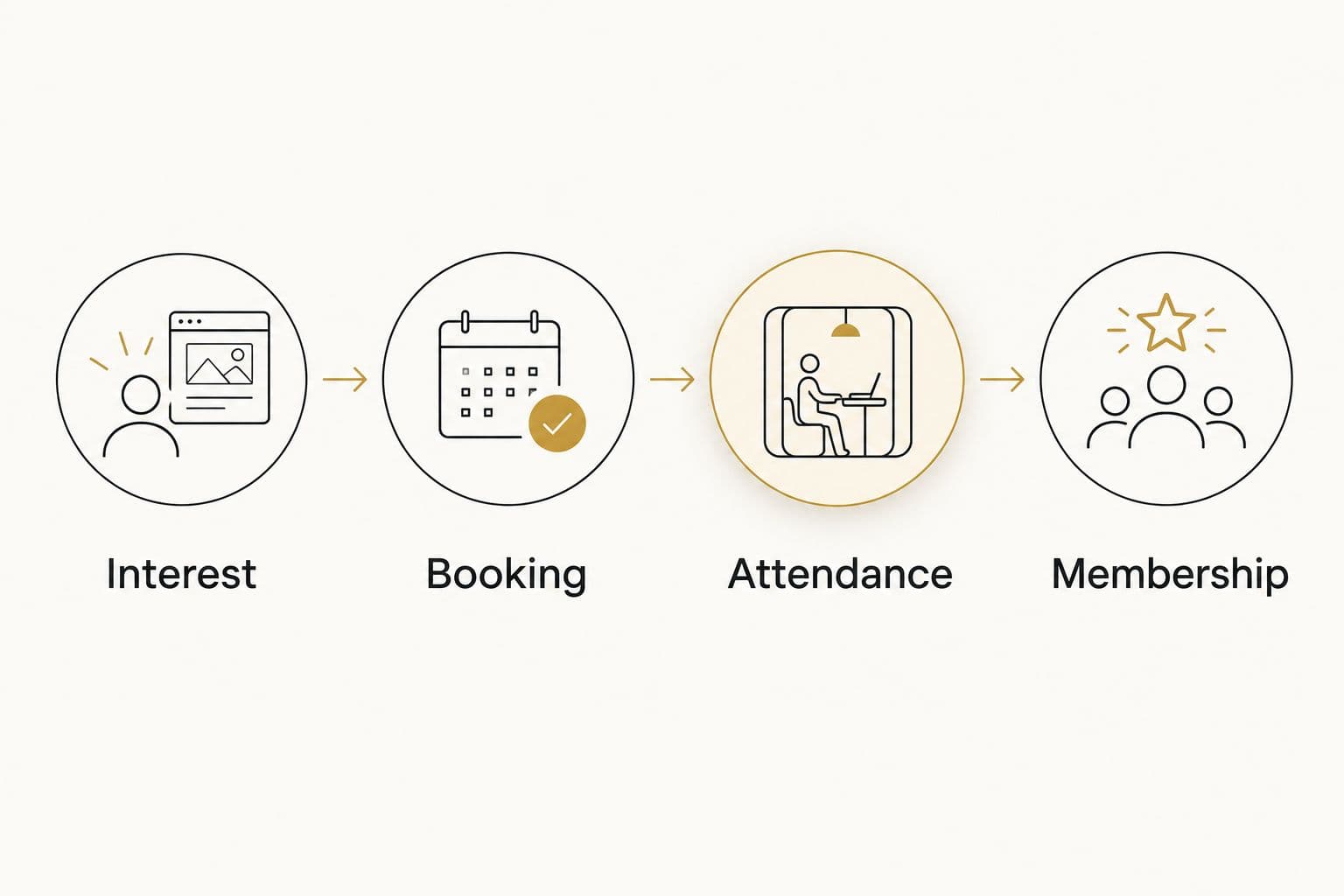
Measure each transition before adding more advertising spend.
If your booking process needs a separate review, use the guide to appointment scheduling software for wellness studios to structure the comparison. Changing software is useful only when it addresses a specific booking constraint.
- Test the complete booking journey on a phone.
- Remove questions that are unnecessary for the booking.
- Check confirmation messages and arrival instructions.
- Record cancellations and non-attendance separately.
- Give staff a clear process for unresolved inquiries.
6. Connect campaign reporting to paying customers
Start with a simple reconciliation between advertising spend and booking records. Add a customer identifier where your systems support it, and keep campaign naming consistent. Avoid putting sensitive student information into advertising tracking fields.
For your 2026 reporting, distinguish platform-attributed conversions from confirmed studio outcomes. Attribution assigns credit to marketing interactions; it is not the same as an independently verified customer record. Review disagreements rather than adding the two totals together.
Use a weekly review to inspect the path from lead to booking, attendance and purchase. A campaign with inexpensive leads can still be commercially weak if those leads never arrive. A more expensive booking can be acceptable when the resulting customers contribute enough profit.
- Track inquiries, confirmed bookings and attended visits separately.
- Reconcile purchases against your booking or payment records.
- Document which attribution window each report uses.
- Check that the same conversion is not counted repeatedly.
- Review privacy notices, consent requirements and data access.
7. Increase spend only after finding the constraint
Review performance manually before making changes. Ask whether the limiting factor is demand, message, booking conversion, attendance or retention. Each diagnosis calls for a different action, and a larger budget is not a substitute for that diagnosis.
If suitable visitors reach the page but do not book, inspect the page and timetable. If booked students do not attend, inspect expectations and reminders. If students attend but do not return, examine the experience and next-step offer before buying more first visits.
Increase spend when acquisition economics and studio operations support it. Watch the classes promoted in the ads, not just the average across the entire timetable.
- Identify the weakest transition in the customer journey.
- Choose one change tied to that constraint.
- Keep a written record of the change and its purpose.
- Compare cohorts with equivalent time to purchase.
- Confirm instructor and class capacity before expanding campaigns.
Compare campaign and management options
Choose an option according to the work required and the team available to do it. These are approaches, not a ranking of universal winners. Each has a useful application and a limitation.
| Option | Best for | Main advantage | Key limitation |
|---|---|---|---|
| Self-managed direct-booking campaign | Studios with a clear class offer and a working booking journey | Keeps the next action close to the ad | Depends on the booking page answering practical questions |
| Inquiry-form campaign with staff follow-up | Studios where prospective students need help choosing a class | Creates space for a relevant conversation | Requires consistent follow-up and qualification |
| Retargeting campaign | Reconnecting with previous visitors or engaged audiences | Supports an existing decision process | Does not replace reaching suitable new students |
| The fVnnel growth partnership | Established studios needing acquisition, conversion and tracking coordinated | Connects campaign decisions to the wider growth system | Not designed for businesses still validating demand |
Use the simplest approach your team can execute reliably. An inquiry campaign without an inquiry owner is not a complete system. A direct-booking campaign without a usable timetable is not one either.
Common mistakes yoga studios make
Treating every lead as a new student
A submitted form is an expression of interest, not attendance or revenue. Report the next stages separately so a low lead cost does not hide weak follow-up or poor class fit.
Promoting a class without checking the timetable
An ad can describe the right experience while sending people to unsuitable times. Check the promoted sessions and the booking destination together before increasing spend.
Selling the atmosphere but hiding the practical details
Beautiful studio footage does not answer where to park, which level to choose or what happens on a first visit. Pair the atmosphere with enough information to make a booking decision.
Counting existing members as acquisition
Returning members who interact with ads are not automatically new customers. Separate acquisition reporting from campaigns intended to support repeat attendance or reactivation.
Changing several campaign elements at once
Changing the audience, creative and booking page together obscures what affected the outcome. Keep a change log and connect each intervention to a specific business question.
FAQ
Do Meta ads work for yoga studios?
Meta ads can support yoga studio acquisition when the class offer, local audience and booking journey fit together. Judge results by attended visits and paying customers, not clicks alone.
What is the best campaign goal for a yoga studio?
The best campaign goal is the closest meaningful action you can measure reliably. Use confirmed bookings when the journey supports them, and use inquiries when students genuinely need help before booking.
Should yoga studios use lead forms or direct bookings?
Use direct bookings for a clear class offer and lead forms when a conversation is necessary. Lead forms require a named person responsible for follow-up and qualification.
How much should a yoga studio spend on Meta ads?
Set the budget from your maximum acceptable customer acquisition cost, cash flow and class capacity. There is no universal budget that establishes profitability for every studio.
How should a studio measure return on ad spend?
Return on ad spend is attributed revenue divided by advertising spend. Check that revenue against payment records, and review contribution as well because revenue alone does not show profit.
What should a yoga studio show in its ads?
Show the class experience, teaching approach, location and next booking action. Use representative footage with permission, and avoid unsupported health claims.
When should a yoga studio hire an agency?
Hire an agency when established demand exists but your team needs acquisition, conversion and tracking coordinated. Agree on the business outcome and reporting responsibilities before choosing a partner.
One last thing
Before changing your 2026 campaigns, ask your front-desk team what new students ask immediately before booking. Put the recurring answers into the ad or booking page. This connects your advertising to an observed decision barrier instead of another assumption about what students want.