
Growth marketing for boutique gyms is the coordination of positioning, acquisition, bookings, and retention to grow profitable membership. In 2026, your plan needs to connect local demand with the classes you can actually fill, then measure whether those new members stay.
TL;DR
- Growth marketing for boutique gyms should optimize retained members, not cheap leads or trial bookings alone.
- The fVnnel is best for established businesses needing acquisition, conversion, and tracking managed as one system.
- Connect local SEO, booking conversion, and member retention before increasing advertising spend.
- Separate booking failures, attendance failures, and membership conversion failures so you fix the actual constraint.
Why growth marketing matters for boutique gyms
A full introductory class is not the same as profitable membership growth. You need to know which bookings become attendees, which attendees become members, and which members keep paying. Otherwise, an apparently successful campaign can hide a weak commercial result.
Boutique gyms also sell something more specific than access to equipment. Your coaching approach, class format, location, and timetable help determine whether someone fits your offer. Marketing should make those differences clear before a prospect books.
At The fVnnel, we connect strategy, paid acquisition, creative, websites, SEO, and tracking as one system. The question is not simply which channel needs more activity. It is where your existing demand stops becoming profitable business.
Two results illustrate that distinction, without providing a gym benchmark:
- Kidney Coach: return on ad spend from 1.33 to over 3.8, profit up roughly 45% while ad spend fell nearly 40%.
- Sniffspot: cost per host acquired down 78%, host growth roughly ninefold.
Neither result predicts your studio’s performance. Both show why acquisition decisions need a business outcome, not just a cheaper advertising metric.
Build your boutique gym growth system
For your 2026 plan, connect five checkpoints: Business economics, Local demand, Trial bookings, Member retention, and Budget decisions. Start with the financial constraint, follow the member journey, and send the results back into your spending decisions.
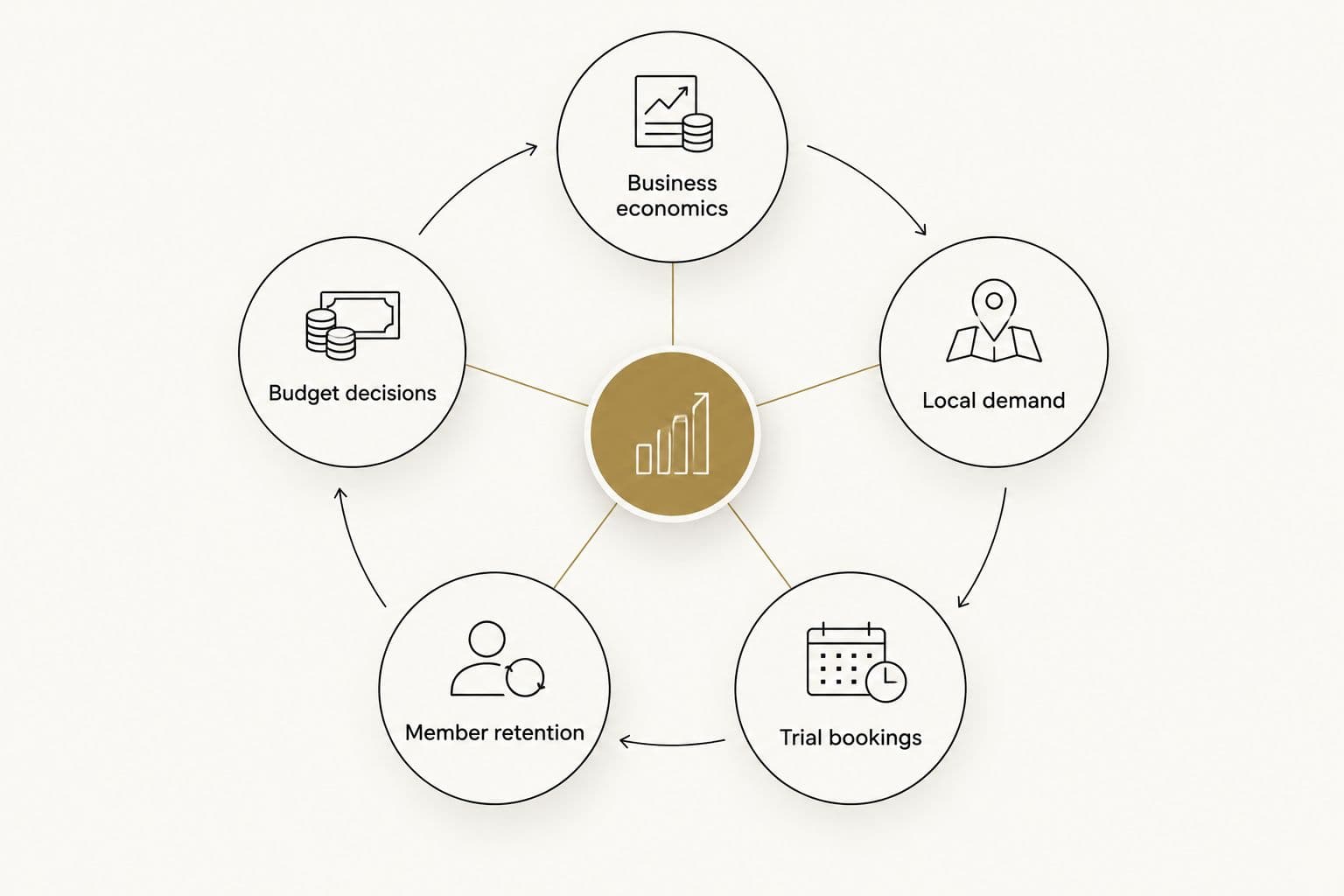
Acquisition decisions should reflect what happens after a prospect books.
Define your member economics
Start with a spreadsheet and your actual membership records. Customer acquisition cost means the acquisition spending required to win a new paying customer. Keep advertising-only acquisition cost separate from a fully loaded calculation that includes other acquisition expenses.
Then calculate contribution: revenue remaining after the direct costs of serving those members. Revenue alone does not show how much acquisition spending the business can support.
Set your acquisition limit from observed member behavior, not an assumed lifetime. If retention records are incomplete, use the revenue and direct costs you can verify. Do not justify today’s spend with renewals that have not happened.
- Define what counts as a new paying member.
- Separate advertising spend from total acquisition costs.
- Calculate contribution using a consistent cost definition.
- Record how long acquisition spending takes to recover.
- Identify class capacity you can sell without adding delivery costs.
Match your message to local demand
Review member inquiries, booking notes, and conversations at reception before buying research software. Look for the reasons people chose your studio and the practical questions they asked before attending.
Translate those findings into a clear offer for a specific situation. A beginner comparing coached strength classes needs different information from an experienced member looking for a more convenient timetable. Do not put every audience and benefit into the same advertisement.
For local search engine optimization, or local SEO, make your location, class offering, and business information clear and consistent. Use search wording that accurately describes what you provide, rather than adding nearby locations you do not serve.
- Group inquiries by training goal and experience level.
- Identify location and timetable objections.
- Describe the class experience in plain language.
- Keep Google Business Profile details accurate.
- Match each campaign to an appropriate booking destination.
Repair your booking journey
Walk through the mobile booking process yourself. Start from an advertisement or search result, not your homepage, and check whether a new visitor can understand the class, find a suitable session, and complete the booking.
A manual review comes first. Compare the promise in your advertising with the landing page, the booking screen, and the confirmation message. Record where the wording changes or essential information disappears.
When separate suppliers own those pieces, fixing the journey requires coordination. At The fVnnel, we connect positioning, performance creative, websites, conversion, and tracking rather than treating each handoff as someone else’s problem. That approach fits an established business with a connected execution problem, not an unproven offer.
- Explain who the introductory class suits.
- Show location and arrival information before booking.
- Remove form fields without a clear operational purpose.
- Test confirmation messages and booking links.
- Check the complete journey on a mobile device.
Test acquisition against attendance
Begin with a campaign log that records the audience, message, destination, and intended outcome. Use it to distinguish a genuine test from a collection of unrelated changes.
For 2026 campaigns, evaluate search and social against the job each must do. Search advertising can address an explicit query; social advertising lets you demonstrate the class experience. Neither channel deserves more budget solely because it produces cheaper inquiries.
Compare attendance and paying membership outcomes alongside lead costs. If you operate a yoga-focused offer, the Meta ads for yoga studios guide provides a related channel-specific starting point. Keep your own studio’s economics as the decision rule.
- Give each campaign a clear audience and message.
- Use creative that accurately represents the class.
- Record bookings separately from attended sessions.
- Connect paying memberships to the originating campaign where possible.
- Change one major variable when diagnosing a weak result.
Turn first visits into repeat attendance
Map the first-visit experience with your front desk and coaches before adding automation. Confirm who welcomes a newcomer, explains the session, answers membership questions, and follows up afterward.
Treat missed attendance differently from hesitation after a completed class. A person who could not find the entrance needs a different response from someone whose preferred sessions conflict with work. A single generic follow-up sequence obscures those differences.
Retention starts with matching the promise to the experience. Marketing cannot repair a class that fails to deliver what the advertisement described. Bring recurring objections back to the team responsible for the offer and delivery.
- Assign an owner to the newcomer experience.
- Send clear preparation and arrival instructions.
- Record attendance accurately after each session.
- Ask non-converting attendees what prevented a decision.
- Explain the next suitable booking or membership step.
Connect your records before automating
Create a shared record linking the inquiry, booking, attendance, membership, and cancellation. A spreadsheet can establish the logic before you change software. Decide which system holds the authoritative record for each event.
Attribution means assigning credit for a conversion to marketing activity. It is useful for decisions, but it does not make every customer journey fully observable. Keep recorded campaign attribution separate from a member’s self-reported answer about how they found you.
In your 2026 reporting, distinguish recorded events from inferred explanations. A booking confirmation does not prove attendance, and a submitted inquiry does not prove membership revenue. Reconcile marketing reports with your operational records.
- Use consistent definitions for each journey stage.
- Preserve campaign information when systems support it.
- Keep self-reported source information in a separate field.
- Remove duplicate records before calculating conversion rates.
- Check that reports exclude canceled or invalid bookings appropriately.
Reallocate spending around the constraint
Review acquisition and retention together. Cohort analysis means comparing groups of members who joined during the same period or through the same source. It helps you avoid mixing new customers with members who have already had time to renew.
Choose your next action from the weakest commercial transition. Strong bookings with poor attendance call for a different response from strong attendance with poor membership conversion. More traffic is not the default answer.
Protect the quality of the comparison. If you change the offer, audience, timetable, and landing page together, you lose a clear explanation for the result. Document the decision before making the change.
- Compare acquisition sources using the same definitions.
- Review attendance before judging booking volume.
- Compare retention over equivalent observation periods.
- Check available class capacity before increasing demand.
- Record what changed and the outcome you expect.
Compare growth support options
Choose support around the work you cannot execute well internally. Buying another platform does not assign accountability for the member journey. Hiring an agency does not remove the need for accurate records and a class experience people want.
| Option | Best for | Main advantage | Key limitation |
|---|---|---|---|
| Owner-led execution | Studios where the owner can consistently own marketing decisions | Direct access to member feedback and business priorities | Marketing competes with coaching, staffing, and operations |
| In-house marketer | Studios needing a dedicated internal coordinator | Close contact with the team and member experience | One person still needs support outside their expertise |
| Channel specialist | Businesses with a clearly isolated search, advertising, or website problem | Focused execution within a defined scope | Cross-channel handoffs still need an owner |
| The fVnnel | Established businesses needing connected growth execution | Strategy, acquisition, creative, conversion, SEO, and tracking run as one system | Does not replace responsibility for class delivery or operational records |
Before selecting support, write a brief naming the constraint, the outcome, and the evidence you will use to judge progress. Ask who owns the transition from inquiry to attendance, not just who creates advertisements.
Keep access to your reporting and operational records. You need to understand how a recommendation connects to member economics, even when another team handles execution.
Common mistakes boutique gyms make
Promoting sessions without checking capacity
A campaign can attract demand for classes you cannot accommodate while leaving other sessions underfilled. Review the timetable before choosing the promoted offer. Direct prospects toward suitable sessions with genuine room, and make that availability clear in the booking journey.
Treating every introductory booking as a win
Bookings are an intermediate outcome. Count attendance, paying membership, and subsequent retention separately. If your report stops at a reservation, you cannot distinguish attractive advertising from a member acquisition process that actually works.
Making newcomers decode the class format
An experienced member understands your studio’s terminology; a new prospect does not necessarily share that knowledge. Explain what happens in the session, who it suits, and how a newcomer gets started. Do not make the prospect interpret internal class names before deciding whether to book.
Using introductory interest to justify long-term assumptions
A booked first visit does not establish future renewal behavior. Base your acquisition limit on observed revenue and retention. When the introductory offer changes, track the resulting members separately rather than assuming they will behave like an earlier group.
FAQ
What is growth marketing for boutique gyms?
Growth marketing for boutique gyms connects positioning, acquisition, booking conversion, attendance, and retention to grow profitable membership. It measures the whole member journey rather than treating lead generation as the final result.
What should an established boutique gym fix first?
Fix the weakest commercial transition in the member journey first. Check whether the constraint is demand, booking completion, attendance, membership conversion, or retention before increasing advertising spending.
Is local SEO better than paid social for a boutique gym?
Neither local SEO nor paid social is automatically better for a boutique gym. Local SEO addresses relevant location-based searches, while paid social can demonstrate the class experience; compare the resulting member economics.
How do I calculate customer acquisition cost for my gym?
Divide the acquisition spending you have defined by the new paying members acquired during the corresponding measurement period. Label advertising-only and fully loaded calculations separately so you do not compare unlike figures.
Can I manage boutique gym marketing without an agency?
You can manage boutique gym marketing internally if someone owns execution, reporting, and the member journey. Start with consistent records and a manual booking review before deciding which work needs outside support.
Should I automate every trial follow-up?
No, define the follow-up process before automating it. Missed attendance, timetable objections, and questions after a completed class need different responses and a clear staff owner.
Which marketing results should a boutique gym review?
Review acquisition cost, booking completion, attendance, paying membership conversion, retention, and contribution together. Use consistent definitions and equivalent observation periods when comparing campaigns or member groups.
One last thing
Before increasing your 2026 advertising budget, ask a staff member unfamiliar with the campaign to book the promoted class on a phone. Have them explain what they expect to happen when they arrive.
Compare that expectation with the experience your coaches deliver. If the promise and the session do not match, fix the mismatch before buying more attention. That is a concrete growth decision you can make without another dashboard.