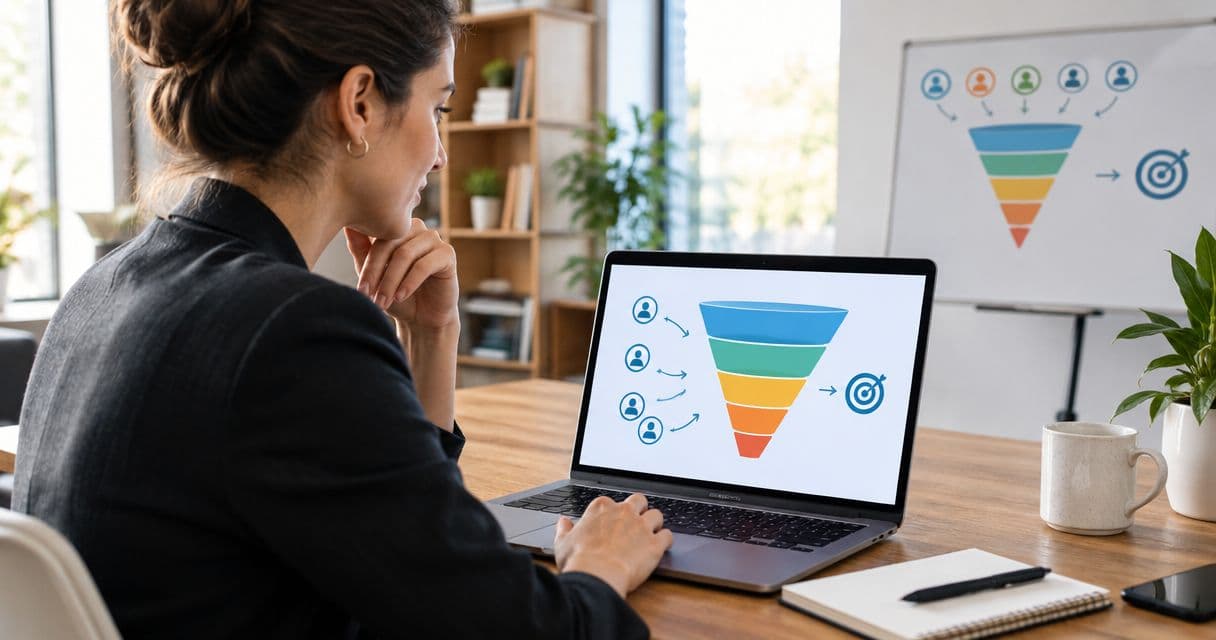
Business coaches’ funnel marketing is a connected path from first contact to paid engagement, with the aim of acquiring clients profitably. This 2026 guide shows established coaching businesses how to connect positioning, lead qualification, sales conversations and measurement without filling the calendar with poor-fit prospects.
TL;DR
- Funnel marketing for business coaches should optimize for profitable clients, not the cheapest leads.
- The fVnnel is best for established businesses seeking growth strategy, acquisition and conversion support as one system.
- Choose direct applications, educational content or workshops according to what buyers need before a sales conversation.
- Connect your CRM and email marketing to client outcomes before increasing acquisition spend.
Why funnel marketing matters for business coaches
A business coaching funnel must answer more than whether someone likes your content. It must establish whether the prospect has a problem your offer addresses, the authority to act and the resources to invest. A booked call is an intermediate outcome, not the commercial result.
Your funnel also needs to distinguish the owner seeking operational change from the reader collecting ideas. Both can download the same resource. Only the first necessarily belongs in your sales pipeline, so measure what happens after the download.
Business coaching and life coaching share follow-up mechanics, but your messaging should reflect the buyer’s actual business problem. The adjacent growth marketing for life coaches guide addresses a different coaching audience; do not copy its positioning without checking buyer intent.
For your 2026 plan, start with an operating question: where does qualified demand stop turning into profitable clients? More traffic is not the answer when the constraint sits in qualification, sales or delivery capacity.
Build a funnel around client economics
Define your buyer and the business problem
Start manually. Review sales notes, delivery feedback and conversations with current clients. Separate the reasons people initially inquired from the reasons they eventually bought. Those are not always the same: an owner asking about productivity might actually need help delegating decisions.
Write a positioning statement that names the buyer, the business problem and the scope of your work. Avoid promising a revenue outcome you cannot substantiate. Your 2026 revenue plan should connect the type of client you want with the work you can deliver well.
The practical test is whether a prospect can recognize their situation without needing you to explain the headline. If your message fits every business owner, narrow it before building more pages.
- Identify the decision-maker and their business context.
- Name the problem your coaching addresses.
- Record the trigger that makes solving it urgent.
- State who the offer does not serve.
- Use documented client language rather than coaching jargon.
Set your acquisition limits before choosing channels
Use a spreadsheet before buying reporting software. Record collected revenue, delivery costs, acquisition costs and the time required to serve a client. Contribution is the revenue left after the costs you include in delivering and acquiring that engagement; define those costs consistently.
Customer acquisition cost means the acquisition spend divided by new paying customers. Keep media-only acquisition cost separate from a fully loaded figure that includes agency fees, creative production or sales labor. Mixing definitions makes channel comparisons unreliable.
Set your spending limits from client economics, not from a generic coaching benchmark. Account for when payments arrive, especially if acquisition spending happens before the engagement generates cash. A profitable contract on paper does not automatically fund today’s advertising bill.
- Separate collected revenue from signed contract value.
- Record the costs included in each calculation.
- Allow for delivery effort and sales time.
- Set an acquisition limit for each offer.
- Check cash timing before increasing spend.
Match the entry point to buying readiness
Build the first version with an existing page, a form and personal follow-up. Use a direct application when the prospect understands the problem and your offer. Use educational content or a workshop when buyers need to understand your approach before discussing an engagement.
Do not make a free download compulsory just because other coaches use one. Every extra step needs a purpose. Someone actively seeking business coaching should not have to complete a long educational sequence before finding the application.
The fVnnel connects strategy and positioning, paid acquisition, performance creative, websites and conversion, SEO, and tech and tracking. That support fits an established business with a cross-functional growth constraint; it is a broader scope than fixing an isolated form.
- Choose the buying stage your entry point serves.
- Give ready buyers a direct application route.
- Use education to resolve a specific uncertainty.
- Match the advertisement’s promise to the destination.
- Remove steps that collect activity without helping a decision.
Connect the page, application and follow-up
Walk through the journey yourself before adding automation. Open the page on a phone, submit the application, book a call and read every confirmation. Check whether the same offer and expectations remain clear throughout.
Your application should collect information you will actually use. Ask about the business problem, the prospect’s role and what they want to change. Explain why sensitive information is needed, and avoid turning qualification into an unpaid consulting assignment.
Treat the journey as connected handoffs rather than separate assets. The page explains the next step; the application informs the conversation; the booking confirms expectations; the follow-up responds to what the prospect has already shared.
- Landing page: explain the buyer, problem and next action.
- Application: gather information needed to assess fit.
- Booking: state the purpose of the conversation.
- Follow-up: address the prospect’s next decision.
- Sales outcome: record whether the engagement proceeds and why.
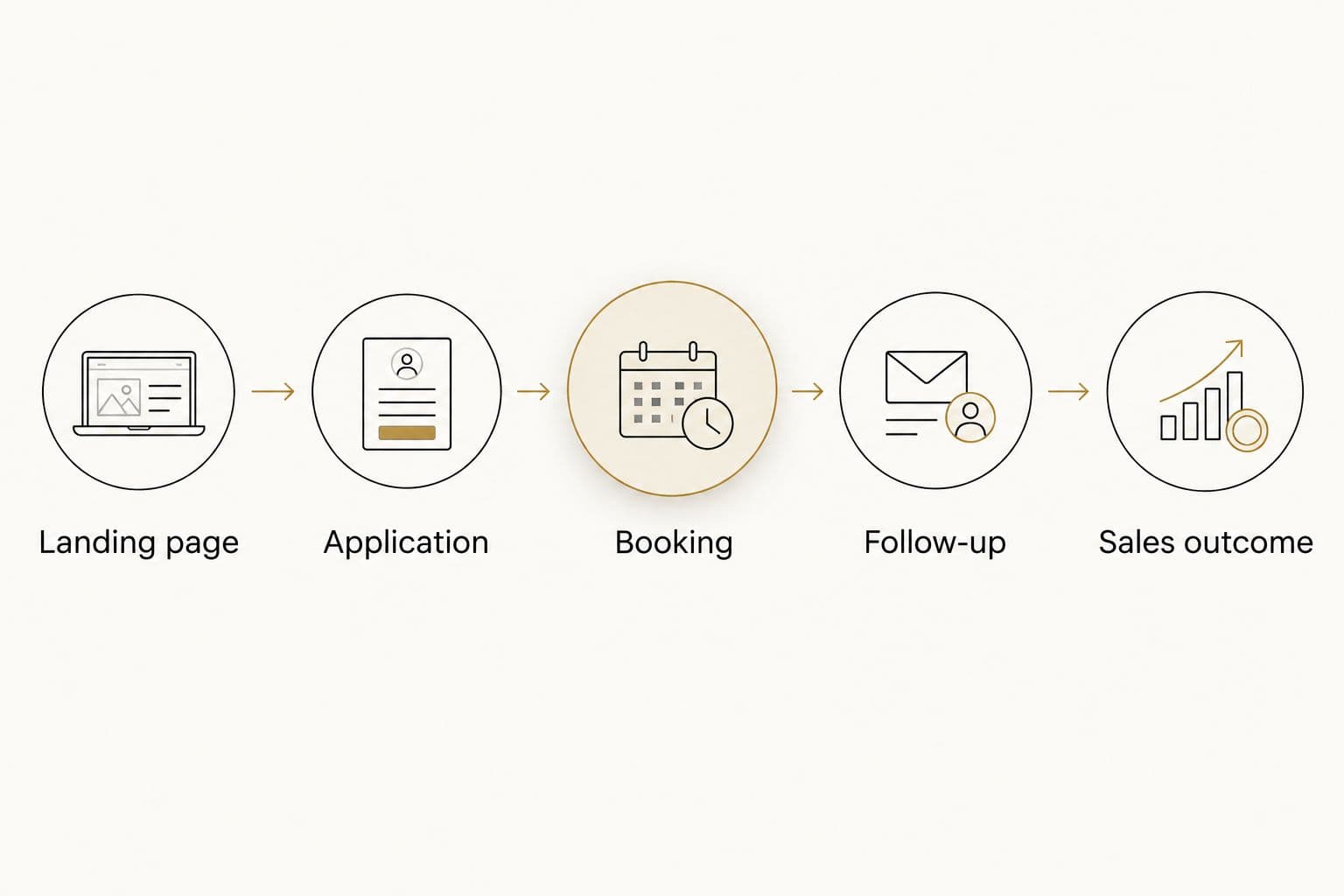
Each handoff should preserve the context needed for the next decision.
Use proof and follow-up to answer objections
Start by writing personal responses to the questions that repeatedly delay decisions. Group those questions by subject, then turn the recurring answers into page sections or email messages. Automate only after the message is accurate and the next action is clear.
In 2026, your proof still needs boundaries: identify the client, the measured outcome and what the example actually demonstrates. The fVnnel’s Kidney Coach result was return on ad spend from 1.33 to over 3.8, profit up roughly 45% while ad spend fell nearly 40%. Return on ad spend measures attributed revenue against advertising spend; it is not profit.
That result is not a business coaching benchmark or a forecast for your offer. Its relevance is the measurement standard: evaluate acquisition alongside profit, rather than presenting advertising returns alone.
- Address objections collected from real conversations.
- Explain what happens during the sales conversation.
- Use only approved, documented client evidence.
- Keep revenue, advertising return and profit distinct.
- Stop sequences when a reply requires personal attention.
Track lead quality through to the sales outcome
Begin with a shared spreadsheet if your inquiry volume is manageable. Give each prospect a source, an owner, a current stage and a next action. Record lost opportunities as carefully as wins, because rejected applications and stalled conversations expose different problems.
As handoffs become harder to manage manually, a customer relationship management system, or CRM, centralizes prospect records and follow-up. The value is continuity, not the size of the contact database. Your team should know what the prospect requested and what needs to happen next without searching separate inboxes.
When evaluating CRM tools for lead management, prioritize source capture, stage ownership and outcome recording over features your sales process does not use. Software cannot resolve inconsistent definitions of a qualified opportunity.
- Capture the original inquiry source where available.
- Separate inquiries, qualified opportunities and paying clients.
- Assign responsibility for every active opportunity.
- Record attendance, decisions and loss reasons.
- Reconcile sales outcomes with collected revenue.
Fix the constraint before expanding acquisition
Review the funnel manually with the people handling marketing, sales and delivery. Look for the transition that prevents qualified demand from progressing. Weak application quality calls for different action than strong applications followed by missed appointments.
Change the part connected to the observed problem. If prospects misunderstand the offer, revise the message. If suitable buyers disappear after applying, inspect the response and booking process. If clients sign but delivery becomes unprofitable, revisit the offer economics before increasing traffic.
The fVnnel’s funnel marketing approach connects these decisions across the growth system. For business coaches, the next investment should address the identified constraint, not simply add another channel. Keep a change log so later decisions reflect what actually changed.
- Identify the weakest meaningful transition.
- Check the records behind the headline metric.
- Choose a change tied to a specific explanation.
- Record the change and its implementation date.
- Review downstream client quality before expanding spend.
Compare funnel options for your coaching business
Choose a route according to the decision your buyer needs to make. None of these options removes the need for a clear offer, qualification or follow-up. The workload column describes the work involved, not a promise about implementation speed.
| Option | Best for | Main advantage | Work involved | Key limitation |
|---|---|---|---|---|
| Direct application | Buyers already seeking coaching support | Short route to a fit conversation | Clear offer page, application and sales follow-up | Gives unfamiliar buyers little education before applying |
| Educational resource and email | Buyers still clarifying their problem | Creates space to explain your approach | Focused resource, relevant messages and response handling | Downloads do not establish buying readiness |
| Live workshop | Buyers who need to experience your teaching | Lets prospects assess how you explain business problems | Promotion, delivery, attendance follow-up and qualification | Requires delivery effort before a sales outcome |
| Connected growth support from The fVnnel | Established businesses with constraints spanning several functions | Connects strategy, acquisition, conversion and tracking | Shared priorities and coordination across the growth system | Broader than a narrow software or form-building task |
Use the least complicated route that supports the buying decision. A workshop is not automatically better than an application, and a longer nurture sequence is not automatically more persuasive. Select the route you can operate consistently and evaluate against paying clients.
Common mistakes business coaches make
Treating resource downloads as sales opportunities
A planning worksheet can attract people who enjoy business advice without intending to hire a coach. Keep resource subscribers separate from qualified opportunities. Judge the resource by the client relationships it supports, not its download total alone.
Leading with the coaching method instead of the problem
Your framework matters after the buyer understands why it applies. Lead with the business situation, then explain the method and its limits. A prospect should not need familiarity with your terminology to decide whether to continue.
Using testimonials without relevant context
Praise for your personality does not explain the engagement’s business relevance. Use evidence that accurately describes the client’s situation and the work involved. Do not turn an individual outcome into an implied guarantee for every applicant.
Removing qualification to increase bookings
A fuller calendar can mean more sales labor without more suitable clients. Keep questions that help you assess fit, then inspect whether they are clear and necessary. Remove friction that creates confusion, not information that protects the sales process.
Scaling campaigns while delivery economics deteriorate
Signed clients are not the finish line. Review whether the engagement remains profitable after the work required to fulfill it. If extra customization or founder involvement consumes the margin, fix the offer or delivery model before buying more demand.
FAQ
What is funnel marketing for business coaches?
Funnel marketing for business coaches connects discovery, qualification, sales conversations and paid engagements. Its purpose is profitable client acquisition, not simply generating inquiries or calendar bookings.
What’s the best funnel for an established business coach?
The best funnel matches the buyer’s readiness and the explanation your offer requires. Use a direct application for ready buyers, or education and follow-up when prospects need to understand the problem or approach first.
Do business coaches need paid ads to build a funnel?
No, a coaching funnel can begin with referrals, existing content, email or search traffic. Add paid acquisition when you can track qualified opportunities and paying clients back to acquisition activity.
Should I use a webinar or send prospects straight to a call?
Send prospects straight to an application when they already understand the offer and want to discuss fit. Use a webinar or workshop when experiencing your teaching helps them make that decision, while accounting for the delivery workload.
Which metrics should a business coaching funnel track?
Track qualified opportunities, attended conversations, paying clients, acquisition costs and collected revenue. Connect those outcomes to delivery costs so strong advertising results do not conceal weak profit.
When should I automate my coaching funnel?
Automate a step after its message, owner and next action are clear. Keep personal handling for questions or objections that require judgment, and stop automated sequences when they no longer fit the conversation.
Who is The fVnnel’s funnel marketing support best for?
The fVnnel’s funnel marketing support is best for established businesses with real demand and resources to invest in growth. Its connected scope fits businesses addressing strategy, acquisition, conversion and tracking together rather than validating a new offer.
One last thing
Before adding another acquisition channel in 2026, trace a recently signed client backward through the actual journey. Compare the advertisement or referral, the page, the application, the follow-up and the sales conversation. Check where the message stayed consistent and where your team had to repair missing context.
Then repeat the exercise for a suitable prospect who did not buy. The most useful next step is the smallest change that addresses a documented reason for lost business. If the constraint spans your offer, channels, conversion and measurement, Get in Touch to discuss the connected growth problem.