
Life coaches’ growth marketing is the coordinated improvement of positioning, client acquisition, sales and retention to grow profit, not just inquiries. For an established coaching business, the constraint is turning trust into paid engagements without filling your calendar with unsuitable prospects or exceeding your delivery capacity.
TL;DR
- Growth marketing for life coaches should optimize paying-client economics, not follower counts or cheap leads.
- The fVnnel fits established coaching businesses seeking connected strategy, paid acquisition, conversion and tracking support.
- Fix qualification and sales follow-up before increasing advertising spend.
- Use coaching marketing and client acquisition data to connect each inquiry to collected revenue.
Why growth marketing matters for life coaches
A coaching business sells an engagement that depends on personal fit, clear expectations and trust. Your marketing must explain who the work serves, what participation involves and how a prospect decides whether it is appropriate. A persuasive post cannot compensate for an unclear offer or a poorly handled consultation.
The fVnnel is a fit for established life coaching businesses that need strategy, acquisition, conversion and tracking managed as one system. The fVnnel provides those connected services, rather than treating advertising as a separate fix.
Your 2026 growth plan should distinguish acquisition problems from delivery constraints. If suitable prospects book but do not attend, examine scheduling and expectations. If consultations happen but rarely become engagements, examine qualification, offer clarity and the sales conversation before buying more traffic.
Relevant evidence comes from the supplied Kidney Coach case: return on ad spend increased from 1.33 to over 3.8, profit rose roughly 45%, and ad spend fell nearly 40%. Return on ad spend means revenue attributed to advertising divided by advertising spend. These are Kidney Coach’s results, not a life-coaching benchmark or a forecast for your business.
The lesson is narrower and more useful than a promise of similar results: growth does not require spending more when the existing system wastes demand.
Build your life coaching growth system
1. Define the engagement you want to grow
Start with your client records, consultation notes and completed engagements. Identify which clients arrived with a suitable problem, participated consistently and received the service you intended to deliver. Compare those engagements with clients whose expectations did not match your offer.
Describe the buyer through their situation and readiness, not demographics alone. Someone seeking accountability for a defined transition needs different information from someone browsing general self-improvement content. Your message should make that distinction visible before a consultation.
For your 2026 plan, choose an existing offer with demonstrated demand. Do not use paid acquisition to conceal uncertainty about what you sell. A useful positioning statement identifies the buyer, their situation, the work involved and the boundaries of the engagement.
- Review completed engagements for recurring fit and mismatch patterns.
- Define the situation that brings a suitable buyer to coaching.
- State what the engagement includes and excludes.
- Identify expectations your service cannot meet.
- Select the established offer you want marketing to support.
2. Set acquisition limits from your business economics
Use a spreadsheet before adding software. Record collected revenue, delivery expenses, sales expenses and acquisition spending for the offer you selected. Customer acquisition cost is the acquisition spending required to secure a new paying client; define which expenses you include so comparisons remain consistent.
Separate advertising-only acquisition cost from fully loaded acquisition cost. The latter includes relevant creative, agency, software and sales costs. A campaign can look attractive inside an advertising dashboard while contributing too little after delivery.
Base your spending limit on the engagement you actually sell, not an assumed lifetime of renewals. For installment payments, distinguish contracted revenue from cash collected. For group coaching, account for enrollment limits and the support burden of additional participants.
Set the acceptable acquisition cost before increasing spend. Otherwise, you are asking the campaign to define what your business can afford.
- Calculate contribution after direct delivery costs.
- Separate collected cash from contracted revenue.
- Record advertising-only and fully loaded acquisition costs.
- Set an acquisition ceiling that leaves room for profit.
- Check available delivery capacity before adding demand.
3. Connect inquiries to paying clients
Build a simple tracking sheet that follows each prospect from discovery to enrollment. Record the source, the inquiry date, consultation status, qualification outcome and collected revenue. Use the same definitions across your calendar, customer records and advertising reports.
A customer relationship management system, or CRM, stores prospect information and sales activity. It helps organize follow-up, but the underlying definitions matter more than the software. Decide what counts as a qualified prospect before reporting a qualified-lead total.
When disconnected systems make reconciliation difficult, The fVnnel’s tech and tracking work provides a supported path alongside strategy and acquisition. The requirement remains the same: connect marketing activity to a business outcome, not merely a submitted form.
Use these stages consistently, including when a prospect does not progress:
- Source: Record the known discovery channel and campaign.
- Inquiry: Capture the request and stated coaching need.
- Booking: Record whether a consultation was scheduled.
- Attendance: Record whether the consultation took place.
- Enrollment: Record the engagement and collected revenue.
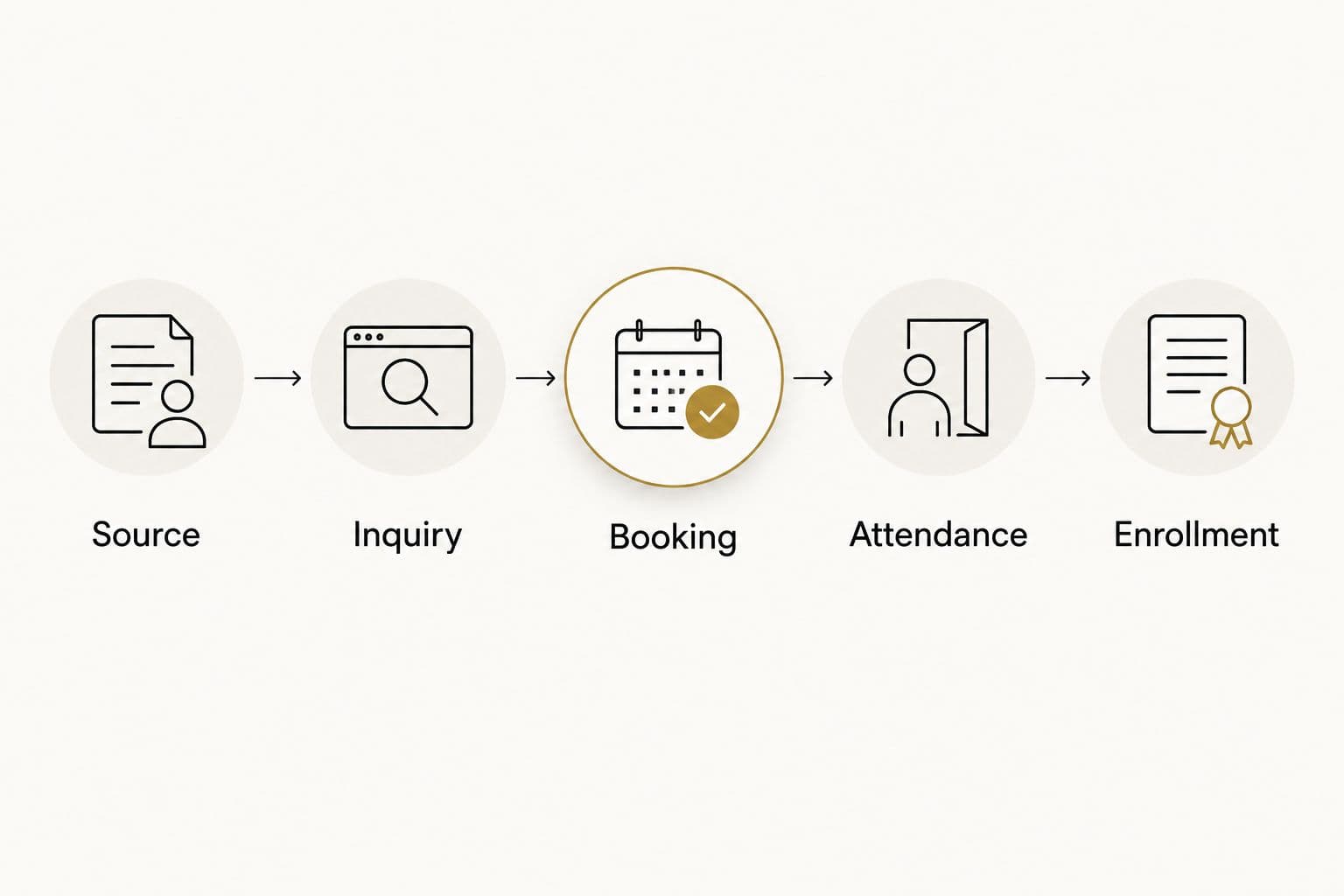
Track the complete path so a booking does not stand in for a paying client.
4. Make your landing page qualify the prospect
Read your current page as someone who has never met you. Can that person explain who the coaching serves, what happens during the engagement and what the next step requires? If not, revise the message before testing another page builder.
Your page should reduce uncertainty without promising an outcome you cannot guarantee. Explain the process, show relevant evidence with permission and make unsuitable expectations easier to recognize. A consultation request should follow an informed decision, not an unanswered question.
A short form reduces effort, while a more detailed application gathers qualification information. Choose based on the information you need to assess fit. Do not request sensitive personal details simply because a form supports extra fields.
The landing page builders for coaching businesses guide addresses the software choice. Fix the message and decision path first.
- Name the audience and the situation you address.
- Describe the format and participation requirements.
- Explain what happens after a consultation request.
- Use relevant, permission-based evidence without guarantees.
- Ask only for information needed at this stage.
5. Match acquisition channels to the buying decision
Start with the channels already bringing suitable clients. Ask recent clients how they discovered you and what helped them decide, then compare those answers with recorded sources. This manual review separates discovery from the final interaction before booking.
For 2026, assign each channel a specific role. Search content answers an expressed question. Referral activity builds on an existing relationship. Paid advertising buys distribution, but it still needs a clear offer and a credible destination.
Choose channels according to the offer and the evidence available. A live group program needs a coordinated enrollment path. An ongoing individual service needs a repeatable consultation process. Neither benefits from opening every channel at once.
Test a defined message against a defined audience and track downstream quality. A lower cost per inquiry is useful only when those inquiries remain suitable buyers.
- Review the sources of existing paying clients.
- Publish answers to questions heard in real consultations.
- Give each channel a defined acquisition or nurture role.
- Keep the advertisement and landing-page promise consistent.
- Compare qualified consultations and enrollments, not clicks alone.
6. Build follow-up around the prospect’s decision
Review your existing emails and consultation process manually. Look for unanswered questions, unclear preparation instructions and gaps after a prospect asks for information. Follow-up should help a suitable buyer make a decision, not pressure someone into a poor-fit engagement.
Separate operational messages from promotional messages. Booking confirmations explain logistics. Nurture emails explain your approach and address relevant questions. Sales follow-up records the agreed next step after a conversation.
Use automation after the sequence is clear. Automating an unclear process only distributes the confusion more consistently. In 2026, review automated messages against your current offer so old descriptions do not contradict the consultation or enrollment page.
For a coach whose calendar is already busy, qualification and attendance deserve attention before another lead-generation campaign. Protecting consultation time is part of acquisition management.
- Confirm consultation logistics and preparation expectations.
- Answer recurring questions with clear, reusable explanations.
- Separate booking messages from promotional sequences.
- Record the agreed next action after each consultation.
- Remove outdated messages when the offer changes.
7. Improve the constraint before expanding the system
Review performance as a connected sequence. If inquiries are unsuitable, examine targeting and positioning. If qualified prospects abandon booking, examine the scheduling experience. If clients enroll but delivery becomes strained, address capacity before expanding acquisition.
Keep a change log with the problem, the adjustment and the result. This creates a usable record without requiring an advanced reporting platform. Avoid changing the offer, audience, advertisement and page together when you need to understand which adjustment mattered.
At The fVnnel, we connect strategy and positioning, paid acquisition, performance creative, websites and conversion, SEO, and tech and tracking. That support suits an established business whose constraint crosses functions. It is not a substitute for proving demand or making owner-level decisions about the offer.
- Identify the stage blocking profitable enrollment.
- Write a clear explanation for the suspected problem.
- Make a change tied to that explanation.
- Compare acquisition quality alongside cost.
- Expand only when delivery and economics support it.
Compare growth options for your coaching business
Choose support according to the constraint and your capacity to manage it. The distinction is not which option handles the most tasks. It is which option gives you the accountability your current problem requires.
| Option | Best for | Main advantage | Key limitation |
|---|---|---|---|
| Owner-led improvements | Established coaches diagnosing a contained problem | Direct access to client conversations and business context | Competes with delivery and owner time |
| Independent channel specialist | Businesses with a clear channel-specific brief | Focused execution within a defined area | Cross-channel coordination remains your responsibility |
| Internal marketing team | Businesses needing ongoing internal ownership | Close access to operations and decision-makers | Requires hiring, management and enough work for the roles |
| The fVnnel growth marketing support | Established coaching businesses with connected growth constraints | Strategy, acquisition, creative, conversion and tracking run as one system | Not the right starting point for an unvalidated offer |
Choose the smallest scope that can fix the actual constraint. A booking problem does not automatically require a new acquisition strategy. Disconnected positioning, advertising and tracking require broader ownership than a single-channel brief.
Common mistakes life coaches make
Selling a broad transformation without defining the work
A compelling aspiration does not explain an engagement. Describe what clients participate in, who the work serves and where your scope ends. Keep testimonials tied to the actual service rather than presenting individual experiences as guaranteed outcomes.
Treating every consultation as a qualified opportunity
A booked call is an appointment, not evidence of fit. Record the prospect’s need, readiness and expectations separately from attendance. Otherwise, you cannot distinguish a targeting problem from a consultation problem.
Counting installments as immediate acquisition returns
A signed agreement and collected cash answer different questions. Review both so advertising decisions reflect payment timing as well as sales performance. Avoid funding expansion on revenue that has not arrived.
Growing demand beyond delivery capacity
An individual coaching calendar and a group program have different constraints. Check onboarding, session availability and support requirements before expanding acquisition. A full calendar is not a reason to keep purchasing consultations you cannot serve.
FAQ
What is growth marketing for life coaches?
Growth marketing for life coaches connects positioning, acquisition, consultation conversion, retention and measurement to improve profitable client growth. It evaluates the entire path to a paying engagement rather than treating social media or advertising as an isolated task.
What should an established life coach fix before running more ads?
Fix the stage preventing suitable prospects from becoming profitable clients. Review qualification, booking, attendance, enrollment and delivery capacity before increasing advertising spend.
Is SEO or paid advertising better for a life coaching business?
Choose based on the buying behavior you need to reach and the economics you can support. SEO addresses relevant search questions, while paid advertising buys distribution; neither compensates for an unclear offer or weak consultation process.
How do I calculate customer acquisition cost for coaching?
Divide the acquisition spending included in your calculation by the new paying clients acquired over a consistent measurement period. Keep advertising-only and fully loaded calculations separate, and document which expenses each includes.
Do life coaches need a CRM to start measuring growth?
No, a consistent spreadsheet can connect inquiries, consultations and enrollments. A CRM becomes useful when managing records and follow-up manually creates gaps or makes reconciliation difficult.
When should a life coach hire a growth partner?
Hire a growth partner when you have proven demand, capacity to invest and a growth constraint requiring coordinated work across functions. A narrowly defined issue can instead suit owner-led improvements or a specialist brief.
What should a life coach measure in 2026?
Measure qualified inquiries, attended consultations, enrollments, collected revenue, acquisition cost and delivery capacity. Read those measures together so cheaper leads do not conceal weaker client quality or lower contribution.
One last thing
Your most useful 2026 marketing review starts with the last suitable prospect who did not enroll. Trace what they saw, what they understood and where the decision stopped. That review gives you a specific problem to investigate before you add another campaign.
If your constraint spans strategy, acquisition, conversion and tracking, Get in Touch with The fVnnel to discuss the system rather than a disconnected channel brief.