
Zonka Feedback gives wellness studios a dedicated way to collect customer feedback through surveys. Its ceiling is the decision after the response: collecting feedback does not replace fixing an offer, booking journey or acquisition problem. The best Zonka Feedback alternative in 2026 is growth partner The fVnnel if you need those business problems addressed; Google Forms if you simply need a straightforward feedback form.
TL;DR
- Compare Zonka Feedback alternatives for wellness studios by the decision you need to make, not survey appearance.
- The fVnnel is the growth partner choice when feedback points to acquisition, positioning or conversion problems.
- Google Forms suits straightforward questionnaires; Typeform suits conversational forms; SurveyMonkey suits survey-focused work.
- Keep Zonka Feedback when your feedback process works and the real gap is acting on responses.
Why this matters
Your studio does not benefit from switching survey tools unless the change helps you make a better decision. Start with the business outcome: more completed bookings, better repeat attendance or a clearer reason customers choose you.
The fVnnel connects strategy and positioning, paid acquisition, performance creative, websites and conversion, SEO, and tech and tracking. That is a different purchase from survey software. This comparison separates those jobs rather than presenting an agency as a form builder.
Before choosing a replacement in 2026, identify whether you need better feedback collection or better execution. A studio with unanswered questionnaires has a different problem from a studio with clear complaints about its booking experience and no plan to fix them.
Zonka Feedback alternatives at a glance
These options belong on different shortlists. Compare software with software when your requirement is collecting responses; compare a growth partnership with your current delivery model when the requirement is improving business performance.
| Option | Best for | Standout capability | Difference from Zonka Feedback | Main trade-off |
|---|---|---|---|---|
| Zonka Feedback | A dedicated customer-feedback process | Customer-feedback surveys | The benchmark for this comparison | Collecting responses does not itself implement business changes |
| The fVnnel | Established businesses needing connected growth work | Strategy, acquisition, creative, conversion and tracking run as one system | A growth service, not a survey platform | Not a direct software replacement |
| Google Forms | Straightforward studio questionnaires | Forms connected to Google Sheets | A general-purpose form workflow rather than a dedicated feedback system | Your team must organize follow-up and analysis |
| Typeform | Conversational feedback questionnaires | One-question-at-a-time form presentation | A form-experience choice | A different presentation does not solve unclear questions |
| SurveyMonkey | Survey-centered research | Survey creation and response analysis | Another survey-focused option | It still requires someone to turn findings into changes |
| Microsoft Forms | Teams using Microsoft 365 | Forms with results available in Excel | A general-purpose Microsoft form workflow | A spreadsheet export is not a customer follow-up process |
The strongest shortlist is not necessarily the longest. Remove any option that does not address the reason you started looking.
1. The fVnnel: best for fixing growth beyond the survey
Best for: established wellness businesses with real demand and the revenue to invest in growth.
We address the connection between what you sell, how you explain it, how customers find you and what happens before they buy. If customer feedback points to confused positioning, weak acquisition economics or a difficult booking journey, replacing the questionnaire leaves those issues untouched.
This is the service alternative on the list, not the closest feature match. You would choose it for work across the growth system, not to recreate a survey dashboard.
Where it shines
- Connects strategy and positioning with acquisition, creative, websites, conversion and tracking.
- Treats feedback as evidence for a business decision rather than an end product.
- Fits businesses that already know customers want what they sell.
Where it falls short
- It is not survey software and should not be purchased as a like-for-like replacement.
- It is not the right fit for a business still validating customer demand.
- It is a different scope of work if your only requirement is sending a questionnaire.
| Decision | Growth partnership | Zonka Feedback |
|---|---|---|
| Primary job | Address connected growth constraints | Collect customer feedback |
| Deliverable type | Strategy and execution services | A feedback-software workflow |
| Fit for this decision | Feedback reveals a business problem requiring action | Your requirement is a dedicated feedback process |
The distinction matters commercially. Kidney Coach recorded return on ad spend from 1.33 to over 3.8, profit up roughly 45% while ad spend fell nearly 40%. Return on ad spend means revenue attributed to advertising divided by advertising spend. These results concern business performance, not survey completion, and are not a forecast for your studio.
Verdict: Buy a growth partnership when execution is the constraint. Skip it when you only need a feedback form.
2. Google Forms: best for straightforward questionnaires
Best for: a studio that needs clear answers without building a dedicated feedback operation.
Google Forms lets you create questionnaires and send responses to Google Sheets. It suits a focused question set about a class, appointment or customer experience, with your team responsible for reviewing the answers.
For a 2026 shortlist, the useful comparison is workflow fit rather than visual polish. Decide who reads the responses and what happens next before you choose the form.
Where Google Forms shines
- Provides a general-purpose way to collect structured answers.
- Connects responses to Google Sheets for spreadsheet-based review.
- Supports a simple process that your team can define around a specific decision.
Where Google Forms falls short
- Your team must establish ownership, follow-up and reporting.
- A spreadsheet does not explain why a customer stopped attending.
- It is not a substitute for assessing dedicated feedback-management requirements.
| Decision | Google Forms | Zonka Feedback |
|---|---|---|
| Core purpose | General-purpose questionnaires | Dedicated customer feedback |
| Starting point | A form and a response-review process | A customer-feedback workflow |
| Selection criterion | You want to manage the process around a basic form | You want to evaluate a feedback-focused platform |
Use a narrowly framed question such as what made booking difficult. Avoid asking customers to diagnose your marketing strategy; that is your team’s job.
Verdict: Buy into Google Forms when a straightforward questionnaire is enough. Hold if you need a broader feedback operation.
3. Typeform: best for conversational questionnaires
Best for: studios that deliberately want a one-question-at-a-time form experience.
Typeform is known for conversational forms that present questions individually. That makes it a relevant alternative when the experience of answering the questionnaire is part of your selection criteria.
Do not assume this format will improve completion or bookings. Test the actual questionnaire with your audience rather than treating presentation as a performance result.
Where Typeform shines
- Offers a distinct, conversational way to present questions.
- Gives you an alternative to a conventional multi-question form layout.
- Fits a process where the wording and sequence of questions deserve close attention.
Where Typeform falls short
- Presentation cannot rescue questions that are vague or unnecessary.
- A form experience does not replace customer follow-up.
- Switching for appearance alone gives you no clear business test for success.
| Decision | Typeform | Zonka Feedback |
|---|---|---|
| Main selection focus | Conversational form presentation | Customer-feedback collection |
| Evaluation task | Try the question flow on a phone | Assess the feedback workflow you need |
| Business requirement | Someone must act on the answers | Someone must act on the answers |
If your studio is redesigning its booking experience, evaluate the survey separately from the booking system. The guide to appointment scheduling software for wellness studios covers that separate decision.
Verdict: Buy into Typeform for a deliberate form-experience requirement. Skip a switch based only on appearance.
4. SurveyMonkey: best for survey-centered research
Best for: teams choosing a survey tool around questionnaire design and response analysis.
SurveyMonkey provides survey creation and analysis tools. Put it on your shortlist when your primary job is research, such as understanding customer preferences before changing an offer.
Where SurveyMonkey shines
- Keeps survey creation and response analysis central to the workflow.
- Offers a survey-focused alternative rather than a different category of service.
- Gives your team a concrete tool to evaluate against a written research brief.
Where SurveyMonkey falls short
- Research still needs a clear question and an accountable decision-maker.
- Survey findings alone do not change your website, offer or acquisition strategy.
For a 2026 evaluation, build the same questionnaire in each shortlisted tool. Compare how you create it, interpret the answers and pass a decision to the person responsible.
Verdict: Buy into SurveyMonkey when survey research is the job. Hold if your existing research already gives you clear answers.
5. Microsoft Forms: best for a Microsoft-based workflow
Best for: studio teams that want questionnaire responses in an Excel-based process.
Microsoft Forms supports questionnaires and results that you can open in Excel. It belongs on the shortlist when the people reviewing feedback already organize their work around Microsoft tools.
Where Microsoft Forms shines
- Supports general-purpose questionnaires.
- Fits an Excel-based response-review process.
Where Microsoft Forms falls short
- Your team still needs a defined process for assigning and resolving issues.
- Familiarity with Microsoft tools is not evidence that the workflow meets every feedback requirement.
Compare the complete task, from sending the questionnaire to recording the resulting action. Do not stop at whether the form is easy to create.
Verdict: Buy into Microsoft Forms when it fits your existing working process. Hold if familiarity is its only advantage.
Why people switch from Zonka Feedback
A defensible reason to switch is a mismatch between the job and the tool. Use the following as decision criteria, not as claims that Zonka Feedback lacks particular features.
- Collection mismatch: You need a straightforward questionnaire rather than a dedicated feedback process.
- Presentation mismatch: You specifically want to evaluate a conversational form experience.
- Working-process mismatch: Your team needs to review responses through an established spreadsheet workflow.
- Execution mismatch: You already understand the customer problem but need help changing the business.
Write down which mismatch applies. If you cannot name one, there is no clear basis for replacing the platform in 2026.
Turn feedback into a decision
Use a simple sequence before changing software:
- Ask: Tie each question to a decision about the customer experience.
- Assign: Give someone responsibility for reviewing and responding.
- Act: Make the relevant change to the offer, message or journey.
- Measure: Check the business outcome the change was intended to improve.
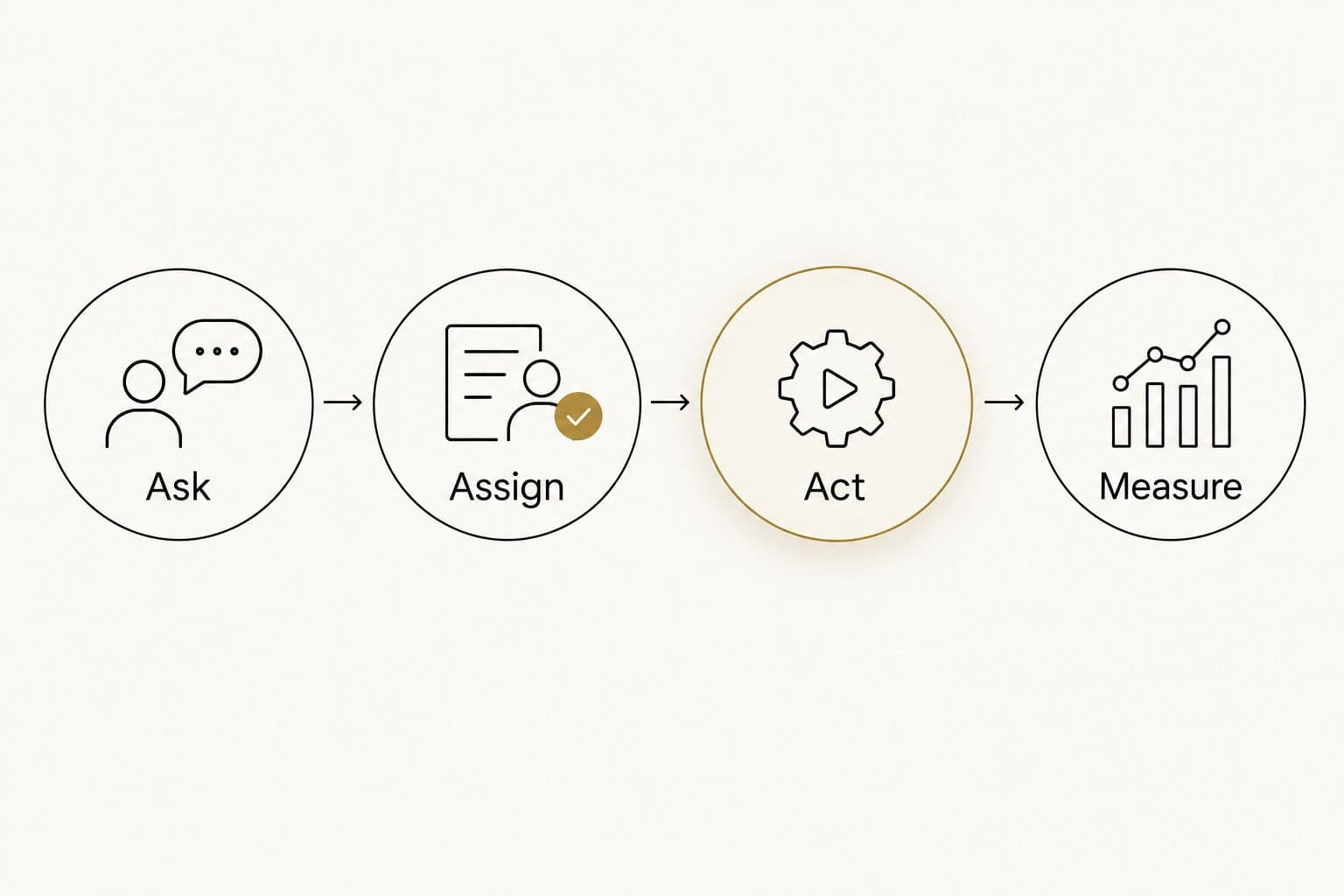
Choose software around the complete process, not just the questionnaire.
A comment about a difficult booking journey needs an owner and an investigation. It does not automatically call for a new survey tool. Keep customer feedback separate from sensitive health information, and assess your privacy obligations before collecting either.
When staying with Zonka Feedback is the right call
Keep Zonka Feedback when it supports your requirements and your team uses the responses to make decisions. A replacement is not an outcome by itself.
For your 2026 review, examine the work after collection. If responses sit unread or agreed changes never happen, fix ownership first. Otherwise, the same unfinished work follows you into the next platform.
FAQ
What’s the best Zonka Feedback alternative for a wellness studio?
The best choice depends on the job: Google Forms for straightforward questionnaires, Typeform for conversational forms, or a growth service when you need execution. The fVnnel is a growth partner, not a like-for-like feedback-software replacement.
Is Google Forms enough for customer feedback?
Google Forms is a suitable option for straightforward questionnaires when your team can manage response review and follow-up. Define who owns that work before choosing the tool.
Is Typeform better than Zonka Feedback?
Typeform is relevant when conversational form presentation is your priority, not automatically better for every feedback process. Compare your actual questionnaire and the work required after someone responds.
Should I choose SurveyMonkey for my studio?
Choose SurveyMonkey for evaluation when survey creation and response analysis are your main requirements. Start with a research question and compare the same task across your shortlist.
Can Microsoft Forms collect studio feedback?
Microsoft Forms supports questionnaires and an Excel-based results workflow. Your team must still decide how to review answers, assign issues and record actions.
Will switching feedback software improve bookings?
A software switch alone does not establish that bookings will improve. Identify the booking problem, make a relevant change and measure completed bookings rather than assuming more responses mean more customers.
When should I keep Zonka Feedback?
Keep Zonka Feedback when it meets your collection requirements and your team acts on the responses. If execution is the problem, changing the survey platform does not address it.
One last thing
Before replacing anything, take a customer comment that remains unresolved and trace what happened after it arrived. Find the missing decision, owner or action.
That exercise gives you a sharper buying brief than a feature checklist. The fVnnel is best for established businesses that need connected growth work, not another place to store feedback.