
Best overall for multi-location wellness businesses: Birdeye. Best for text-led customer conversations: Podium. Best starting point for a single local practice: Google Business Profile. This 2026 guide compares review management tools by the workflow you need, not the longest feature list.
TL;DR
- Birdeye leads the best review management tools for wellness businesses shortlist for multi-location review workflows.
- Podium fits teams that want review requests alongside text-based customer conversations.
- Google Business Profile is the starting point for managing reviews on your Google listing.
- NiceJob suits focused review collection; Reputation suits more complex location-level oversight.
- Choose review software around appointment workflows, response ownership, and customer privacy.
Why this matters
Your review process connects the experience you deliver with the evidence prospective customers see. A tool helps you request, monitor, and respond to reviews. It does not fix missed appointments, unclear expectations, or an unresolved service complaint.
The fVnnel is a growth partner for established businesses that need strategy, acquisition, conversion, and tracking to work together. Review management belongs inside that system, not beside it as an isolated reputation project.
The commercial test is whether your process supports profitable growth. Our Kidney Coach work increased return on ad spend, revenue attributed to advertising divided by advertising spend, from 1.33 to over 3.8. Profit rose roughly 45% while ad spend fell nearly 40%. Those are growth results, not review-software results: use the same commercial discipline when assessing another subscription.
The fVnnel is best for established businesses that need review management connected to their wider growth strategy, rather than treated as a standalone software purchase.
What makes the best review management tools?
For this 2026 shortlist, prioritize these criteria:
- Request workflow: Send requests after a relevant customer interaction without requiring staff to remember every follow-up.
- Channel coverage: Match the review destinations your customers actually use. Google reviews and private feedback serve different purposes.
- Response ownership: Make it clear who monitors reviews, drafts responses, and handles complaints.
- Location control: Keep location-specific requests and responses separate when your business operates multiple sites.
- Privacy safeguards: Assess what customer information enters the platform and what staff can disclose publicly.
- Operational fit: Confirm the connection to your appointment, customer relationship management, or messaging systems before committing.
A customer relationship management system, or CRM, stores customer records and interactions. A review platform should fit that recordkeeping process rather than create another disconnected customer list.
Review management tools at a glance
| Tool | Best for | Standout capability | Key limitation |
|---|---|---|---|
| Birdeye | Multi-location wellness businesses | Review management across locations and review sources | A broader platform requires more setup and ownership |
| Podium | Text-led customer communication | Review requests alongside customer messaging | Messaging needs extend the implementation beyond reviews |
| Google Business Profile | A single local practice focused on Google | Direct management of Google listing reviews and replies | Does not manage reviews on other platforms |
| NiceJob | Focused review collection | Automated review invitations and follow-up | Complex governance needs require closer evaluation |
| Reputation | Larger wellness groups needing oversight | Location-level reputation monitoring and reporting | Operational complexity is unnecessary for a simple review process |
These are workflow recommendations, not a claim that one platform wins every feature comparison. Confirm current product capabilities and the specific functions included in your agreement during your 2026 evaluation.
1. Birdeye: best for multi-location wellness businesses
Birdeye brings review collection, monitoring, and responses into a broader customer experience platform. Its strongest fit here is an established wellness business that needs oversight across multiple locations rather than separate staff-managed routines.
Use the demonstration to follow a real customer journey. Start with a completed appointment, identify the request trigger, and trace the review back to the correct location and response owner.
Birdeye pros:
- Supports review management across multiple locations.
- Brings review monitoring and response work into a shared platform.
- Offers a broader customer feedback toolkit beyond public review collection.
Birdeye cons:
- The broader scope creates more configuration decisions than a Google-only workflow.
- Central visibility still requires local staff to investigate and resolve service issues.
Best for: Wellness groups that need consistent review operations across locations.
Before choosing Birdeye, ask the vendor to demonstrate your actual appointment-system connection. A supported integration name is not enough: you need to understand which event triggers a request and how duplicate messages are prevented.
Verdict: Buy Birdeye when multi-location coordination is the problem you need to solve.
2. Podium: best for text-led customer conversations
Podium combines customer messaging with review-related workflows. It fits a wellness business where staff already handle customer questions and follow-up through text conversations.
The buying question is bigger than review collection. You need to decide whether customer messaging belongs in Podium or should remain in an existing system, then establish a clear owner for incoming conversations.
Podium pros:
- Places review requests alongside customer messaging.
- Supports a shared approach to customer conversations.
- Suits teams evaluating messaging and review workflows together.
Podium cons:
- Overlaps with existing messaging systems unless responsibilities are defined.
- A shared inbox still needs staffing, escalation rules, and response standards.
Best for: Wellness teams that want customer texting and review requests managed together.
Ask staff to demonstrate how they would handle a booking question, a review request, and a complaint. Keep sensitive health details out of ordinary review-request messages. A convenient communication channel is not permission to send every category of customer information through it.
Verdict: Buy Podium when messaging is part of the operational requirement, not an unwanted extra.
3. Google Business Profile: best for a Google-first local practice
Google Business Profile lets eligible businesses manage their presence on Google Search and Maps, including responding to Google reviews. It also provides a way to share a review-request link with customers.
For a single practice focused on its Google listing, this is the simplest starting point. Establish a reliable request and response routine before adding software to automate it.
Google Business Profile pros:
- Gives you direct access to Google review responses.
- Provides a review-request link for customer follow-up.
- Keeps Google listing information and Google review management together.
Google Business Profile cons:
- Does not collect other review platforms into a unified workspace.
- Requires a separate process for request timing, staff accountability, and broader reporting.
Best for: A single local wellness business whose immediate priority is its Google presence.
Google Business Profile is not a substitute for an internal complaint process. Staff need somewhere private to record a service problem and assign follow-up without placing customer details in a public reply.
For your 2026 decision, separate missing software from missing discipline. If nobody owns review responses today, buying another dashboard does not assign that responsibility.
Verdict: Buy into a Google Business Profile workflow first when your needs are limited to Google.
4. NiceJob: best for focused review collection
NiceJob focuses on collecting reviews through automated invitations and follow-up. It belongs on the shortlist when your main issue is inconsistent requests rather than complex reporting or a company-wide messaging change.
Assess it against your existing appointment workflow. The useful question is whether the right customer receives the right request after the right interaction, without staff maintaining a second process.
NiceJob pros:
- Centers the workflow on review collection.
- Supports automated review invitations and follow-up.
- Offers a focused alternative to evaluating a broader customer experience platform.
NiceJob cons:
- Does not remove the need for someone to handle public responses and complaints.
- Complex location permissions and reporting requirements need specific demonstration.
Best for: Established wellness businesses that want a more consistent review-request process.
Do not equate automation with appropriate timing. A completed appointment, a canceled visit, and an unresolved complaint are different operational events. Define eligible request triggers before enabling automated follow-up, without using customer satisfaction to decide who receives a public review invitation.
Verdict: Buy NiceJob when review collection is the defined requirement and broader operational needs are already covered.
5. Reputation: best for larger groups needing oversight
Reputation combines review management with broader customer feedback and reputation reporting. Its fit here is a wellness group that needs location-level visibility and formal operational oversight.
Start with the decisions your managers need to make. Useful reporting should help them identify unresolved issues, assign responsibility, and distinguish a local service problem from a request-process problem.
Reputation pros:
- Supports reputation management across locations.
- Combines public review work with broader customer feedback capabilities.
- Provides reporting for teams overseeing multiple operating units.
Reputation cons:
- A broad implementation needs clear administrative ownership.
- Extensive reporting adds work if nobody uses it to change operations.
Best for: Larger wellness organizations with defined location management and reporting responsibilities.
Ask the vendor to show how a regional manager identifies a problem and routes it to the responsible location. Then ask the location manager to complete the task. A report is useful only when the receiving team can act on it.
Verdict: Buy Reputation when oversight and accountability justify a broader platform.
How we ranked the tools
The ranking prioritizes operational fit: request workflow, channel coverage, response ownership, location control, privacy safeguards, and integration requirements. It is not a hands-on performance benchmark or a forecast of review volume.
Birdeye takes the overall slot for multi-location coordination. Podium owns the messaging use case. Google Business Profile is the direct Google-only option, NiceJob addresses focused collection, and Reputation addresses broader organizational oversight.
For a 2026 buying decision, ask each shortlisted vendor to demonstrate the same customer journey. Comparing different demonstrations makes it harder to distinguish a useful capability from an attractive presentation.
Set up the workflow before choosing software
A review platform should support an agreed process. Use this sequence before migration or automation:
- Request trigger: Define the completed customer interaction that makes a request appropriate.
- Customer choice: Invite honest feedback without filtering customers by expected rating.
- Response owner: Assign responsibility for monitoring, replies, and escalation.
- Private resolution: Move account-specific or health-related discussion out of public responses.
- Business review: Assess operational issues alongside booking and customer acquisition performance.
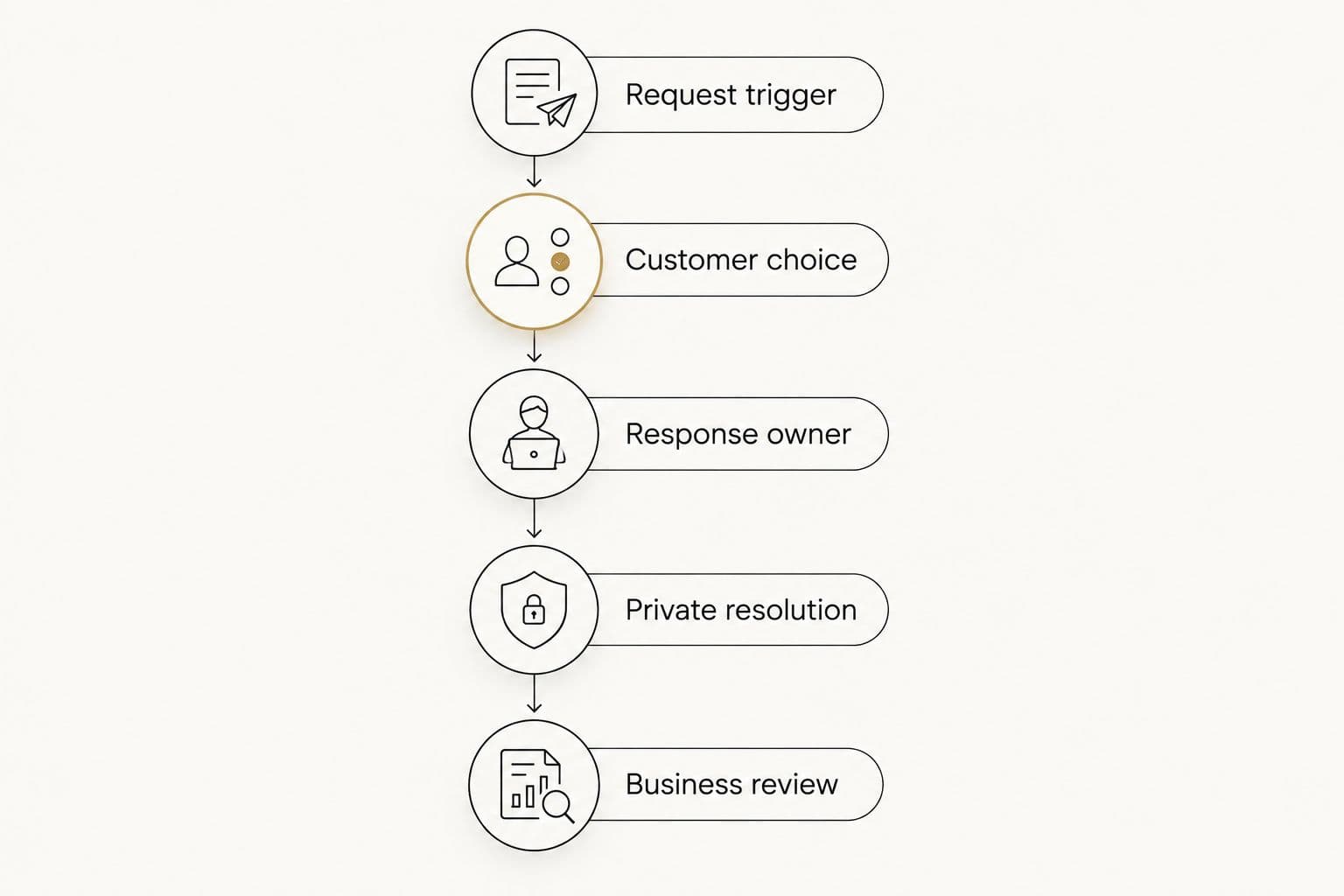
Define the review process before automating it.
Keep public responses factual and restrained. For healthcare providers subject to the Health Insurance Portability and Accountability Act, or HIPAA, a customer’s public review does not authorize disclosure of protected health information in a response. Obtain appropriate privacy guidance for your business and proposed software use.
Do not route only satisfied customers toward public reviews. That practice, commonly called review gating, conflicts with Google’s review policies. Offer a private support route without using it to suppress negative public feedback.
Which review management tool should you choose?
Choose Birdeye as the default shortlist leader when your wellness business needs multi-location review management. Choose Podium instead when customer messaging is central to the requirement.
For a single Google-focused practice, start with Google Business Profile. Choose NiceJob for a focused collection workflow, or Reputation when formal oversight across operating units is the priority.
The fVnnel’s recommendation is to resolve the operating question before the software question: who requests feedback, who responds, and what changes when the feedback exposes a problem? Your 2026 shortlist should follow those answers.
FAQ
What’s the best review management tool for a wellness business?
Birdeye is the default shortlist leader for a wellness business needing multi-location review management. Podium fits messaging-led teams, while Google Business Profile is the direct starting point for a Google-focused local practice.
Is Podium better than Birdeye for a wellness studio?
Podium is the better fit when customer texting and review requests need to sit together. Birdeye is the stronger shortlist choice when your main requirement is coordinated review management across locations.
Do I need review software if I already use Google Business Profile?
You need additional software only when your workflow requires capabilities beyond direct Google review management. Examples include automated requests, shared work across review sources, and broader location reporting.
Can I ask only happy customers to leave Google reviews?
No. Selectively asking satisfied customers for public reviews is review gating and conflicts with Google’s review policies. Invite honest reviews without filtering customers by expected sentiment.
Can a wellness clinic discuss treatment in a review response?
A public review does not authorize a HIPAA-covered clinic to disclose protected health information in its reply. Keep the response general and move account-specific discussion to an appropriate private channel.
What should I ask during a review software demonstration?
Ask the vendor to demonstrate a completed appointment triggering a request, the resulting review reaching the right location, and a staff member handling the response. Also verify permissions, duplicate-message controls, and the handling of customer information.
Will review management software fix negative reviews?
Review management software does not fix the underlying customer experience. It helps organize requests, monitoring, and responses; your team still needs to investigate complaints and correct operational problems.
One last thing
An unresolved complaint is an operational task, not just a response-writing task. Before adding more review requests, make sure somebody can investigate the issues those requests bring to the surface.
A consistent request process and accountable service recovery matter more than an unused dashboard.