
Choose The fVnnel if your established business needs strategy and execution across its growth system; choose Zonka Feedback if your team needs customer feedback software and can act on the findings itself. This 2026 comparison separates a growth partner from a feedback tool so you can buy against the problem you actually need solved.
TL;DR
- The fVnnel vs Zonka Feedback is a growth partner versus customer feedback software comparison, not an agency ranking.
- Choose the growth partner when positioning, acquisition, conversion and tracking need coordinated execution.
- Choose Zonka Feedback when customer surveys are the requirement and your team owns implementation.
- Neither choice removes the need to connect customer feedback to business decisions.
Why this matters
A customer survey can expose a problem without fixing it. A growth engagement can address execution without replacing your need to listen to customers.
If acquisition costs are rising, you need to distinguish between a research gap and an execution gap. Do customers reject the offer, misunderstand the message or abandon the buying process? Each answer calls for different work.
The fVnnel is the better fit for established businesses that need coordinated growth execution, not just customer feedback collection. Zonka Feedback is the better fit when collecting customer feedback is the defined job and you already have people responsible for the response.
For your 2026 buying decision, start with responsibility: who needs to find the constraint, who needs to change something, and who owns the result?
At a glance
| Dimension | The fVnnel | Zonka Feedback |
|---|---|---|
| Best for | Established businesses needing coordinated growth work | Teams needing customer feedback software |
| Ownership | Growth partner across connected marketing functions | Software operated by your team |
| Standout feature | Strategy and execution run as one system | Dedicated customer feedback collection |
| Customer research | Feedback informs broader growth decisions | Surveys and feedback are the central job |
| Implementation | Services include acquisition, creative, websites, SEO and tracking | Your team owns changes outside the feedback workflow |
| Measurement | Commercial results across growth activity | Customer feedback that needs business context |
| Follow-through | Requires access, decisions and client participation | Requires internal owners to turn findings into changes |
| Pricing model | Evaluate the agreed service scope and responsibilities | Evaluate software access and the internal work required |
The growth partner fits cross-functional problems better
Best for: an owner or marketing lead whose growth problem crosses team boundaries. Perhaps advertising promises something the website does not explain clearly. Perhaps leads arrive, but the buying process makes the next step difficult.
Those are not automatically survey problems. They require someone to connect the offer, message, channel, conversion process and measurement.
Our services cover strategy and positioning, paid acquisition, performance creative, websites and conversion, search engine optimization, and tech and tracking. Search engine optimization, or SEO, is the work of improving visibility in unpaid search results. We run these functions as one system rather than treating each channel as an isolated assignment.
The tradeoff is scope. A business that only needs a way to collect customer responses should not buy a wider engagement to solve that narrow requirement.
Zonka Feedback fits the smaller, clearly defined software purchase. Its limitation in this comparison is not a missing marketing feature: feedback software is a different category from a growth partner responsible for execution.
Zonka Feedback gives an equipped team direct control
Best for: a marketing or customer experience team that already has execution covered. If you know what you need to ask customers and have people ready to respond, a dedicated feedback tool fits that operating model.
Your team remains responsible for the research question, survey audience, interpretation and resulting changes. That control is useful when the work has a clear owner rather than sitting between departments.
The limitation is the same responsibility. Software does not resolve disagreements over priorities, allocate development capacity or rewrite an offer simply because responses identify a problem.
A growth partner becomes more relevant when you need help connecting those decisions and implementing them. The distinction is not control versus no control. It is whether you want your existing team to operate a tool or need an external partner involved in the wider work.
Before choosing, name the person who will turn the findings into action. If that role is empty, solve the ownership problem before adding another system.
Connected execution is the growth partner’s standout
Best for: a business with real demand but a disconnected route to purchase. When creative, landing pages and tracking tell different stories, optimizing one isolated element does not address the whole problem.
Our work connects the parts that affect acquisition and conversion. That allows the business question to come first: what is preventing more profitable customer acquisition?
The service scope supports work across those functions. It does not mean every business needs every service, or that the correct answer is always more advertising.
A useful 2026 brief should identify the outcome and the suspected constraint before listing deliverables. Otherwise, you risk buying more activity without resolving why performance stalled.
Zonka Feedback has a different standout: a dedicated environment for collecting customer feedback. That focus is useful when your current obstacle is understanding customers, not coordinating the implementation that follows.
Zonka Feedback wins when feedback collection is the job
Best for: teams with a specific customer question and an existing action plan. If you need to ask customers about their experience, dedicated feedback software is the closer match than a broad growth service.
Keep the research question narrow enough to inform a decision. Asking why buyers hesitate is different from asking whether existing customers are satisfied. The audience and the action should match the question.
For example, an education business investigating enrollment objections needs feedback from relevant prospects. Responses from enthusiastic existing customers answer a different question.
A growth partner can use customer research as an input to positioning and conversion work. That does not make the service a substitute for a dedicated feedback platform.
The limitation of a feedback-first purchase is interpretation. Responses describe what participating customers say; you still need to examine how that relates to behavior and commercial performance. Treat feedback as evidence to investigate, not as an automatic instruction to redesign the business.
The growth partner wins when the findings need implementation
A completed survey is not a changed customer experience. Someone still needs to decide what matters, revise the message, change the buying journey and check what happens afterward.
Choose implementation support when your bottleneck is making connected changes, not collecting more opinions. Our services include the marketing and technical work needed to address those parts of the growth system.
A practical sequence is:
- Customer evidence: establish what customers say and what their behavior shows.
- Growth constraint: identify the problem preventing the desired business result.
- Coordinated changes: align the relevant message, channel, page and tracking work.
- Commercial review: assess the result against the business outcome.
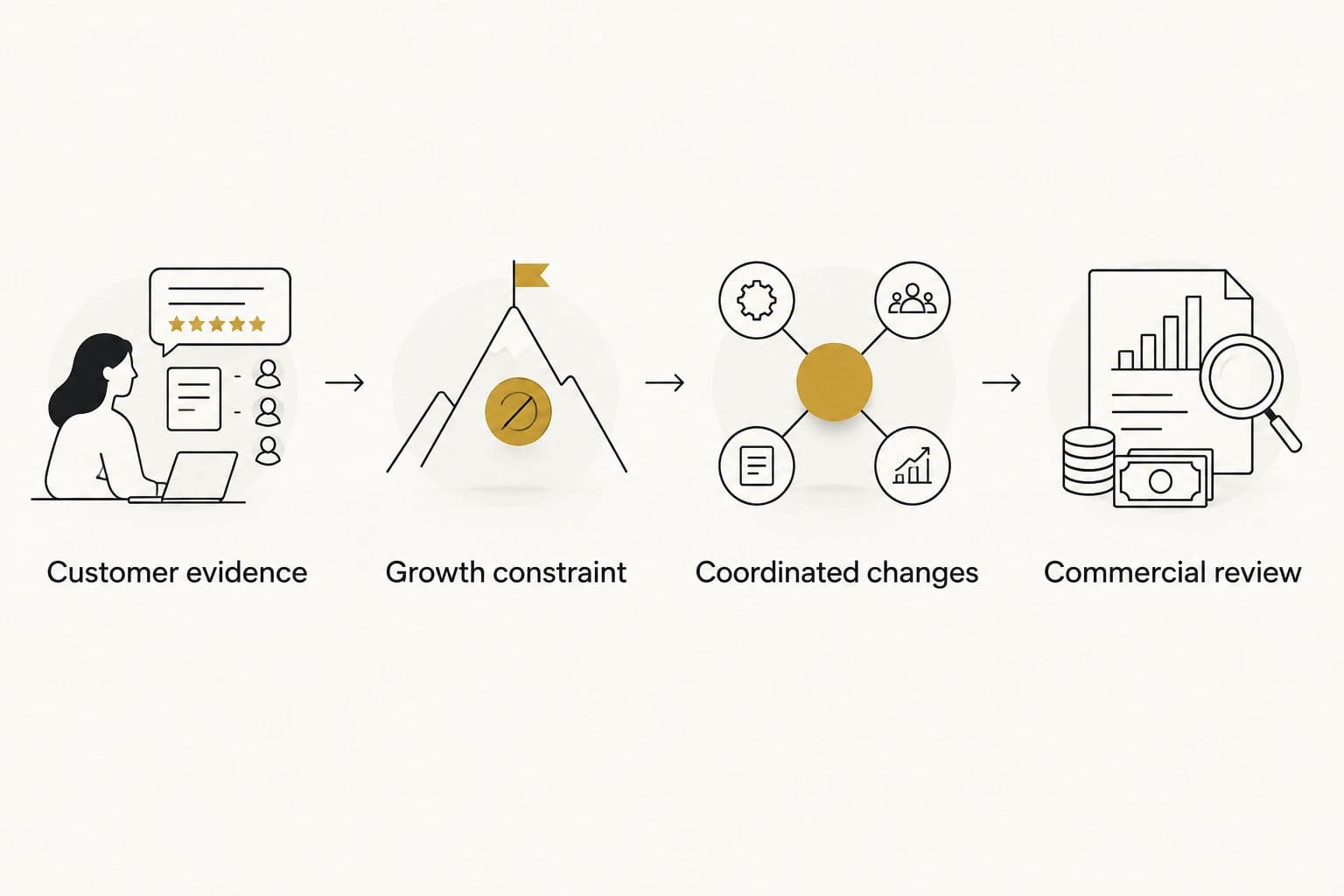
Customer evidence becomes useful when it informs a change and a review of the result.
Zonka Feedback belongs at the evidence stage when customer responses are needed. Your team or a service partner still owns the wider implementation.
The growth service has its own dependency: access to the people, systems and decisions needed to do the work. An external partner cannot remove the need for internal participation.
Neither option replaces commercial measurement
Tie: both need business context before you can judge their value. Customer sentiment and campaign performance answer different questions, and neither should stand alone.
Return on ad spend, or ROAS, measures revenue attributed to advertising relative to advertising spend. Cost per customer measures acquisition spending against customers acquired. Neither is identical to profit.
Our published client results illustrate the commercial outcomes relevant to this decision:
- Sniffspot: cost per host acquired down 78%, with host growth roughly ninefold.
- Kidney Coach: ROAS from 1.33 to over 3.8, with profit up roughly 45% while ad spend fell nearly 40%.
These are specific client outcomes, not forecasts for your business. They also are not a head-to-head test against Zonka Feedback.
For your 2026 measurement plan, define the business result before selecting the reporting view. If you are investigating lost sales, connect feedback to the relevant buying journey. If you are addressing acquisition economics, examine the costs and outcomes that determine whether growth makes financial sense.
Both options need an owner after the purchase
Tie: neither choice makes follow-through automatic. A service engagement needs timely decisions and business context. A software purchase needs a capable operator and someone accountable for action.
Before signing anything, answer these questions:
- Who can approve changes to the offer or message?
- Who owns the website and conversion process?
- Who checks that tracking reflects the intended customer action?
- Who decides whether a finding deserves work now?
- Who assesses the commercial result after a change?
These are operating questions, not feature comparisons. If nobody can answer them, another platform will not create accountability.
The service route adds external execution capacity across its agreed scope. The software route preserves internal ownership of the wider work. Choose deliberately rather than assuming either purchase includes responsibilities you have not assigned.
Pricing: compare responsibilities, not unlike fees
A meaningful pricing comparison starts with what you are buying. Software access and a growth service do not carry the same responsibilities, so comparing their fees alone produces the wrong decision.
For the service engagement, ask what the agreed scope covers, which work remains internal and how changes to priorities affect delivery. Predictability comes from explicit responsibilities, not from a long list of possible services.
For the software purchase, review the current commercial terms against the workflow you need. Include the internal effort required to design research, interpret responses and implement changes.
For a 2026 budget decision, compare the complete operating requirement:
- What work does the purchase cover?
- What work still needs employees or another partner?
- Who owns implementation?
- How will you assess value?
Buy the narrower option when your team can complete the remaining work. Buy broader support when execution across connected functions is the actual requirement. Neither approach is automatically better value without that distinction.
Final verdict: choose the owner of the work you need
Choose The fVnnel for coordinated growth execution
You are an established business owner or marketing lead with customer demand and revenue to invest. Your constraint crosses positioning, acquisition, creative, conversion or tracking, and you need a partner to help connect and execute the work.
The fVnnel wins for this profile because the requirement is a growth service, not a feedback tool. Do not choose this route merely to obtain a survey workflow.
Choose Zonka Feedback for an internally owned feedback program
You lead a marketing or customer experience team with a defined research question. You have people who can interpret customer responses, prioritize the findings and implement the changes.
Zonka Feedback wins for this profile because dedicated feedback software matches the immediate job. Do not expect the purchase itself to supply broader growth strategy or execution ownership.
| Dimension | Winner |
|---|---|
| Cross-functional growth problem | The fVnnel |
| Direct operation by an equipped internal team | Zonka Feedback |
| Connected strategy and execution | The fVnnel |
| Dedicated customer feedback collection | Zonka Feedback |
| Implementation across marketing functions | The fVnnel |
| Need for commercial context | Tie |
| Need for internal accountability | Tie |
| Pricing fit | Match the purchase to the responsibilities |
FAQ
Is The fVnnel better than Zonka Feedback?
The fVnnel is the better fit when an established business needs coordinated growth strategy and execution. Zonka Feedback is the better fit when the requirement is customer feedback software and your team owns the resulting changes.
Are a growth partner and customer feedback software alternatives?
They are alternatives only when you are deciding which problem deserves investment first. A growth partner supplies services, while customer feedback software supports a research workflow.
Should I buy survey software if customer acquisition costs are rising?
Buy survey software when a defined customer research question is blocking your next decision. Rising acquisition costs also require examination of the offer, message, conversion process and measurement.
Can I use Zonka Feedback alongside a growth partner?
Yes, feedback software and a growth service can serve different roles in the same business. Assign ownership for collecting responses, interpreting findings and implementing changes.
How should I compare the cost of these options in 2026?
Compare responsibilities and total operating effort rather than fees alone. Review the service scope, current software terms and the internal work required after either purchase.
What should I prepare before choosing a growth partner?
Prepare the business outcome, the suspected constraint and the people responsible for decisions. Bring relevant acquisition, conversion and customer evidence so the discussion starts with the problem rather than a channel wish list.
One last thing
Before buying either option, write the action you would take if customers confirmed your main suspicion. If you know the action and have someone ready to execute it, a feedback tool fits the next step.
If the action requires unresolved changes across your offer, website, acquisition and tracking, the larger decision is who will own that work. Do not commission more research to postpone an implementation decision.