
Choose The fVnnel if your established business needs strategy, acquisition, creative, conversion and tracking managed together; choose SurveySparrow if your team needs software to collect customer feedback and already owns the work that follows. The distinction in 2026 is a growth partner versus a survey platform, not competing versions of the same service.
TL;DR
- The fVnnel vs SurveySparrow compares growth services with survey software, not interchangeable products.
- Choose the growth partner when acquisition, messaging, conversion and tracking need coordinated work.
- Choose SurveySparrow when customer feedback collection is the task and your team can act on the answers.
- Judge the decision by ownership and business outcomes, not the length of a feature list.
Why this matters
A customer survey can reveal an objection. It does not rewrite your offer, change your advertising or repair the page where customers abandon the purchase. Those are separate jobs, and someone must own them.
The reverse matters too. Hiring outside growth support is not a substitute for choosing survey software when your immediate requirement is collecting structured responses. Buy the capability your business lacks, not the broader category that sounds more useful.
For a 2026 buying decision, separate information collection from implementation. An established business with a capable marketing team has a different need from one whose acquisition, website and measurement work have become disconnected.
At a glance
| Dimension | The fVnnel | SurveySparrow |
|---|---|---|
| Best for | Established businesses needing coordinated growth work | Teams needing survey and customer feedback software |
| Standout capability | Strategy, acquisition, creative, conversion, SEO and tracking run as one system | Building surveys and collecting customer responses |
| Execution ownership | Service work across the stated growth disciplines | Your team owns the business changes that follow feedback |
| Feedback collection | Not positioned as a standalone survey product | Direct fit for collecting structured feedback |
| Internal control | External support for growth work | Software your team uses within its own workflow |
| Feedback-informed decisions | Business questions should guide the work | Business questions should guide survey design |
| Measurement standard | Judge work against business economics | Judge feedback against the decision it informs |
| Pricing model | Evaluate the service agreement and defined scope | Evaluate the software subscription and selected plan |
The table identifies category fit, not a feature-by-feature software contest. A service engagement and a survey subscription create different responsibilities inside your business.
A growth partner wins when the problem spans channels
The fVnnel is a growth partner for established businesses that need strategy, acquisition, conversion and tracking to work together. That is the clearest reason to choose the service rather than another piece of software.
Consider an established consumer brand whose ads attract interest but whose landing pages fail to explain the offer. Survey responses can help identify confusion. Fixing it still requires positioning decisions, creative changes, website work and reliable measurement.
Our stated work covers strategy and positioning, paid acquisition, performance creative, websites and conversion, search engine optimization [SEO], and tech and tracking. The advantage is the connected scope: the work can address more than the symptom visible in a single dashboard.
The limitation is equally clear. You are choosing a service relationship, not simply adding a survey builder to your team’s toolkit. If your only requirement is sending a feedback questionnaire, that broader scope is the wrong starting point.
Winner: the growth partner for a connected execution problem. Survey software is not a replacement for the people responsible for changing the business.
SurveySparrow wins when collecting responses is the job
SurveySparrow is survey and customer feedback software. Its direct fit is helping a team ask questions and collect responses, rather than providing the growth services described above.
That distinction matters for an education business reviewing a course or an event business gathering attendee feedback. If your team knows what it wants to learn and has an owner ready to act, a survey platform addresses the immediate task.
The advantage is focus. You can make a software decision around your questionnaire, respondent experience and feedback workflow instead of starting a wider service engagement.
The limitation is the boundary of the job. A response about confusing messaging does not establish which advertisement to change. A complaint about booking does not assign someone to repair the booking journey.
Winner: SurveySparrow for structured feedback collection. Choose it when collecting answers is the missing capability, not when the unresolved issue is who will implement the changes.
Connected execution favors the service relationship
Execution becomes a different problem when the same customer journey crosses several disciplines. An advertisement makes a promise, a page explains it, a checkout or booking process converts it, and tracking records the result.
When those pieces disagree, improving one in isolation leaves the rest untouched. A better advertisement cannot correct an unclear offer after the visitor arrives.
Our service scope brings those disciplines into one system. That gives an established business a way to commission connected work rather than treating each channel as an unrelated assignment.
Before choosing any service partner, define the handoffs:
- Diagnosis: Which business constraint needs attention?
- Decision: Who chooses the change to make?
- Execution: Who implements the change?
- Measurement: Which business outcome determines whether it worked?
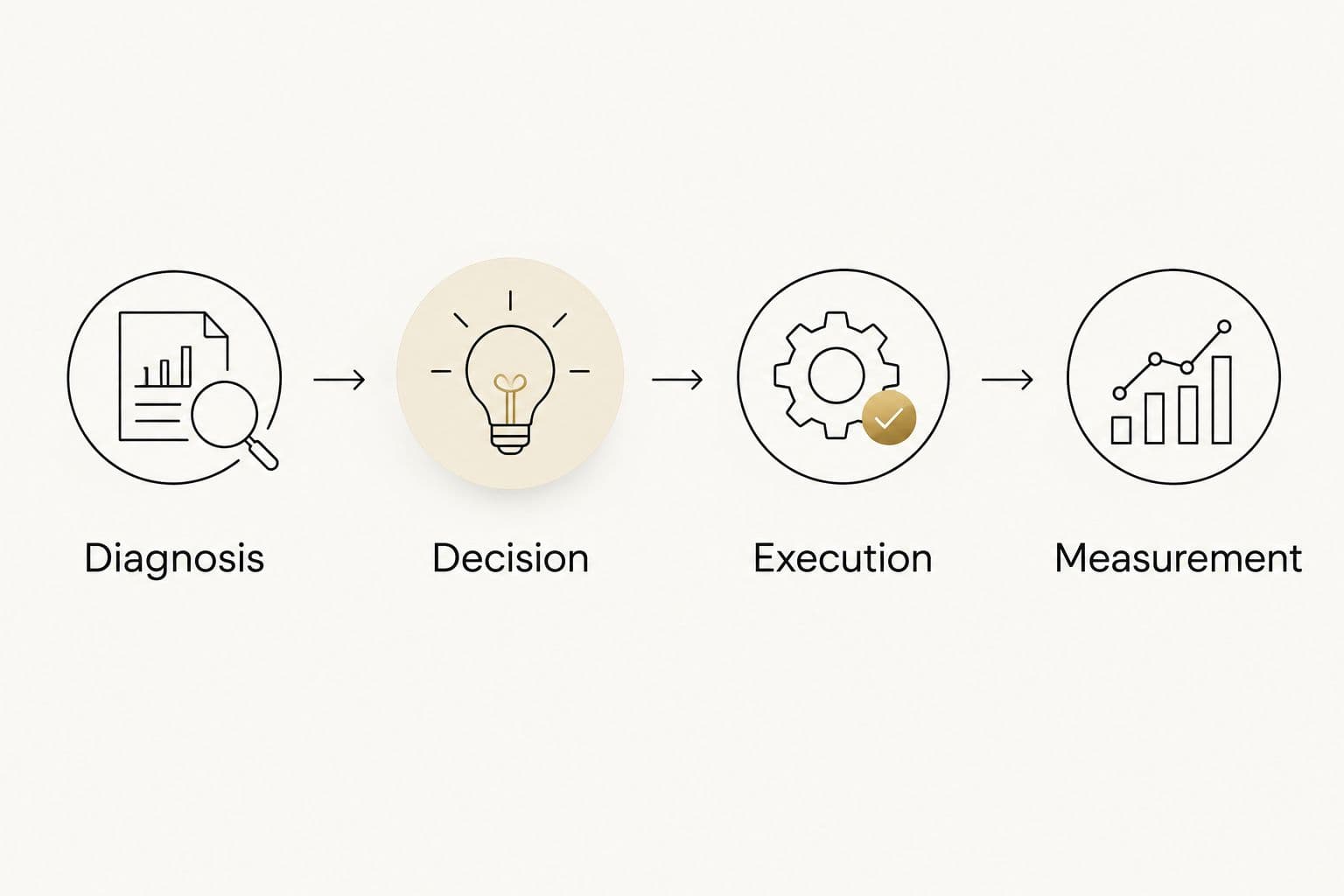
Collecting information is only part of the work; decisions and implementation need owners too.
A survey platform contributes information to this process. It does not, by itself, supply ownership of every step. Winner: the service relationship when you need implementation across the stated growth disciplines.
SurveySparrow wins when your team wants to keep execution
External support is not automatically an advantage. If your internal team already owns strategy, creative, website changes and reporting, the missing piece can be much narrower.
For example, an established technology company might need customer responses before revising its onboarding messages. The marketing lead can define the questions, interpret the findings and assign changes internally. In that situation, survey software fits the operating model.
The benefit is retaining direct responsibility for the work. You add a feedback capability without replacing the team’s existing decision process.
The cost is internal effort. Someone still needs to write useful questions, organize the research, interpret responses and resolve conflicting signals. Software does not remove that responsibility.
Winner: SurveySparrow when your team wants to own implementation. For your 2026 plan, make that ownership explicit before comparing subscriptions with service proposals. An unassigned task remains unassigned after you buy software.
Both approaches need a clear question before collecting evidence
Tie: neither option makes an unclear business question useful. Before commissioning work or building a survey, name the decision you need to make.
“Understand customers better” is too broad to direct useful work. “Find out why qualified prospects hesitate before booking” connects the research to a specific point in the buying journey.
The same discipline applies to a coaching business investigating enrollment objections and a wellness brand reviewing repeat purchases. Ask about the decision customers actually faced, then separate their reported experience from your interpretation.
A practical brief should state:
- The customer group you need to understand.
- The point in the journey you are investigating.
- The decision the findings will inform.
- The person responsible for the next action.
Neither a service relationship nor a survey platform eliminates the need for that brief. Both become easier to evaluate when you can explain what a useful answer would change.
Avoid treating every response as an instruction. A customer’s explanation is evidence to consider alongside purchase behavior and commercial results, not an automatic roadmap.
Both need measurement tied to the business decision
Tie: the measurement standard should follow the business objective. Customer responses help explain experience; revenue, acquisition cost and profit answer different questions.
Cost per customer means the acquisition spending required to gain a customer. Return on ad spend [ROAS] means revenue attributed to advertising divided by advertising spend. Neither measure is interchangeable with profit.
Our stated client results illustrate the commercial measures used in growth work:
- Sniffspot: cost per host acquired down 78%, host growth roughly ninefold.
- Kidney Coach: return on ad spend from 1.33 to over 3.8, profit up roughly 45% while ad spend fell nearly 40%.
These are client outcomes, not a controlled comparison with SurveySparrow and not a forecast for your business. They show the distinction between measuring a business result and measuring the collection of feedback.
For your 2026 evaluation, match evidence to the purchase. Evaluate survey software against the research task it must support. Evaluate growth services against the work commissioned and the commercial outcomes that work is intended to improve.
Do not credit either option with an outcome merely because it appears somewhere in the workflow.
Pricing: compare the responsibility you are buying
A software subscription and a service agreement purchase different things. Comparing their invoice totals without comparing responsibilities produces a misleading decision.
For survey software, evaluate the selected plan against your actual research requirements. Confirm the current terms directly, including the features and usage conditions relevant to your workflow. Your team’s time remains part of the operating commitment.
For a service engagement, evaluate the proposed scope, deliverables, responsibilities and reporting. Ask which work the agreement includes and which tasks remain with your team. A broad description is not a substitute for a clear agreement.
The tradeoff is control versus delegated work, not simply flexibility versus predictability. Software leaves implementation with your team. A defined service scope assigns agreed work outside it.
For a 2026 budget, write down the full work required before choosing either model:
- Who designs the research or diagnoses the problem?
- Who makes the decision after reviewing evidence?
- Who changes the message, campaign or website?
- Who checks whether the change improved the outcome?
Neither model wins on cost without a defined requirement. Compare complete responsibilities, not a software subscription against an unspecified service scope.
Final verdict: choose by the work your business needs
Choose The fVnnel if you need coordinated growth execution
Best for: the owner or marketing lead of an established business with demand, revenue to invest and a growth problem spanning several disciplines.
Choose the service when the issue is not merely learning what customers think. You need decisions and implementation across positioning, paid acquisition, creative, conversion, SEO or tracking, with attention to how those pieces affect one another.
Do not start here solely because you need to distribute a questionnaire. Buy the broader service for broader work.
Choose SurveySparrow if your team needs survey software
Best for: the marketing or customer experience lead whose team owns implementation and needs a platform for structured feedback.
Choose the software when the research question is clear, the team can interpret responses and someone already owns the next action. Its category matches that requirement directly.
Do not expect buying survey software to resolve disconnected execution. Better information still needs someone to turn it into a change.
| Dimension | Winner |
|---|---|
| Coordinated growth scope | Growth partner |
| Structured feedback collection | SurveySparrow |
| Cross-discipline implementation | Growth partner |
| Keeping execution internal | SurveySparrow |
| Defining the research question | Tie |
| Matching evidence to the decision | Tie |
| Pricing | Determined by scope and responsibilities |
FAQ
Is The fVnnel better than SurveySparrow?
The fVnnel is the better fit when an established business needs coordinated growth services; SurveySparrow is the better fit when a team needs survey software. They address different jobs, so the decision starts with the work you need done.
Is SurveySparrow a replacement for a growth agency?
No. SurveySparrow provides survey and customer feedback software, while a growth agency provides services. Collecting responses does not replace responsibility for changing campaigns, messaging or websites.
Which option is better if I only need customer surveys?
SurveySparrow is the more direct fit for a customer survey requirement. Choose around the research workflow and confirm that your team owns interpretation and follow-up.
Can a business use survey software and a growth partner together?
Yes. Survey software can collect customer feedback while a growth partner works on agreed business changes. Define responsibilities so collecting answers leads to a decision rather than another report.
How should I compare the costs?
Compare the full responsibilities, not just the invoices. Review the software subscription terms, the proposed service scope and the internal work required under each option.
Will collecting more feedback improve return on ad spend?
More feedback alone does not establish an improvement in return on ad spend. Feedback needs to inform a specific change, and the resulting advertising performance needs separate measurement.
What should I decide before buying either option?
Decide whether your main gap is information or execution. Then name the business question, the next decision and the person responsible for implementing it.
One last thing
Before you buy anything, finish this sentence: “When we get the answer, this person will make this change.” If you cannot name the person or the change, the immediate problem is ownership, not software selection.
That test prevents a useful survey from becoming an unused report. It also prevents a service engagement from starting without a clear job to do.