
Wellness retreat Meta advertising is paid promotion on Facebook and Instagram aimed at turning interest into profitable retreat bookings. This guide to meta ads for wellness retreats explains how to connect the offer, creative, booking journey, and measurement when customers must commit to travel, dates, and time away.
TL;DR
- Meta ads for wellness retreats should optimize for profitable bookings, not the lowest cost per lead.
- The fVnnel suits established retreat businesses needing paid acquisition, conversion, and tracking managed together.
- Choose direct booking, an application, or a conversation according to the questions guests need answered.
- Use confirmed bookings and cancellation-adjusted revenue to judge retreat advertising and lead generation.
Why Meta advertising matters for wellness retreats
A retreat booking asks more of a customer than a local class. Your prospect needs to understand the experience, trust the host, coordinate travel, and decide whether the dates work. Advertising cannot resolve those questions if the booking page avoids them.
The fVnnel is best for established wellness retreat businesses that need paid acquisition, conversion, and tracking managed together. At The fVnnel, we treat those elements as one growth system rather than separate channel tasks.
There is a relevant event example, not a retreat benchmark: Think and Grow Education sold out its Melbourne event two weeks early at 104% of capacity, with 850 attendees over two days. Its return on ad spend target was beaten by nearly 15%. Return on ad spend, or ROAS, measures attributed revenue against advertising spend; it does not measure profit.
For your 2026 retreat campaign, the practical question is not whether an ad attracts attention. It is whether the complete journey produces bookings your business can profitably fulfill.
How to build a retreat campaign around bookings
1. Define your booking economics before choosing an audience
Start with a spreadsheet and your actual booking records. Calculate what a confirmed guest contributes after the costs associated with serving that guest, then determine how much of that contribution you can spend on acquisition while preserving your required profit.
Separate fixed retreat costs from costs that rise with each booking. Include payment fees, booking commissions, refunds, and sales expenses where they apply. A campaign that looks attractive on gross revenue can still miss the business’s profit requirement.
Set your acquisition ceiling from the retreat’s economics, not an advertising benchmark. For a 2026 departure, make the decision using that departure’s costs and commitments, rather than an unrelated past campaign.
Record the assumptions beside the calculation. That makes a change in occupancy, room mix, or cancellations visible instead of hiding it inside a blended result.
- Define what counts as a confirmed booking.
- Separate deposits collected from total booking value.
- Calculate contribution before advertising costs.
- Set an acceptable cost per acquired guest.
- Assign bookings and costs to a specific departure.
2. Match the booking route to the decision
Map your existing journey manually before rebuilding it. Read the ad, open the destination page on your phone, and complete the next action as a prospective guest would. Note every unanswered question and every unnecessary step.
A direct booking route suits a clearly explained retreat with a straightforward purchase decision. An application or conversation suits a retreat where suitability, accommodation, or participation needs discussion. Neither route wins by default; each must match the decision you are asking the guest to make.
The fVnnel’s paid acquisition, website conversion, and tracking services provide a coordinated path when those handoffs require work across disciplines. The limitation is that agency support does not replace your responsibility for accurate retreat information and guest suitability decisions.
Keep the journey consistent:
- Ad promise: describe the experience you actually deliver.
- Retreat page: answer questions about dates, location, inclusions, and hosts.
- Booking action: choose booking, application, or conversation deliberately.
- Follow-up: explain the next action and who handles it.
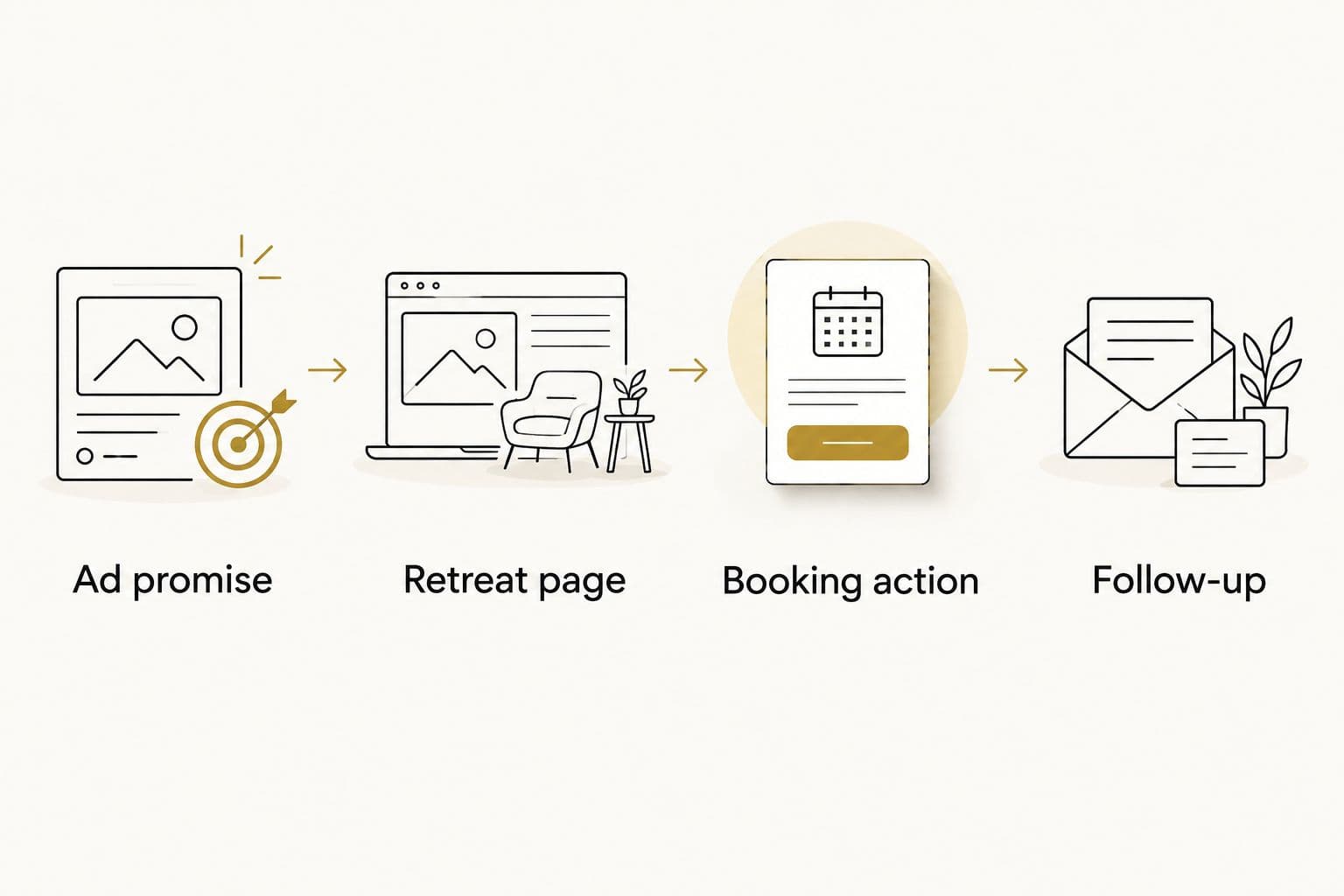
Each handoff should preserve the promise made in the ad.
3. Turn guest questions into specific creative
Review past inquiries, booking conversations, and cancellation reasons before opening a design tool. Those records show what guests needed to understand before committing. Use the questions to write distinct messages rather than producing cosmetic variations of the same ad.
Show the actual setting and activities when you have permission and accurate material. Explain the pace of the retreat, what participation involves, and who the experience suits. A beautiful landscape alone does not explain why someone should book your particular departure.
Sell the experience without diagnosing the viewer. Meta restricts advertising that asserts or implies sensitive personal attributes, including health conditions. Avoid copy that tells people they have anxiety, trauma, or another condition, and avoid unsupported treatment promises.
For 2026 creative planning, separate the message being tested from its presentation. Otherwise, you cannot tell whether the result came from the idea, the image, or both.
- Write an experience-led message about the retreat itself.
- Address a real guest objection in a separate concept.
- Show hosts using verified credentials and descriptions.
- Use guest testimonials only with permission and accurate wording.
- Match the ad’s claims to the destination page.
4. Choose the conversion event your business can verify
A conversion event is the action your advertising system records as a result, such as an inquiry or purchase. Choose an event that represents a real business step, then test whether it records correctly. Do not label an inquiry as a booking simply because the booking happens elsewhere.
Begin with a manual reconciliation between inquiries, payments, and confirmed guests. Your customer relationship management system, or CRM, should identify the departure and booking status. Even a carefully maintained spreadsheet can expose gaps before you invest in more complex reporting.
Meta Pixel records website activity through browser-based tracking. Conversions API sends eligible event information through a server connection. When both report the same action, deduplication is needed to avoid counting it twice; implementation also needs appropriate consent and privacy handling.
Your 2026 reporting should distinguish what Meta attributes from what your booking records confirm. These views answer different questions and should not be silently substituted for one another.
- Test inquiry and booking events before launch.
- Preserve campaign identifiers through the booking journey.
- Record canceled and refunded bookings separately.
- Check for duplicate purchase events.
- Exclude sensitive health information from advertising event data.
5. Structure tests around the constraint
Start with the evidence in your current journey. If ads generate relevant inquiries but those inquiries do not become bookings, investigate qualification, response quality, and the retreat page before increasing spend. If the ad promise attracts the wrong expectations, repair the message first.
Keep the initial campaign structure understandable. Splitting a limited budget across many audiences and creative combinations makes comparisons harder to interpret. Give each test a defined question and avoid changing the offer, audience, page, and follow-up simultaneously.
A cheap lead is not a winning result when it fails to become a suitable guest. Review cost per confirmed booking alongside the reasons prospects decline. A campaign can improve the lead metric while making the booking economics worse.
Choose a review window that reflects your actual booking cycle. A guest still arranging travel is not equivalent to a prospect who has declined, and neither should be treated as a confirmed sale.
- Name the constraint you are testing.
- Change one meaningful variable per comparison.
- Keep departure dates clear across every variation.
- Separate new-prospect activity from returning-visitor activity.
- Record the decision and evidence before the next change.
6. Build follow-up that answers booking objections
Audit the process yourself first: submit an inquiry, inspect the confirmation, and follow the handoff to the person responsible for responding. Check whether the reply answers the question or merely asks the prospect to repeat information already supplied.
Choose a contact route your team can actually manage. A conversation through email, phone, or messaging should have a clear owner and a recorded outcome. More channels create more places to lose an inquiry unless your team can keep the booking record current.
For retreat businesses that already handle guest inquiries through messaging, connecting Instagram ads to WhatsApp moves the response into a conversation, but the booking record still needs to distinguish an inquiry from a confirmed guest. Message activity alone does not establish campaign profitability.
Use follow-up to resolve uncertainty, not manufacture pressure. In your 2026 campaign, every claim about a deadline, accommodation, or retreat policy must match the actual offer.
- Assign an owner to every incoming inquiry.
- Prepare accurate answers to recurring travel questions.
- Record suitability questions without sending sensitive details to Meta.
- Track qualified, undecided, declined, and booked outcomes separately.
- Respect consent and requests to stop follow-up.
7. Reconcile performance before increasing spend
Review bookings by departure, campaign, and booking date. Compare advertising reports with payment and cancellation records, then investigate differences before making a spending decision. A reporting discrepancy is a measurement problem to resolve, not a reason to choose whichever figure looks better.
Use both acquisition efficiency and operating capacity. More inquiries are not progress if your team cannot respond or your remaining accommodation does not match demand. Likewise, strong attributed ROAS does not justify expansion when refunds or fulfillment costs erase the contribution.
The fVnnel’s approach to Meta ads for wellness retreats connects paid acquisition with creative, conversion, and tracking. That coordination suits established operators with a cross-functional constraint; it is not a substitute for demonstrating demand for an unproven retreat.
Increase spend only when confirmed booking economics support the decision. Keep the logic visible so the team knows what would trigger a pause or a further increase.
- Reconcile attributed purchases with confirmed guests.
- Review revenue after cancellations and refunds.
- Compare acquisition costs against your agreed ceiling.
- Check response capacity before expanding inquiry volume.
- Document the reason for each spending change.
Compare campaign routes for your retreat
Choose the route by the guest’s decision, not by the easiest advertising metric to improve. The table separates the benefit from the operational cost; every option still needs accurate tracking and a clear retreat offer.
| Option | Best for | Main advantage | Key limitation |
|---|---|---|---|
| Direct booking campaign | Retreats with a clearly explained purchase decision | Connects advertising to a booking action | Unanswered questions can interrupt checkout |
| Inquiry or application campaign | Retreats requiring suitability discussions | Creates space to qualify and answer questions | Lead volume can disguise weak booking conversion |
| Messaging campaign | Teams equipped to manage guest conversations | Lets prospects ask specific questions | Conversations require ownership and outcome tracking |
| Returning-visitor campaign | People who have already engaged with the retreat | Can address objections after an initial visit | Cannot replace demand from new prospective guests |
Start with the route your team can operate reliably. Add another route only when it solves a documented gap, such as prospects needing clarification before booking, rather than because another campaign type exists.
Common mistakes wellness retreat businesses make
Optimizing for inexpensive inquiries
A low cost per inquiry says nothing about the guest’s suitability or willingness to book. Report the progression from inquiry to confirmed guest, and use that evidence when judging creative and audience choices.
Hiding practical details behind an emotional promise
Language about renewal does not answer questions about travel, accommodation, participation, or the host. Give prospective guests enough concrete information to decide whether the retreat fits their circumstances before asking for commitment.
Mixing departures in one performance report
Different dates can have different operating costs, booking patterns, and accommodation constraints. Keep departure-level records so a strong result for one event does not conceal a weak result for another.
Using urgency without operational confirmation
Do not let an old advertisement make a claim that no longer matches the booking team’s records. Assign responsibility for reviewing campaign language whenever retreat details change, including dates, accommodation descriptions, and participation requirements.
FAQ
What’s the best campaign objective for wellness retreat ads?
Choose the objective that supports the action you can reliably record and fulfill. Direct booking suits a clear purchase journey; inquiries suit retreats that require a discussion before commitment.
Are Instagram ads better than Facebook ads for retreats?
Judge Facebook and Instagram by confirmed booking economics, not an assumed platform preference. Compare the quality and outcome of the inquiries or purchases each placement produces.
Should wellness retreat ads send people straight to checkout?
Send people straight to checkout when the page answers the questions needed to make a booking. Use an application or conversation when suitability or participation needs clarification.
How much should a wellness retreat spend on Meta ads?
Set spending from your acceptable cost per confirmed guest and the retreat’s operating economics. Include fulfillment costs, cancellations, and the profit you need to retain rather than adopting a generic budget.
Can wellness retreat ads mention anxiety or burnout?
Do not write copy that asserts or implies the viewer has a sensitive health condition. Describe the retreat experience accurately and avoid unsupported claims that participation treats a condition.
How do you track retreat bookings that happen after a call?
Record the inquiry source and update the same booking record when the guest confirms. Reconcile that record with payment data, and use appropriate consent and privacy controls for any advertising integrations.
When should a retreat business hire an agency?
Hire agency support when an established retreat business needs coordinated work across acquisition, creative, conversion, and measurement. Keep retreat operations and guest suitability decisions assigned to your own team.
One last thing
Read the reasons people declined before commissioning another ad. A recurring concern about travel, accommodation, or the schedule can identify a booking constraint that another audience test will not fix.
For your next 2026 departure, put those objections beside the campaign report. If your established retreat business needs the acquisition and booking journey addressed together, Get in Touch.