
Survicate gives agencies a dedicated way to collect customer feedback through surveys. Its ceiling is the decision after the response: collecting feedback does not itself fix positioning, acquisition or conversion. The best Survicate alternative in 2026 is The fVnnel if you need a growth partner to act on customer insight; Typeform if you need a form-led survey experience.
TL;DR
- Compare Survicate alternatives for agencies by the decision you need to make, not the length of the feature list.
- The fVnnel is the growth partner option, not a replacement survey platform.
- Choose Typeform for form-led feedback, SurveyMonkey for survey research, or Qualtrics for broader experience management.
- Keep Survicate when feedback collection works and the real constraint sits elsewhere in your growth system.
Why this matters
A client does not need another dashboard of customer opinions. They need to know which objection to address, which page to change and whether the change improves the economics of acquiring customers.
That distinction matters when you compare Survicate alternatives for agencies. You can replace the survey platform, improve the research process or bring in a partner to connect the findings to execution. Those are different purchases.
The fVnnel is best for established businesses that need customer insight connected to growth execution, not another survey subscription. If you already know what to ask and who will act on the answers, compare software instead.
Survicate alternatives at a glance
This 2026 shortlist separates feedback collection from growth services. It is not a ranking of interchangeable products: the service option addresses a different need from the survey platforms.
| Option | Best for | Core strength | Difference from Survicate |
|---|---|---|---|
| Survicate | Keeping a dedicated customer-feedback workflow | Customer feedback surveys | The benchmark when your existing collection process works |
| The fVnnel | Established businesses needing coordinated growth execution | Strategy, acquisition, creative, conversion, SEO and tracking as one system | A growth service, not survey software |
| Typeform | Form-led feedback and question flows | A question-by-question form experience | An alternative when the response experience drives your choice |
| SurveyMonkey | Teams running structured survey research | Survey creation and analysis | An alternative centered on questionnaire-based research |
| Qualtrics | Organizations evaluating broader experience management | Research and experience-management software | A broader scope than a standalone survey requirement |
The right comparison starts with ownership. Who writes the questions, interprets the responses, approves the change and measures the outcome? A software feature does not answer those operating questions for you.
1. The fVnnel: best for acting on customer insight
We connect strategy and positioning, paid acquisition, performance creative, websites and conversion, SEO, and tech and tracking. For an established business, that means customer feedback can inform the message, the campaign and the destination page rather than becoming a separate research exercise.
This is a service alternative, not a software substitute. You would still need a suitable way to collect responses if surveys remain part of your process.
Where The fVnnel shines
- Connected execution: We treat the message, channels, conversion experience and measurement as parts of the same growth system.
- Commercial priorities: We buy media on business economics rather than attention metrics alone.
- Established demand: Our work fits businesses that already have customers and revenue to invest in growth.
Where the service falls short
- It does not replace a survey builder or provide a self-service feedback interface.
- It is the wrong purchase when your only requirement is to create and distribute questionnaires.
- It is not positioned for businesses still establishing whether customers want their offer.
The commercial evidence belongs to the growth work, not to any survey platform. For Kidney Coach, return on ad spend, meaning revenue attributed to advertising divided by advertising spend, moved from 1.33 to over 3.8. Profit increased roughly 45% while ad spend fell nearly 40%.
Those results do not establish that changing a feedback tool improves profit. They demonstrate the kind of business outcome that matters when deciding whether you need software or execution support.
| Dimension | Growth partner | Survicate |
|---|---|---|
| What you buy | Coordinated growth services | Customer-feedback software |
| Main output | Strategy and execution across growth activities | Collected customer feedback |
| Survey requirement | A separate collection method is still needed | Survey collection is central |
Best for: Established businesses with a growth constraint that crosses messaging, acquisition, conversion and measurement.
Verdict: Buy the service route when execution is the gap. Skip it for a survey-only requirement.
2. Typeform: best for form-led feedback
Typeform is a form and survey platform known for presenting questions as a step-by-step experience. Choose it when the interaction itself matters, such as a feedback form that needs a clear progression from context to a specific answer.
For an agency, the useful question is not whether that format looks different. It is whether it suits the information you need and the situation in which someone will respond.
Where Typeform shines
- A question-by-question format gives the questionnaire a clear sequence.
- Forms can support feedback collection as well as other question-based workflows.
- It is a distinct option when your brief starts with the form experience rather than a wider feedback program.
Where Typeform falls short
- A different presentation does not establish that you will receive more useful answers.
- It does not decide which customer segment to research or which business change to prioritize.
- If your current workflow already works, a format change alone is a weak reason to migrate.
| Dimension | Typeform | Survicate |
|---|---|---|
| Evaluation focus | Form and question flow | Customer-feedback workflow |
| Core use here | Collecting answers through forms | Collecting customer feedback through surveys |
| Decision test | Does this format fit the questionnaire? | Does the existing feedback process meet the brief? |
Best for: Agencies choosing a form-led way to ask customers a defined set of questions.
Verdict: Buy when the question flow solves a documented requirement. Hold if appearance is the only reason to switch.
3. SurveyMonkey: best for structured survey research
SurveyMonkey is a survey platform for creating questionnaires and analyzing responses. Put it on your shortlist when the assignment is a defined research project rather than a broader growth engagement.
Start with the research question. Comparing customer objections, evaluating a proposition and collecting satisfaction feedback require different questionnaires, even when they use the same platform.
Where SurveyMonkey shines
- Survey creation and response analysis sit at the center of the product category.
- It is a relevant option for teams that organize their work around research questions and questionnaires.
- It gives you a software route without turning a survey requirement into an agency engagement.
Where SurveyMonkey falls short
- It does not remove the need for sound question design or a relevant respondent group.
- Survey findings still need an owner who can turn them into changes.
- A familiar platform name is not evidence that its workflow fits your client accounts.
| Dimension | SurveyMonkey | Survicate |
|---|---|---|
| Core purpose | Survey research | Customer-feedback collection |
| Evaluation focus | Questionnaire and analysis requirements | Feedback collection requirements |
| Work outside software | Research design and implementation | Research design and implementation |
Best for: Agencies with a clear research brief and someone responsible for interpreting the answers.
Verdict: Buy when the research workflow fits. Hold until you have tested the actual questionnaire.
4. Qualtrics: best for broader experience management
Qualtrics provides research and experience-management software. Evaluate it when your requirements extend beyond an isolated survey and involve a broader organizational feedback program.
Broader scope is not automatically a benefit. In a 2026 selection process, make the required workflow explicit before comparing platforms with different remits.
Where Qualtrics shines
- It belongs on a shortlist for broader research and experience-management needs.
- It offers a different evaluation category when a standalone questionnaire is not the whole assignment.
Where Qualtrics falls short
- A broad platform does not remove the need for clear ownership and research design.
- It is an unnecessary evaluation detour if your requirement is simply a working feedback form.
| Dimension | Qualtrics | Survicate |
|---|---|---|
| Scope to evaluate | Research and experience management | Customer-feedback surveys |
| Best-fit brief | Broader organizational program | Defined feedback-collection workflow |
| Selection question | Is the wider scope required? | Does the collection workflow fit? |
Best for: Organizations with a documented need for broader experience management.
Verdict: Buy only against a defined program. Skip a scope upgrade without a business requirement.
Why people switch from Survicate
A defensible reason to switch is a mismatch between the work and the platform. That is different from assuming Survicate has failed because growth has slowed.
Use these requirement-led reasons to structure your 2026 review:
- Question flow: You need a different respondent experience for a specific questionnaire.
- Research scope: Your assignment has become a wider research or experience-management program.
- Execution gap: You already collect useful feedback, but nobody connects it to campaigns, pages or offers.
- Operating fit: Your team needs a workflow that matches its documented responsibilities and approval process.
Do not infer a platform limitation from an unanswered business question. If you have not defined the respondent, the decision and the action owner, changing software leaves the underlying problem intact.
Test the workflow before you migrate
A practical 2026 evaluation follows the work from question to decision. Use the same research brief for each candidate so that presentation differences do not distract from the actual requirement.
- Research question: State the business decision the answers will support.
- Respondent group: Define whose experience is relevant to that decision.
- Collection: Build the questionnaire and inspect the response experience.
- Decision owner: Assign someone to interpret the findings and approve action.
- Outcome check: Define how you will judge the resulting change.
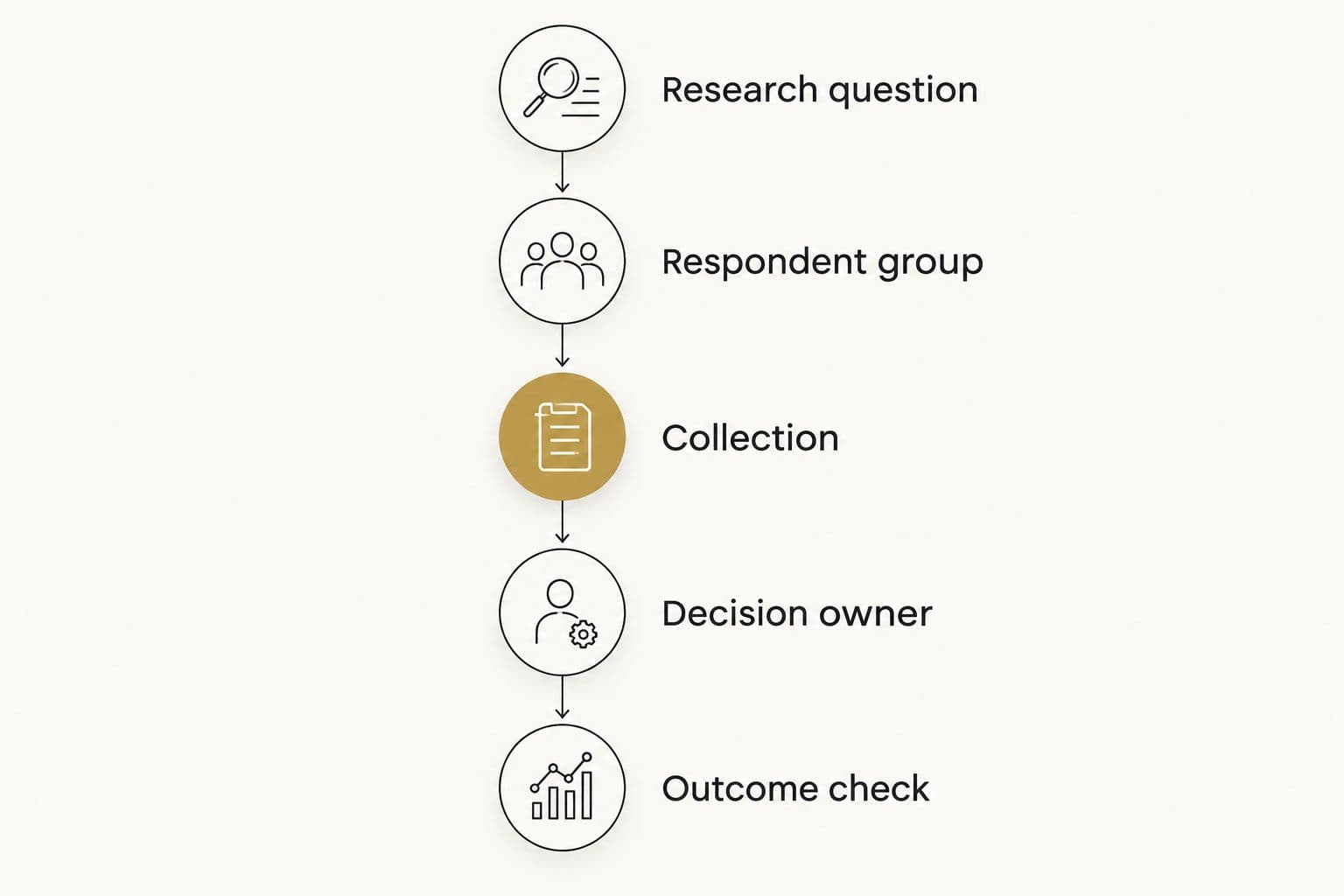
Choose the platform inside the workflow, not before defining the decision.
Implementation effort deserves attention, but installation is only part of the work. When evaluating easy-to-implement customer feedback software, distinguish getting a form live from establishing who reads the responses and what happens next. A quick setup does not supply that ownership.
Ask each vendor to demonstrate your actual questionnaire and reporting task. Separately, check the permissions, data handling, exports and client-account requirements you need. Treat those as acceptance criteria to verify, not features to assume from a comparison article.
When staying with Survicate is the right call
Keep Survicate when it collects the feedback you need and the real gap is action. Replacing a functioning collection process adds migration work without addressing an unassigned decision.
Before switching, inspect the latest responses. Identify a recurring objection, connect it to a specific customer journey and assign a change. For example, a repeated question about what happens after purchase belongs in the relevant explanation, not merely in a survey report.
Then measure the change against its intended outcome. For a landing page, that means examining the action the page exists to produce, not treating response volume as proof of growth.
FAQ
What are the best Survicate alternatives for agencies in 2026?
Typeform, SurveyMonkey and Qualtrics are options for different feedback and research requirements. The fVnnel is a service alternative for established businesses that need insight connected to growth execution, not replacement survey software.
Is Typeform better than Survicate for an agency?
Typeform is the stronger candidate when a form-led, question-by-question experience is the requirement. Compare your actual questionnaire and operating workflow before choosing either platform.
Is SurveyMonkey a suitable Survicate alternative?
SurveyMonkey is a relevant alternative for structured survey research. Its suitability depends on the questionnaire, analysis and account requirements you need to verify.
When should an agency consider Qualtrics?
Consider Qualtrics when the brief extends into broader research and experience management. Do not expand the platform scope without a documented organizational requirement.
Can a growth partner replace customer-feedback software?
A growth partner does not replace the software used to collect survey responses. The service addresses strategy and execution, while a collection method is still needed for surveys.
Should we switch if customer feedback is not improving conversions?
Not unless the collection workflow is the constraint. First check whether the findings have produced a specific change with an owner and a defined outcome.
What should agencies check before migrating survey tools?
Test the actual questionnaire, response experience and reporting task. Verify permissions, data handling, exports and client-account requirements before committing to a migration.
One last thing
Your strongest reason not to switch is already sitting in your response history. If useful customer objections remain unaddressed, the next move is execution, not procurement.
For your 2026 review, bring an unanswered business question and an example of feedback that never became a change. Get in Touch with The fVnnel when the constraint needs a growth partner rather than another survey tool.