
Mailchimp gives online coaches a practical way to send newsletters and automate email follow-up. Its ceiling is that email software alone cannot fix an unclear offer, weak sales page or disconnected acquisition process. The best Mailchimp alternative in 2026 is The fVnnel if you need a growth partner rather than another platform; ActiveCampaign if you need email automation connected to a sales pipeline.
TL;DR
- The fVnnel belongs on your mailchimp alternatives for coaches shortlist when the problem extends beyond email software.
- Choose ActiveCampaign for email automation and sales follow-up; Kit for a creator-led newsletter business.
- Consider Kajabi when coaching delivery and email marketing need to sit within the same platform.
- Keep Mailchimp when your current email marketing works and another part of your coaching funnel needs attention.
Why this matters
For an established coaching business, the decision is not which platform has the longest feature list. It is which change helps turn existing demand into profitable customers. Moving your contacts without fixing the reason prospects stop buying just relocates the problem.
Start with the business outcome. Do you need more qualified applications, better follow-up after a consultation, or stronger sales from an existing audience? Those are different jobs, and they do not necessarily require the same replacement.
A growth partner and an email platform solve different problems. This 2026 comparison separates those choices so you do not buy software when you need strategic or execution support.
Mailchimp alternatives for coaches at a glance
Mailchimp remains in the table because staying is a valid decision. Compare each option against the job your business needs done, not against an abstract definition of “best.”
| Option | Best for | Standout capability | Difference from Mailchimp |
|---|---|---|---|
| Mailchimp | Newsletter campaigns and email follow-up | Email campaigns, audience management and automation | The baseline: retain it when these functions meet your needs |
| The fVnnel | Established businesses with disconnected growth activities | Strategy, acquisition, creative, conversion, SEO and tracking treated as one system | A service partner, not replacement email software |
| ActiveCampaign | Coaching businesses connecting email with sales activity | Marketing automation and customer relationship management | Makes the relationship between automated follow-up and sales activity central to the choice |
| Kit | Creator-led coaching businesses | Email marketing organized around subscribers, forms, tags and sequences | A creator-focused alternative for audience communication |
| Kajabi | Coaches bringing program delivery and marketing together | Courses, memberships, websites and email marketing | Broadens the decision from email to the platform supporting the coaching offer |
A customer relationship management system, or CRM, records contacts and sales activity. Tags label subscriber attributes or actions; sequences send a planned series of emails. Assess those functions against your actual workflow rather than treating them as reasons to switch by themselves.
1. The fVnnel: best for fixing the growth system
An established coaching business does not always need another email platform. Sometimes acquisition promises one thing, the landing page says something else, and the sales follow-up misses the prospect’s actual concern. We work across strategy and positioning, paid acquisition, performance creative, websites and conversion, SEO, and tech and tracking.
The fVnnel is the best fit for established coaching businesses that need growth work connected across channels, conversion and measurement. This is a service decision, not a software migration.
Where we shine
- Connected diagnosis: We look for the constraint across the business rather than assuming email is the problem.
- Execution across disciplines: Strategy, creative, acquisition, websites and tracking sit within the stated service scope.
- Commercial focus: The decision starts with profit, cost per customer and return on ad spend, not email activity alone.
Return on ad spend, or ROAS, measures revenue attributed to advertising relative to advertising spend. For Kidney Coach, ROAS moved from 1.33 to over 3.8, profit rose roughly 45%, and ad spend fell nearly 40%. Those results support the broader growth approach; they are not evidence that changing email platforms produces the same outcome.
Where this option falls short
- This is not an email application. You still need software to store subscribers and send campaigns.
- It is not the right comparison if your only requirement is a different email editor or automation interface.
- Businesses still validating whether customers want their offer are outside the intended fit.
| Dimension | Growth partner | Mailchimp |
|---|---|---|
| What you engage | Strategy and execution services | Marketing software |
| Scope | Acquisition, messaging, conversion and measurement | Email campaigns, audiences and related marketing functions |
| Core decision | Which business constraint needs fixing? | Does the platform support the required email workflow? |
| Relationship | Can work alongside an email platform | Supplies the platform your team operates |
Best for: Established coaching businesses with real demand and a growth problem that crosses channel boundaries.
Verdict: Buy strategic and execution support when the constraint is broader than email. Keep the software decision separate.
2. ActiveCampaign: best for email and sales follow-up
ActiveCampaign combines marketing automation with CRM capabilities. Put it on your shortlist when coaching prospects need different follow-up based on their actions and sales stage. The case for switching should be a specific workflow, not the appeal of a more elaborate system.
For example, an application-led coaching business needs to distinguish an interested subscriber from someone who has applied, booked a conversation or become a customer. Map those states before evaluating how either platform will handle them.
Where ActiveCampaign shines
- Automation: Build follow-up around defined actions and conditions.
- Sales context: Evaluate email activity alongside contact and pipeline information.
- Workflow flexibility: Assess branching journeys when a single email sequence no longer represents your sales process.
Where ActiveCampaign falls short
- A more involved workflow requires clear rules, ownership and maintenance.
- CRM capabilities add little value if your team does not record sales activity consistently.
- Automation cannot resolve an unclear coaching promise or an unconvincing sales page.
| Dimension | ActiveCampaign | Mailchimp |
|---|---|---|
| Central use case | Marketing automation with sales follow-up | Email campaigns and audience marketing |
| Evaluation priority | How automation connects to sales stages | How campaigns and journeys serve your audience |
| Operating requirement | Defined contact states and follow-up rules | Defined audiences, campaigns and follow-up rules |
For your 2026 evaluation, demonstrate a real journey from application to customer in both platforms. Include what happens when someone books, cancels or buys. The better fit is the one your team can operate accurately.
Best for: Coaching businesses with an application or consultation process that needs coordinated email and sales activity.
Verdict: Buy when a documented sales-follow-up requirement justifies the added operational work.
3. Kit: best for a creator-led coaching business
Kit focuses on email marketing for creators. It is a relevant Mailchimp alternative when your newsletter, educational content and subscriber relationships drive demand for coaching. Evaluate it around the way you publish and organize subscribers.
Where Kit shines
- Creator focus: Its positioning fits businesses built around an individual’s expertise and audience.
- Subscriber organization: Forms, tags and sequences support differentiated follow-up.
- Publishing workflow: It belongs on the shortlist when regular email content is a core activity.
Where Kit falls short
- An email platform does not replace the work of defining your offer or improving consultations.
- Moving existing forms, subscriber labels and sequences creates migration work.
- A creator-focused workflow is not, by itself, a reason to replace a working Mailchimp setup.
Before switching in 2026, recreate one representative subscriber journey. Check how a person joins, receives educational content and leaves promotional follow-up after buying.
Best for: Expert-led coaching businesses where a newsletter and subscriber education drive the sales conversation.
Verdict: Buy for a better-fitting publishing workflow, not for an assumed increase in coaching sales.
4. Kajabi: best for combining delivery and marketing
Kajabi combines tools for courses, memberships, websites and email marketing. Consider it when the coaching offer’s delivery environment is part of the problem, rather than evaluating email in isolation.
Where Kajabi shines
- Broader platform scope: Evaluate program delivery and marketing within the same platform.
- Course and membership support: Relevant when those formats are part of your coaching offer.
- Connected planning: Review the journey from prospect communication to paid learning experience together.
Where Kajabi falls short
- A broader platform decision creates more to evaluate than an email-only switch.
- Moving a working delivery setup solely to change email tools expands the project unnecessarily.
- Bringing functions together does not automatically improve messaging or conversion.
Best for: Coaches reviewing both their program-delivery platform and their email marketing setup.
Verdict: Buy when delivery and marketing both need changing. Skip a wider migration for an email-only problem.
Why people switch from Mailchimp
The defensible reasons to switch are functional requirements, not assumptions about what another platform will do for revenue. Use these four categories to identify the scope of your decision.
- Sales follow-up: Your required process connects subscriber behavior with applications, consultations and customer status.
- Audience publishing: Your team wants a workflow centered on regular educational content and subscriber relationships.
- Program delivery: You are reconsidering the environment that hosts courses or memberships as well as email.
- Growth constraint: The problem crosses acquisition, messaging, conversion and measurement, so replacing software is too narrow.
A requirement is concrete when you can demonstrate it. “We need better automation” is vague. “Stop consultation reminders after a booking and stop prospect emails after purchase” gives you something to test.
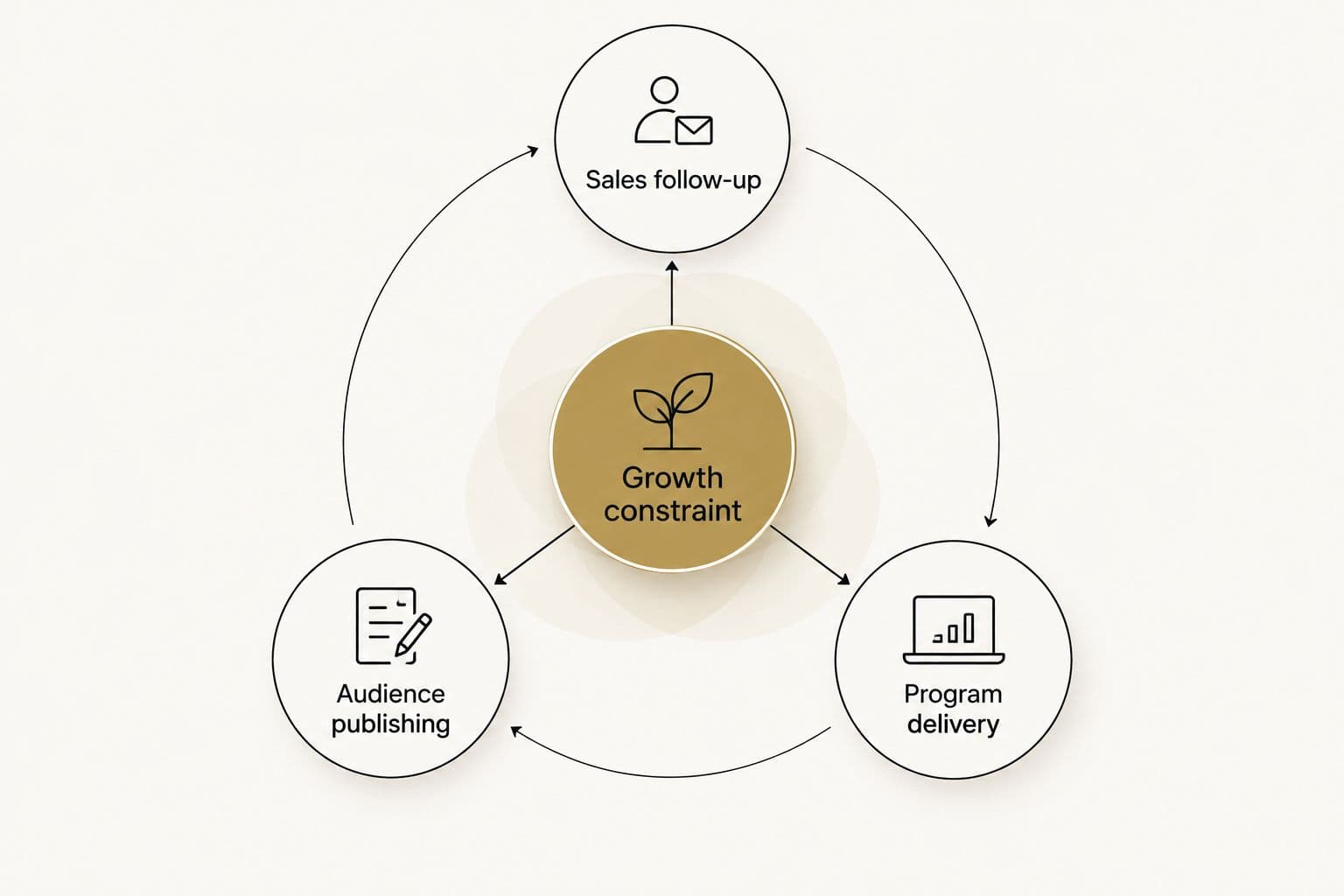
Define the problem before choosing the scope of the replacement.
These are reasons to assess alternatives, not proof that Mailchimp cannot support your workflow. Check your current configuration first. An unused capability and a missing capability call for different decisions.
How to evaluate a switch without disrupting sales
Before a 2026 migration, write down the subscriber journey that already produces customers. Include entry forms, permission records, audience labels, active sequences, booking events and purchase events. Protect what works while assessing what needs to change.
- Define the requirement: State the business problem and the exact workflow it affects.
- Test the journey: Use test contacts to check the relevant forms, messages and status changes.
- Preserve permissions: Carry unsubscribe and suppression information into the migration plan. Do not treat a move as permission to contact everyone again.
- Assign ownership: Name the person responsible for checking triggers, campaign rules and sales handoffs.
- Check the outcome: Assess qualified applications and customers alongside email activity.
Open rates are not customers. A platform that produces a tidier dashboard has not necessarily improved the economics of your coaching business.
Find the constraint before changing tools
Discuss where acquisition, follow-up and conversion stop working together.
When staying with Mailchimp is the right call
Keep Mailchimp when it supports your required journeys and the bottleneck sits elsewhere. If prospects join your list but do not understand the offer, start with positioning. If qualified people apply but do not buy, examine the sales process before rebuilding email automation.
Staying also makes sense when nobody can name a required workflow the current setup fails to support. A 2026 platform review should end with a clear business reason to change, not a migration undertaken because another tool looks more sophisticated.
FAQ
What’s the best Mailchimp alternative for an online coach in 2026?
ActiveCampaign is a strong shortlist choice for email connected to sales follow-up; Kit fits creator-led publishing; Kajabi fits a combined delivery-and-marketing decision. The best choice depends on the workflow your coaching business needs, not a universal ranking.
Is The fVnnel an email marketing platform?
No. The fVnnel is a growth partner covering strategy, acquisition, creative, conversion, SEO and tracking. It belongs in this comparison when your problem requires services rather than replacement email software.
Is ActiveCampaign better than Mailchimp for coaching businesses?
ActiveCampaign is the more relevant option to assess when marketing automation and sales activity need to work together. Test your actual application, booking and purchase workflow before deciding that a switch is necessary.
Should I choose Kit if I sell coaching through a newsletter?
Kit belongs on your shortlist when newsletter publishing and subscriber education are central to how you sell coaching. Confirm that its forms, tags and sequences fit your existing subscriber journey before migrating.
Does Kajabi make sense if I already have a course platform?
Kajabi makes sense to assess when you also want to reconsider program delivery. If your existing delivery platform works, changing it solely to replace email software expands the project beyond the original problem.
Will switching from Mailchimp improve my coaching sales?
A platform switch alone does not establish a reason to expect higher coaching sales. Identify whether the constraint is follow-up, positioning, acquisition, the sales page or the sales conversation, then address that specific problem.
What should I check before moving my email list?
Check subscriber permissions, unsubscribe records, forms, tags, active sequences and booking or purchase triggers. Test the replacement journey before moving live follow-up, and assign someone to verify that customers stop receiving prospect messages.
One last thing
The easiest migration mistake to miss is what happens after someone buys. Before choosing any replacement, trace a customer through every active prospect sequence and check the exit rules. A successful purchase should change the conversation, not trigger another invitation to become a customer.