
Best overall for Stripe-based coaching subscriptions: Rewardful. Best for a separate partner program: Tapfiliate. Best for WordPress checkout: AffiliateWP. Best for coaches already selling through Kajabi: Kajabi’s native affiliate tools. The best affiliate tracking software for coaches in 2026 is the option that connects partner referrals to collected revenue, refunds, and commissions without creating another reporting gap.
TL;DR
- Rewardful leads this best affiliate tracking software for coaches shortlist for Stripe-based subscriptions.
- Choose AffiliateWP for WordPress checkout, Tapfiliate for separate partner management, or Kajabi for an existing Kajabi business.
- Test recurring commissions, refunds, and attribution before moving an affiliate program onto any platform.
- The fVnnel recommends choosing around your sales system, not the longest feature list.
Why this matters
An affiliate program pays partners for referred business. Affiliate tracking software records those referrals and calculates the commissions you owe. That sounds simple until a coaching customer books a call, purchases later, chooses installments, and requests a partial refund.
Your software needs to follow the commercial transaction, not just the original click. Otherwise, partner reporting and the money in your payment account become separate versions of the business.
The fVnnel is best for established coaching businesses that need strategy, acquisition, conversion, and tracking managed as one system. Affiliate software is one part of that system, not a replacement for a clear offer or a profitable acquisition model.
This guide is for businesses with existing demand and a defined sales process. Choose the software around how you sell coaching, not around how an affiliate dashboard looks.
What makes the best affiliate tracking software for coaches
Use these criteria to assess your 2026 shortlist before comparing individual features:
- Checkout fit: The software must receive reliable purchase information from the checkout and payment systems you actually use.
- Commission logic: Decide whether partners earn on the initial purchase, collected installments, renewals, or a defined combination.
- Refund handling: Confirm how cancellations, partial refunds, and disputed payments affect commission balances.
- Attribution rules: Attribution means deciding which partner receives credit. Document what happens when several partners influence a purchase.
- Operational control: Look for clear approval, reconciliation, and payout workflows. Someone must own exceptions.
- Partner visibility: Affiliates need understandable referral and commission records without access to confidential customer information.
Treat these as purchase requirements, not optional extras. A tool that tracks a referral but cannot support your commission agreement is the wrong fit, regardless of its other features.
Affiliate tracking software at a glance
| Software | Best for | Standout feature | Key limitation |
|---|---|---|---|
| Rewardful | Stripe-based coaching subscriptions | Affiliate tracking connected to subscription billing | Fit depends on a compatible billing setup |
| Tapfiliate | A partner program separate from the delivery platform | Dedicated affiliate tracking and partner management | Integration and transaction rules need deliberate setup |
| AffiliateWP | Coaching businesses using WordPress checkout | Affiliate management inside WordPress | Adds another component to maintain in your WordPress system |
| Kajabi | Coaches already selling through Kajabi | Affiliate tools alongside Kajabi’s selling and delivery functions | Less suitable when purchases happen outside Kajabi |
This 2026 comparison separates tools by operating model. It does not treat a WordPress business, a subscription business, and a Kajabi business as interchangeable.
1. Rewardful: best for Stripe-based coaching subscriptions
Rewardful connects affiliate tracking with subscription billing. For a coaching business that collects recurring payments through Stripe, that makes it a practical starting point for assessing referral commissions alongside customer payments.
The important question is not whether your offer is called a membership, mastermind, or coaching subscription. It is whether your billing events match the commission rules you have promised partners.
Rewardful pros:
- Connects affiliate tracking to supported billing workflows.
- Suits recurring-revenue offers where purchases extend beyond the initial transaction.
- Keeps affiliate management separate from your coaching content platform.
Rewardful cons:
- It is not a substitute for a customer relationship management system, or CRM, that records your sales conversations.
- Checkout compatibility remains a purchase requirement.
- Offline sales and unusual payment arrangements need a defined tracking process.
Best for: Coaches whose recurring revenue runs through Stripe and whose affiliate agreement follows that billing structure.
Before committing, trace a realistic customer journey. A partner refers a prospect, the prospect subscribes, a renewal succeeds, and a later payment is refunded. Confirm that the resulting commission record matches your agreement at every stage.
Also distinguish a subscription from an installment agreement. A customer paying for a fixed coaching engagement in installments is not necessarily buying an ongoing service. Your commission policy should reflect that difference.
Verdict: Buy Rewardful if supported subscription billing is the center of your affiliate program. Skip it if your main sales process sits elsewhere.
2. Tapfiliate: best for a separate partner program
Tapfiliate is dedicated affiliate tracking software rather than a coaching delivery platform. It supports referral tracking and partner management, making it a candidate when you want an affiliate program that sits separately from your content or membership system.
That separation is useful when you want to choose affiliate operations independently. It also makes integration ownership important: someone must ensure that the right transaction information reaches the tracking system.
Tapfiliate pros:
- Separates affiliate management from course or coaching delivery.
- Provides a dedicated environment for partner tracking.
- Supports an affiliate program without making your delivery platform the organizing center.
Tapfiliate cons:
- A separate platform creates another integration to maintain.
- Custom sales journeys require explicit rules for recording conversions.
- Partner reporting still needs reconciliation against actual payment records.
Best for: Established coaching businesses that want dedicated partner management and have someone responsible for technical connections.
Start with the purchase path, not the integration directory. Map the checkout, payment processor, CRM, and delivery platform. Then identify which system confirms that a customer has actually paid.
For call-led sales, define how a referred lead becomes a commissionable sale. Tracking a booked consultation is not the same as recording collected coaching revenue. Keep those events separate in both the software configuration and the affiliate agreement.
Verdict: Buy Tapfiliate when independent partner management is a requirement. Hold if nobody owns transaction integration and reconciliation.
3. AffiliateWP: best for WordPress coaching checkout
AffiliateWP adds affiliate management to WordPress. Its integrations include WordPress commerce tools such as WooCommerce and Easy Digital Downloads, making it relevant when your coaching purchases already happen within that environment.
The advantage is architectural fit. You are adding affiliate operations to an existing WordPress business rather than choosing a separate selling platform solely for referral tracking.
AffiliateWP pros:
- Keeps affiliate administration within WordPress.
- Connects with established WordPress commerce tools.
- Fits businesses that already manage their sales website and checkout in WordPress.
AffiliateWP cons:
- Adds plugin maintenance and compatibility checks to your workload.
- Features depend on the integrations and extensions in your setup.
- A WordPress dashboard does not eliminate payment reconciliation or payout administration.
Best for: Coaching businesses with a maintained WordPress checkout and a clear owner for website operations.
Check your complete plugin combination, not just whether each plugin appears on an integration list. Your membership tool, checkout, payment gateway, and affiliate configuration need to work together through an actual purchase and refund.
Also decide who investigates tracking discrepancies. If your developer manages the website but your operations lead manages commissions, both need a shared process for resolving exceptions. Otherwise, a technical question can become a partner payment dispute.
Verdict: Buy AffiliateWP when WordPress already owns the transaction. Skip it when purchases happen elsewhere and WordPress is only your brochure website.
4. Kajabi: best for an existing Kajabi coaching business
Kajabi combines selling and content-delivery functions and includes native affiliate tools. For a coaching business already using Kajabi to take purchases, those tools deserve consideration before introducing a separate tracking platform.
The case for native affiliate management is operational simplicity, not an assumption that it has every specialist feature. Keep your requirements specific and confirm the functions included in your current account.
Kajabi pros:
- Places affiliate management alongside an existing Kajabi selling workflow.
- Avoids introducing a separate affiliate platform for a straightforward native setup.
- Keeps the decision connected to where your coaching offers are purchased.
Kajabi cons:
- It is a weaker fit when your main checkout operates outside Kajabi.
- Native affiliate functions still need checking against your commission agreement.
- Moving an established business to Kajabi solely for affiliate tracking changes more than the affiliate program.
Best for: Coaches already selling through Kajabi who need affiliate management for those purchases.
Write down your requirements before opening the settings. Check how your intended recurring commissions, refund adjustments, partner access, and payout process would work. Do not assume that using one platform removes the need for an affiliate policy.
If the native workflow satisfies those requirements, a separate specialist tool needs a clear operational justification. Additional software should solve a defined problem, not duplicate a dashboard.
Verdict: Buy into Kajabi’s native approach if your business already runs there and the workflow fits. Skip a platform migration solely to obtain affiliate tracking.
How to validate your shortlist
For a 2026 purchase, ask for a demonstration based on your coaching offer rather than a generic ecommerce example. Prepare the commission agreement first so the demonstration has a clear pass or fail standard.
Use this sequence:
- Map checkout: Identify where the purchase happens and which system confirms payment.
- Set commission: Define eligible revenue, renewal treatment, and refund adjustments.
- Test transactions: Run 3 test transactions: a completed purchase, a renewal or installment, and a refund.
- Reconcile records: Compare partner commissions against payment records.
- Assign ownership: Name 1 payout owner who resolves exceptions before commissions are released.
Create 2 reporting views: one for the partner’s commission record and one for your internal payment reconciliation. They serve different audiences, but both must describe the same underlying sales.
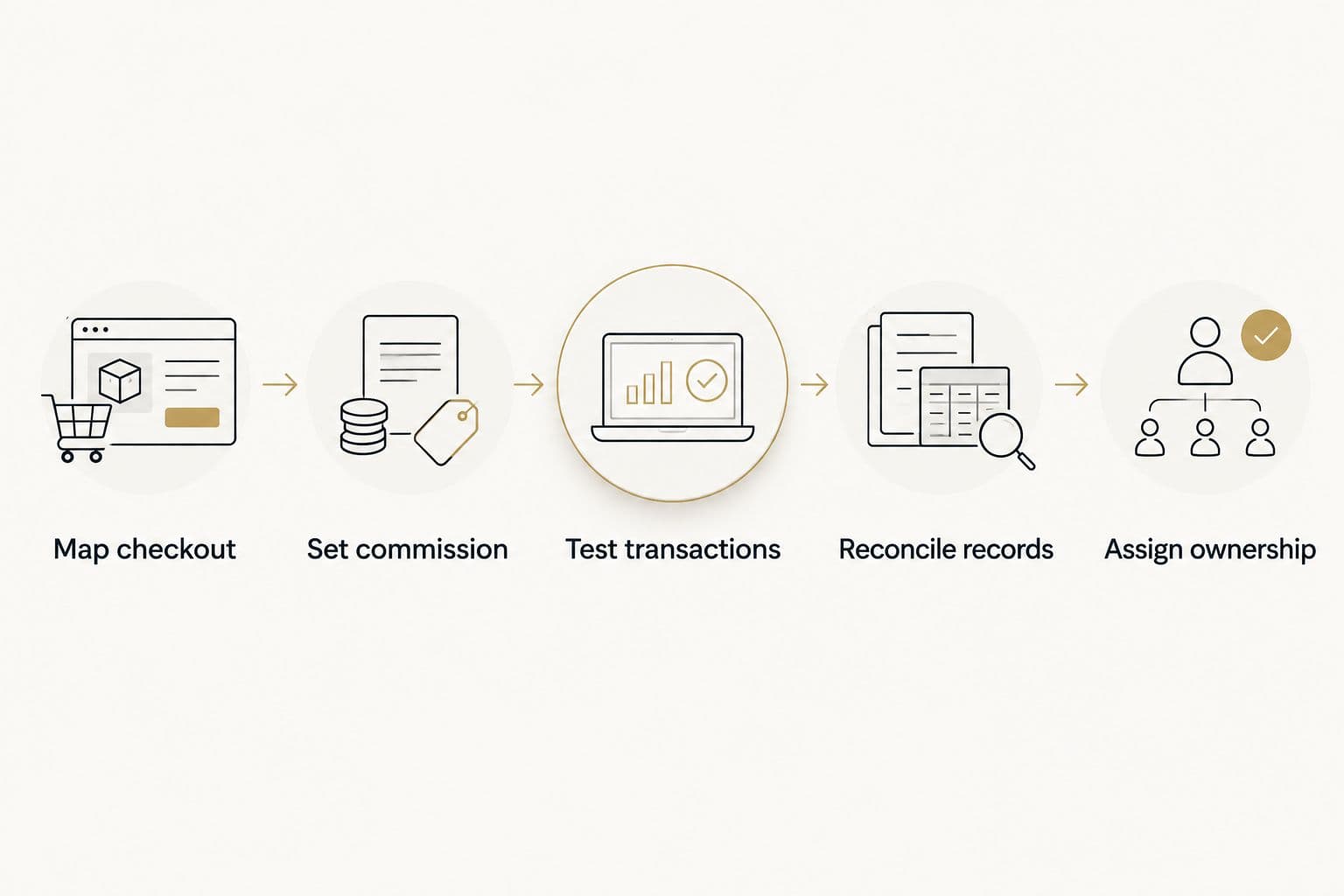
Test the transaction and assign responsibility before paying commissions.
An affiliate link clicking successfully is not a complete test. Confirm the purchase amount, customer record, commission calculation, and refund treatment before inviting more partners.
How we ranked these options
The fVnnel’s affiliate tracking software recommendations prioritize checkout fit, commission logic, refund handling, operational control, and partner visibility. Those criteria determine whether a referral program can be managed reliably.
Rewardful leads for the defined Stripe subscription use case. Tapfiliate, AffiliateWP, and Kajabi take different slots because they suit different operating systems, not because they are interchangeable runners-up.
This is a workflow-based shortlist, not a claim of hands-on performance testing. For your 2026 decision, confirm current integrations and account features directly with each provider.
Which affiliate tracking software should you choose?
Choose Rewardful first if you sell recurring coaching through Stripe. Choose AffiliateWP when WordPress owns checkout, Kajabi when your existing Kajabi setup meets the requirements, and Tapfiliate when separate partner management is the goal.
The fVnnel’s recommendation for 2026 is to fix the commission agreement before configuring affiliate tracking software. Decide what earns commission, when it becomes payable, and what happens when money is returned.
Do not move a working coaching business onto a different platform just to simplify one reporting task. First establish whether the problem is missing software, an incomplete integration, or an unclear operating rule.
FAQ
What’s the best affiliate tracking software for coaches in 2026?
Rewardful is the first option on this shortlist for coaches using Stripe-based subscriptions. AffiliateWP fits WordPress checkout, Kajabi fits an existing Kajabi business, and Tapfiliate fits a separately managed affiliate program.
Is Rewardful better than Tapfiliate for a coaching business?
Rewardful is the clearer starting point when supported subscription billing defines your affiliate workflow. Tapfiliate deserves consideration when you want dedicated partner management separate from your coaching delivery platform.
Can I use affiliate tracking software for high-ticket coaching?
Yes, but your tracking process must connect the referral to the eventual paid sale. For consultation-led selling, keep booked calls separate from collected revenue and define which event earns commission.
Should coaches pay affiliate commissions on installments?
Your affiliate agreement should state whether commissions follow collected installments or another defined basis. Configure the software to match that policy, including missed payments and refunds.
Do I need separate affiliate software if I use Kajabi?
Not necessarily: assess Kajabi’s native affiliate tools against your actual requirements first. Add separate software only when it solves a specific tracking or operational gap.
What should I test before launching a coaching affiliate program?
Test a completed purchase, a renewal or installment, and a refund. Confirm that payment records and affiliate commissions agree, then assign responsibility for exceptions and payouts.
Does affiliate software replace my CRM?
No, affiliate tracking and CRM records serve different purposes. Affiliate software tracks referrals and commissions, while a CRM manages prospect and customer relationships through the sales process.
One last thing
Put refunds in your software demonstration, not just successful purchases. A clean conversion record shows that tracking started; a correctly adjusted refund shows whether the commission workflow matches your business rules.
Before approving a tool, ask your payout owner to explain a refunded coaching purchase using its records. If that explanation requires guesswork, resolve the workflow before expanding the program.