
Woorise combines giveaways, forms and landing pages in one campaign platform. Its ceiling appears when your problem extends beyond collecting entries to improving customer acquisition and conversion. The best Woorise alternative in 2026 is The fVnnel if you need a growth partner; Gleam if you need a dedicated competition platform.
TL;DR
- Compare Woorise alternatives against your actual constraint: campaign entries, lead generation, landing-page conversion or customer acquisition.
- The fVnnel is the growth-partner option for established businesses, not a replacement giveaway application.
- Choose Gleam for competitions, Typeform for conversational forms or Unbounce for landing-page testing.
- Keep Woorise when its campaign tools fit your workflow and the problem sits elsewhere.
Why this matters
A campaign can collect entries without creating customers. Before replacing Woorise, establish whether you need different campaign software or a different approach to growth.
For an established business, the deciding question is commercial: where does the journey from attention to revenue break? More form submissions do not solve weak lead qualification. A different giveaway builder does not fix an offer that attracts people who never buy.
This 2026 comparison separates a service alternative from software alternatives. They solve different problems. Choose the category first, then compare individual providers.
Woorise alternatives at a glance
There is no single replacement that serves every Woorise use case equally well. Start with the job you need done, rather than the longest feature list.
| Option | Best for | Standout capability | How it differs from Woorise |
|---|---|---|---|
| Woorise | Running giveaways, forms and landing-page campaigns together | Multiple campaign formats in one platform | The baseline when you want campaign-building software |
| The fVnnel | Established businesses needing coordinated growth work | Strategy, paid acquisition, creative, conversion, SEO and tracking run as one system | A growth partner rather than self-service campaign software |
| Gleam | Competition-led audience acquisition | Competition entry actions | A competition-focused alternative for giveaway workflows |
| Typeform | Collecting structured answers through conversational forms | Question-by-question form experience | A form-first option rather than a giveaway-first choice |
| Unbounce | Building and testing campaign landing pages | Landing-page creation and A/B testing | A landing-page-focused alternative rather than a competition platform |
Treat this table as a routing decision. If your problem is a competition mechanic, evaluate competition software. If your problem is that paid traffic produces leads but not profitable customers, examine the offer, message and follow-up before changing the entry form.
1. The fVnnel: best for fixing the growth system
The fVnnel is a growth partner for established businesses with demand and revenue to invest in growth. We connect strategy and positioning, paid acquisition, performance creative, websites and conversion, SEO, and technology and tracking.
This is not a like-for-like Woorise replacement. It is the alternative when you need someone to address how the parts work together, rather than another application for building campaigns.
Where this approach shines
- Connected decisions: Positioning, media, creative and conversion belong in the same commercial discussion.
- Business economics: Cost per customer and return on ad spend guide the work, rather than entry volume alone.
- Work beyond campaign setup: The scope includes the website and tracking, not just the acquisition form.
The supplied results demonstrate the difference between software selection and growth work. For Sniffspot, cost per host acquired fell 78%, with host growth roughly ninefold. For Kidney Coach, return on ad spend rose from 1.33 to over 3.8, while profit increased roughly 45% and ad spend fell nearly 40%.
Return on ad spend means revenue attributed to advertising divided by advertising spend. It is not profit, so the Kidney Coach profit result matters separately. These are client-specific results, not a forecast for your business.
Where this approach falls short
- It is not a self-service tool for building your next giveaway.
- It is the wrong category if you only need to change a form or competition mechanic.
- It is not positioned for businesses still establishing whether customers want their offer.
| Decision | Growth partner | Woorise |
|---|---|---|
| What you engage | Coordinated growth services | Campaign-building software |
| Main scope | Strategy, acquisition, creative, conversion and measurement | Giveaways, forms and landing pages |
| Best-fit problem | Several parts of growth need coordinated work | You need to create and manage campaigns |
Best for: Established businesses whose acquisition problem extends across channels, messages, conversion and measurement.
Verdict: Buy the service approach when the constraint crosses those boundaries. Skip it when you only need a campaign builder.
2. Gleam: best for competition-led campaigns
Gleam is a direct option to evaluate when competitions are the main reason you use Woorise. Its competition product centers on entry actions, making it relevant when participation mechanics matter more than a broad collection of campaign formats.
Keep the evaluation grounded in your campaign. List the actions you want entrants to complete, how you will select a winner and what happens to participants afterward. Compare those requirements against the current product, not assumptions about feature parity.
Where Gleam shines
- Competition focus: It belongs on a shortlist built around giveaways and entries.
- Action-based participation: Entry actions give you a concrete workflow to evaluate.
- Clear buying question: You can judge it against a defined competition brief rather than an open-ended growth objective.
Where Gleam falls short
- A competition platform does not determine whether entrants match your ideal customer.
- Entry activity is not evidence of purchase intent.
- Switching competition software leaves your offer, sales process and follow-up to be addressed separately.
| Dimension | Gleam | Woorise |
|---|---|---|
| Comparison focus | Competition entry workflow | Giveaways alongside forms and landing pages |
| Strongest reason to evaluate | You need a competition-led setup | You want several campaign formats together |
| Commercial check | Do participants become qualified prospects? | Do campaign responses become qualified prospects? |
For your 2026 shortlist, write the competition brief before opening either editor. Include eligibility, entry requirements, winner selection and the follow-up journey. That gives you a practical comparison instead of a preference based on templates.
Best for: Businesses running competitions with clearly defined entry requirements and a plan for participants after the draw.
Verdict: Buy if the competition workflow matches your brief. Hold if you have not defined what a valuable entrant looks like.
3. Typeform: best for conversational lead qualification
Typeform is a stronger category fit when your real need is to ask questions, understand respondents and qualify interest. Its question-by-question form experience gives you a different starting point from a giveaway-led campaign.
Use that distinction carefully. A form can gather information; your team still needs to decide which answers matter and what action each answer triggers.
Where Typeform shines
- Structured discovery: Questions can capture needs, circumstances and intent.
- Qualification design: You can build the form around the information your sales or service team needs.
- Focused experience: The question-by-question presentation is a clear format to assess with your audience.
Where Typeform falls short
- Better questions do not create demand for your offer.
- Asking for information without using it adds work for respondents.
- A form-first tool is a different choice from software selected primarily for competition entry mechanics.
| Dimension | Typeform | Woorise |
|---|---|---|
| Primary evaluation | Form experience and response collection | Campaign formats including forms and giveaways |
| Best-fit objective | Understand and qualify respondents | Capture participation through campaigns |
| Key decision | Which answers change the next action? | Which campaign format fits the objective? |
Before switching in 2026, mark every proposed question with its operational purpose. Remove questions that do not affect qualification, routing or follow-up. That discipline matters regardless of the form platform you choose.
Best for: Businesses that need useful information about prospective customers, not just contact details or competition entries.
Verdict: Buy for a defined qualification process. Skip if you only need a giveaway entry mechanism.
4. Unbounce: best for landing-page testing
Unbounce belongs on the shortlist when the landing page is the part you need to change. It focuses on landing-page creation and A/B testing, which compares page variants against a chosen conversion goal.
That makes it a different decision from choosing a competition platform. Your brief should describe the page, traffic source, offer and conversion action before you assess the editor.
Where Unbounce shines
- Landing-page focus: It suits a brief centered on campaign destinations.
- Testing: A/B testing supports a structured comparison between page variants.
- Message evaluation: You can frame tests around a specific difference in the offer or page experience.
Where Unbounce falls short
- A landing-page builder does not fix an unattractive offer.
- A form submission is not automatically a qualified lead.
- Page testing still requires a clear hypothesis and a meaningful outcome to measure.
Best for: Businesses with a specific landing-page problem and a clear conversion goal.
Verdict: Buy when page creation and testing are the job. Hold when you cannot explain what the test should establish.
Why people switch from Woorise
The defensible reasons to switch are changes in the job you need done. They are not assumptions about outages, product quality or pricing changes.
The campaign objective changed
A competition and a customer application are different experiences. If you now need detailed qualification, evaluate the form journey. If you need a paid-traffic destination, evaluate the landing page.
Purpose also changes how you define success. For online fundraising campaigns, the completion action is a donation, not a giveaway entry. The same discipline applies to commercial campaigns: name the valuable action before choosing the capture mechanism.
The bottleneck moved downstream
You might have a working entry process but an unclear next step. Map the journey before replacing software:
- Offer: What gives the right person a reason to act?
- Capture: What information do you need to collect?
- Follow-up: What happens after the response?
- Revenue: How will you connect participation to business value?
These are diagnostic questions, not claims that a particular platform lacks a feature. A different editor will not resolve a follow-up process nobody owns.
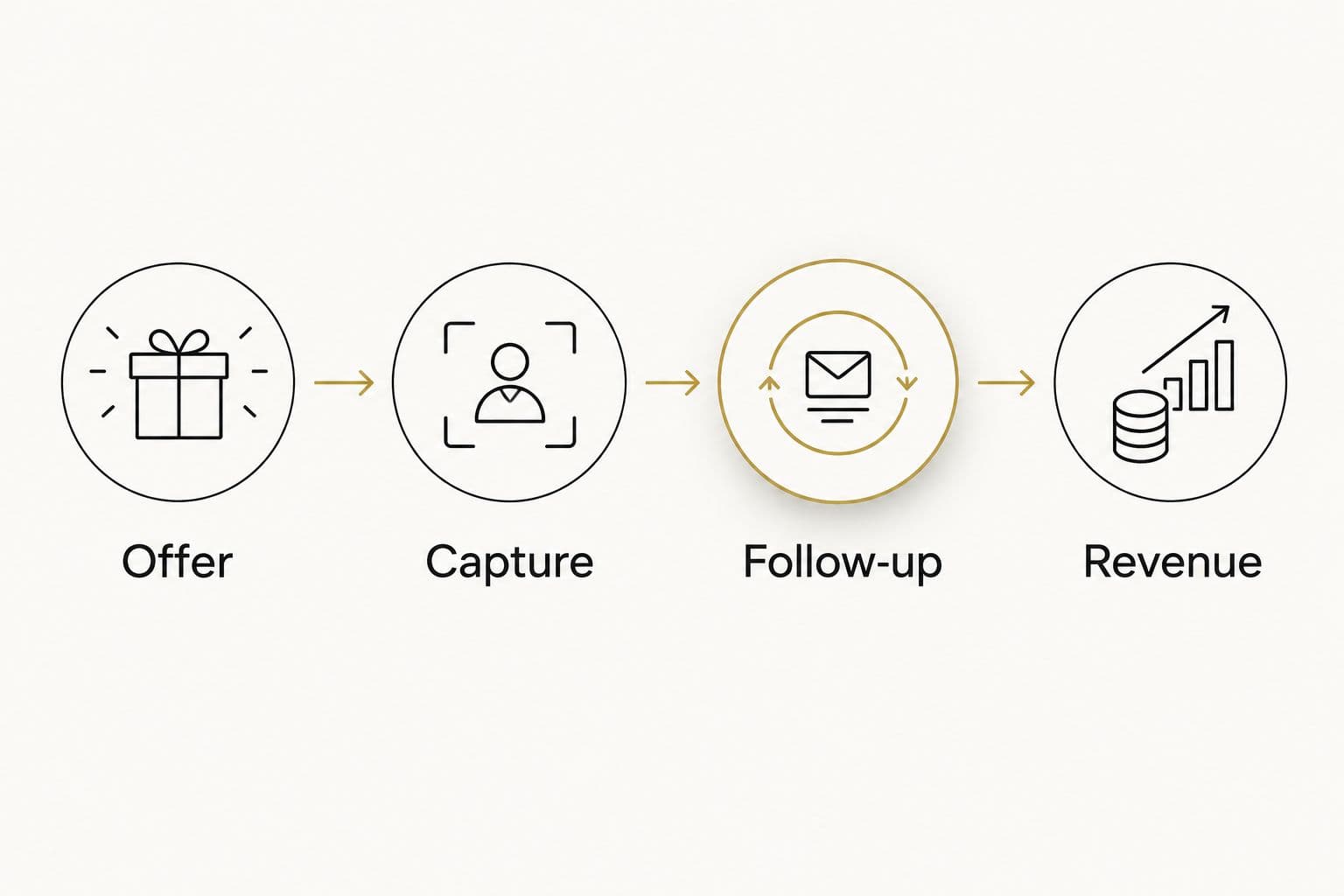
Choose software for the step that needs changing, not the whole journey by default.
Your reporting needs a business outcome
Choose a success measure before your 2026 migration. For a host acquisition campaign, that means acquired hosts rather than entry totals. For a sales campaign, distinguish inquiries, qualified opportunities and customers.
Keep the distinction visible in reporting. If the team celebrates submissions while the owner needs profitable customers, changing software leaves the disagreement intact. Fix the definition of success first.
When staying with Woorise is the right call
Stay with Woorise when its campaign formats fit your requirements and you cannot identify a specific workflow that needs replacing. Familiarity alone is not a reason to stay, but novelty is not a reason to move.
Write a replacement requirement in plain language: what must the new option let you do, and how will you verify it? Then run a representative campaign through the proposed workflow before committing to a migration.
A sensible 2026 decision can be to keep the campaign software and change the offer, qualification criteria or follow-up. Treat those as separate decisions. Do not make a platform migration carry a commercial problem it cannot solve.
FAQ
What’s the best Woorise alternative in 2026?
The best choice depends on the job: Gleam for competition workflows, Typeform for conversational forms and Unbounce for landing-page creation and testing. The fVnnel is the service alternative when an established business needs coordinated growth work rather than replacement software.
Is Gleam better than Woorise for giveaways?
Gleam is a relevant alternative when competition entry actions are your main requirement. Compare your exact entry workflow, winner-selection process and participant follow-up before deciding.
Can Typeform replace Woorise?
Typeform is a relevant replacement when your primary need is collecting and qualifying responses through forms. Do not treat a form-first product as an automatic substitute for every giveaway workflow.
Should I choose Unbounce instead of Woorise?
Choose Unbounce for evaluation when your main requirement is building and testing landing pages. Keep competition requirements separate from page-design and conversion-testing requirements.
Do I need an agency instead of giveaway software?
You need a growth partner when the problem spans strategy, acquisition, creative, conversion and measurement. If you only need to build and manage a competition, evaluate campaign software instead.
What should I measure before switching from Woorise?
Measure the business outcome your campaign exists to produce, such as qualified opportunities or acquired customers. Keep entries and submissions visible, but do not confuse them with revenue or profit.
When should I keep using Woorise?
Keep Woorise when its campaign formats meet your requirements and the constraint sits elsewhere. Changing your offer or follow-up does not automatically require changing the platform.
One last thing
Before buying anything, ask the person handling campaign responses to walk through the most recent follow-up. Identify what happened after someone submitted the form, not just whether the submission arrived.
If you cannot describe the next action, start there. A better campaign builder is not a substitute for deciding what happens next.